



Zikhron Ya’akov is a pioneer town on the southern slopes of Mount Carmel, founded in 1882 by Romanian Jewish immigrants and funded by Baron Edmond de Rothschild, who named it after his father James (Ya’akov). The town, with its restored main street, its wineries, and its views over the Mediterranean coast, has become one of the most charming destinations in central Israel. But beneath the boutique restaurants and wine bars lies a story of desperation, defiance, espionage, and a stubborn refusal to give up that shaped the entire Zionist project.
The Founding at Zikhron Ya’akov: Wine, Pioneers, and the Founders’ Street
In December 1882, approximately 100 families from Romania, mostly from the regions of Moldavia and Wallachia, arrived on the southern ridge of Mount Carmel. They were fleeing antisemitic persecution and economic restrictions imposed on Jews in Romania, and they were part of the broader Hovevei Zion movement that believed the only solution was to return to the ancestral homeland. They purchased land near an Arab village called Zammarin and named their settlement after it. The reality that greeted them was brutal: malaria from the nearby coastal marshes killed settlers in their first years. The soil was unfamiliar. The heat was relentless. The poverty was so desperate that the settlers were forced to sell their Torah scrolls to pay their debts.
Everything changed when Baron Edmond de Rothschild took the settlement under his patronage in 1883, renaming it Zikhron Ya’akov in memory of his father. Rothschild sent money, agricultural experts, and grapevine cuttings from France. He funded the planting of eucalyptus groves, which were believed at the time to help dry swampy ground and repel mosquitoes. He funded the establishment of the Carmel Winery, whose cellars were completed around 1890, the first modern winery in the Land of Israel, introducing French winemaking techniques to the Carmel hillside. But the Baron’s generosity came with a price: his administrators, the pekidim, exercised tight control over every aspect of the settlers’ lives, dictating what to plant, how to farm, and how to manage their affairs. The settlers, who had come to build a free life, found themselves turned into dependent employees on the Baron’s estate. The tension eventually erupted in what became known as the Farmers’ Revolt, a series of protests and petitions in the 1880s and 1890s that challenged the paternalistic administration. The conflict was resolved only when Rothschild transferred responsibility for his settlements to the Jewish Colonization Association (ICA) in 1899, gradually restoring the autonomy the settlers had sought from the beginning.
The Zikhron Ya’akov Synagogue’
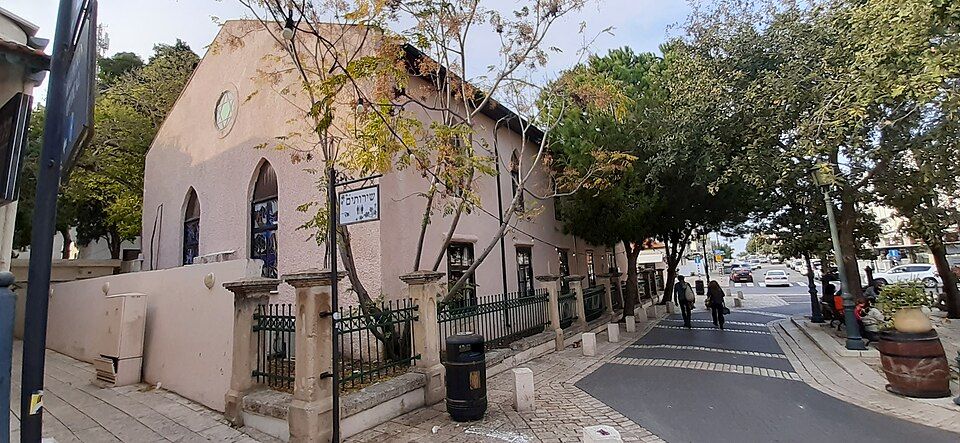
Among the first buildings Baron Rothschild funded was the synagogue, Ohel Ya’akov (“Tent of Jacob”), built in 1886 and named, like the town itself, after his father. The building stands on HaMeyasdim Street with arched windows and stone construction that blends European and local Ottoman influences. Inside, a painted wooden ceiling and a finely crafted Holy Ark reflect the European craftsmanship that the Baron imported for his settlements. Ohel Ya’akov was more than a house of prayer: it was the center of communal life, the place where disputes were settled, decisions were made, and the community gathered in times of crisis. In the early years of the settlement, rabbinical delegations visited Zikhron Ya’akov and the other First Aliyah colonies to assess their religious character, provide guidance on agricultural halachic questions such as Shemitah (the sabbatical year) and the separation of tithes, and confer religious legitimacy on the new communities.
These visits helped secure support from religious Jewish communities in the diaspora for the settlement enterprise. When a delegation of rabbis arrived at Ohel Ya’akov during one of the early rabbinical visits, they were alarmed to find that the bimah (the reading platform) had been placed very close to the Holy Ark, an arrangement associated with Reform Judaism rather than Orthodox practice. The rabbis refused to pray in the synagogue under those conditions. The community promised to move the bimah to the center of the hall, where it belonged according to traditional custom, and the crisis was resolved. The synagogue has been restored and is preserved as a heritage landmark on HaMeyasdim Street.
HaMeyasdim Street
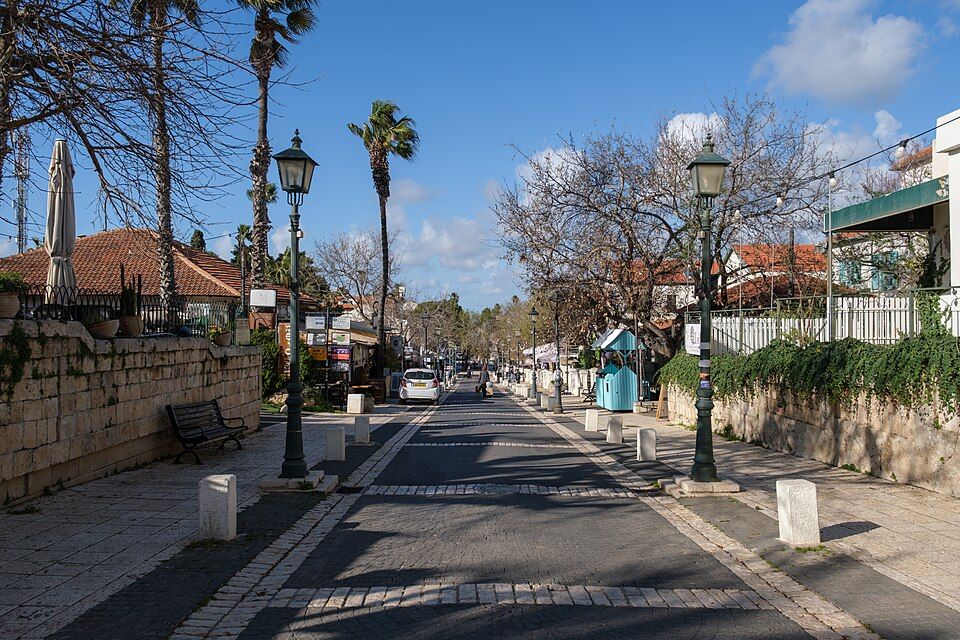
The Founders’s Street (Rehov HaMeyasdim) is the heart of Zikhron Ya’akov and one of the most iconic pedestrian streets in Israel. The restored Ottoman-era boulevard stretches through the center of town, lined on both sides with stone buildings from the 1880s and 1890s that have been carefully converted into restaurants, wine bars, cafes, galleries, and boutiques. The architecture preserves the character of a late 19th-century First Aliyah settlement: locally quarried limestone in warm honey tones, red Marseilles roof tiles imported through French influence (a signature of Rothschild-funded colonies), arched doorways and windows, wrought-iron balconies, and inner courtyards shaded by mature trees. The administrative buildings erected by Rothschild’s officials stand alongside the modest homes of the original settlers, and the contrast tells its own story.
The street has been designated a heritage conservation area, and on evenings and weekends it fills with visitors who come for the food, the wine, and the atmosphere of a village that feels closer to Provence than to the Middle East. The Aaronsohn House (Beit Aaronsohn), the Ohel Ya’akov synagogue, the old Carmel Winery cellars, and the First Aliyah Museum are all on or just off the street, making HaMeyasdim a single walk through the entire story of the town.
The Wineries
Zikhron Ya’akov is the birthplace of the Israeli wine industry. The Carmel Winery, established by Baron Rothschild in 1882, was the first modern winery in the Land of Israel and remains one of the largest in the country. The Baron brought French grape varieties and winemaking expertise to the Carmel hillside, and for over a century Carmel wines were synonymous with Israeli wine. In recent decades, boutique wineries have sprung up in and around the town, producing wines that rival the best in Israel. The combination of the Carmel mountain terroir, the Mediterranean climate, and the pioneering winemaking tradition makes Zikhron Ya’akov the most historically significant wine region in Israel.
NILI and the Aaronsohns
The Aaronsohn family is inseparable from the story of Zikhron Ya’akov. Aaron Aaronsohn (1876-1919) grew up in the settlement and became a world-renowned agronomist. In 1906, he discovered wild emmer wheat (Triticum dicoccoides) growing in the Upper Galilee region, a find of major scientific importance because wild emmer is an ancestor of cultivated wheat and held the potential to improve crop resilience worldwide. The discovery brought him international recognition, invitations to speak at scientific institutions in Europe and the United States, and connections with the U.S. Department of Agriculture. In 1910, he established a research station in nearby Atlit, where he conducted agricultural experiments that attracted scientists from across the world.
When World War I broke out, Aaron saw an opportunity. Believing that a British victory over the Ottomans would advance the Zionist cause, he and his sister Sarah, along with a small circle of associates including Avshalom Feinberg and Yosef Lishansky, formed the NILI spy ring. The name was an acronym from 1 Samuel 15:29: “Netzach Yisrael Lo Yeshaker” (the Eternal One of Israel does not lie). Operating from Zikhron Ya’akov and the Atlit research station, the group gathered intelligence on Ottoman troop movements, supply lines, and military positions in Palestine and transmitted it to British intelligence in Cairo. The information they provided is believed to have contributed to General Allenby’s successful campaign to capture Palestine in 1917-1918.
The Ottoman Period
The risks were enormous. The Yishuv (the pre-state Jewish community) largely opposed NILI, fearing that discovery would bring Ottoman reprisals against the entire Jewish population. That fear proved justified. In September 1917, a carrier pigeon bearing a coded NILI message was intercepted by the Ottomans. The network began to unravel. Avshalom Feinberg had already been killed in the Sinai Desert in January 1917 while attempting to reach British lines. Yosef Lishansky was captured and, under torture, revealed names. On October 1, 1917, Ottoman soldiers arrived at the Aaronsohn house in Zikhron Ya’akov and arrested Sarah. She was interrogated and tortured for four days. On October 5, she managed to obtain a concealed pistol and shot herself. The wound was not immediately fatal, and she died on October 9, 1917, at the age of 27. Lishansky was hanged by the Ottomans in Damascus in December 1917. Aaron Aaronsohn survived the war but was killed in May 1919 when his plane disappeared over the English Channel on his way to the Paris Peace Conference.
The Aaronsohn House on HaMeyasdim Street is now the Beit Aaronsohn NILI Museum, preserving the family’s home as it was during the spy ring’s operations. Sarah Aaronsohn has become one of the heroic figures of the pre-state period, and her story is one of the most powerful narratives in the history of Zikhron Ya’akov.
Visit with Hoshen Tours
Zikhron Ya’akov today is a town of approximately 25,000 residents with a small-town, boutique atmosphere and a growing reputation as a culinary and wine-tourism destination. Above the town, Ramat HaNadiv, the memorial gardens and burial place of Baron Rothschild, crowns the ridge with panoramic views. Hoshen Tours walks HaMeyasdim Street, visits the Ohel Ya’akov synagogue, tells the story of the NILI spy ring at the Aaronsohn House, and arranges wine tastings at the local wineries. The annual Zikhron Ya’akov Wine Festival, held on HaMeyasdim Street, celebrates the town’s deep connection to winemaking. From the pioneers’ desperation to the Baron’s rescue, from Sarah’s sacrifice to the boutique wineries of today, Zikhron Ya’akov tells the story of how modern Israel began. Hoshen Tours often combines this site with Al Jazzar Mosque Akko, Park Alona, and Nahal Taninim for a memorable day exploring the region.
Explore Our Tour Collection
Ready to experience Israel in true colors?
Plan Your TourPrivate tours designed around your interests, schedule, and pace.