



The Church of the Holy Sepulchre is the holiest site in Christianity. According to tradition dating back to the 4th century, it stands on the site where Jesus was crucified at Golgotha (John 19:17), where his body was anointed for burial on the Stone of Unction, and where he was buried and rose from the dead. For over 1,700 years, pilgrims have traveled from around the world to touch these stones, and the church remains the most important destination in Christendom.
How the Site Was Found
In 326 CE, the Emperor Constantine’s mother, Helena, traveled to Jerusalem to identify the sites of the Passion. According to tradition, she discovered three crosses buried beneath a Roman temple that the Emperor Hadrian had built over Golgotha two centuries earlier. To determine which cross was Christ’s, the crosses were placed on a sick woman: one of the three healed her, and the True Cross was identified. Constantine ordered the Roman temple demolished and a grand church built over the site. The original church, the Martyrium, was dedicated in 335 CE.
Six Denominations
The Church of the Holy Sepulchre is shared by six Christian denominations: Greek Orthodox, Roman Catholic (Franciscan), Armenian Apostolic, Coptic, Syriac Orthodox, and Ethiopian Orthodox. The arrangements governing who controls which part of the church, and when, are known as the Status Quo and were formalized by an Ottoman decree in 1852. Every chapel, every lamp, every stone belongs to a specific denomination, and the boundaries are enforced with a vigilance that has occasionally led to fistfights between monks.
On the roof of the church, the Ethiopian Orthodox community maintains a small monastery called Deir es-Sultan. The Ethiopians lost their foothold inside the church over the centuries and, unable to maintain their chapels within, moved to the roof and have been there ever since. The rooftop monastery, a cluster of modest huts around the dome of the church, is one of the most unexpected and moving sights in Jerusalem.
Immovable Ladder
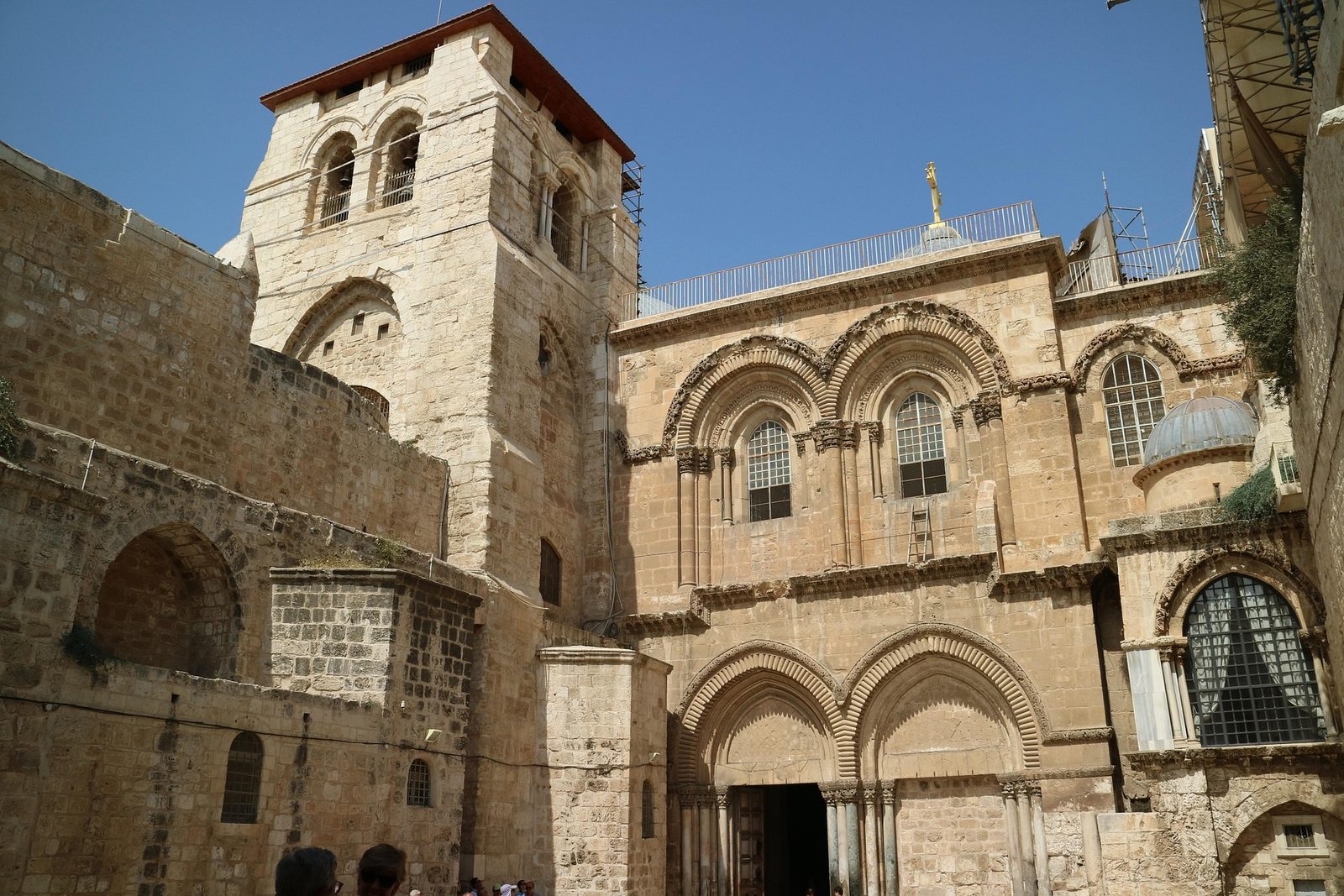
On a ledge above the main entrance of the Church of the Holy Sepulchre, a small wooden ladder has stood against the wall since at least the mid-18th century. The ladder, placed there by someone (no one knows exactly who) cannot be moved because the Status Quo agreement (formalized by an Ottoman decree in 1852) forbids any denomination from moving, rearranging, or altering any part of the church without the agreement of all six denominations. Since no such agreement has ever been reached about the ladder, it remains exactly where it was placed over 250 years ago. The Immovable Ladder is the most visible and most absurd symbol of the Status Quo: a piece of wood that no one owns, no one uses, and no one can touch. It has survived earthquakes, restorations, wars, and the curiosity of millions of visitors, and it will remain on its ledge until the six denominations agree on what to do with it. Which is to say, probably forever.
Golgotha: Place of the Skull
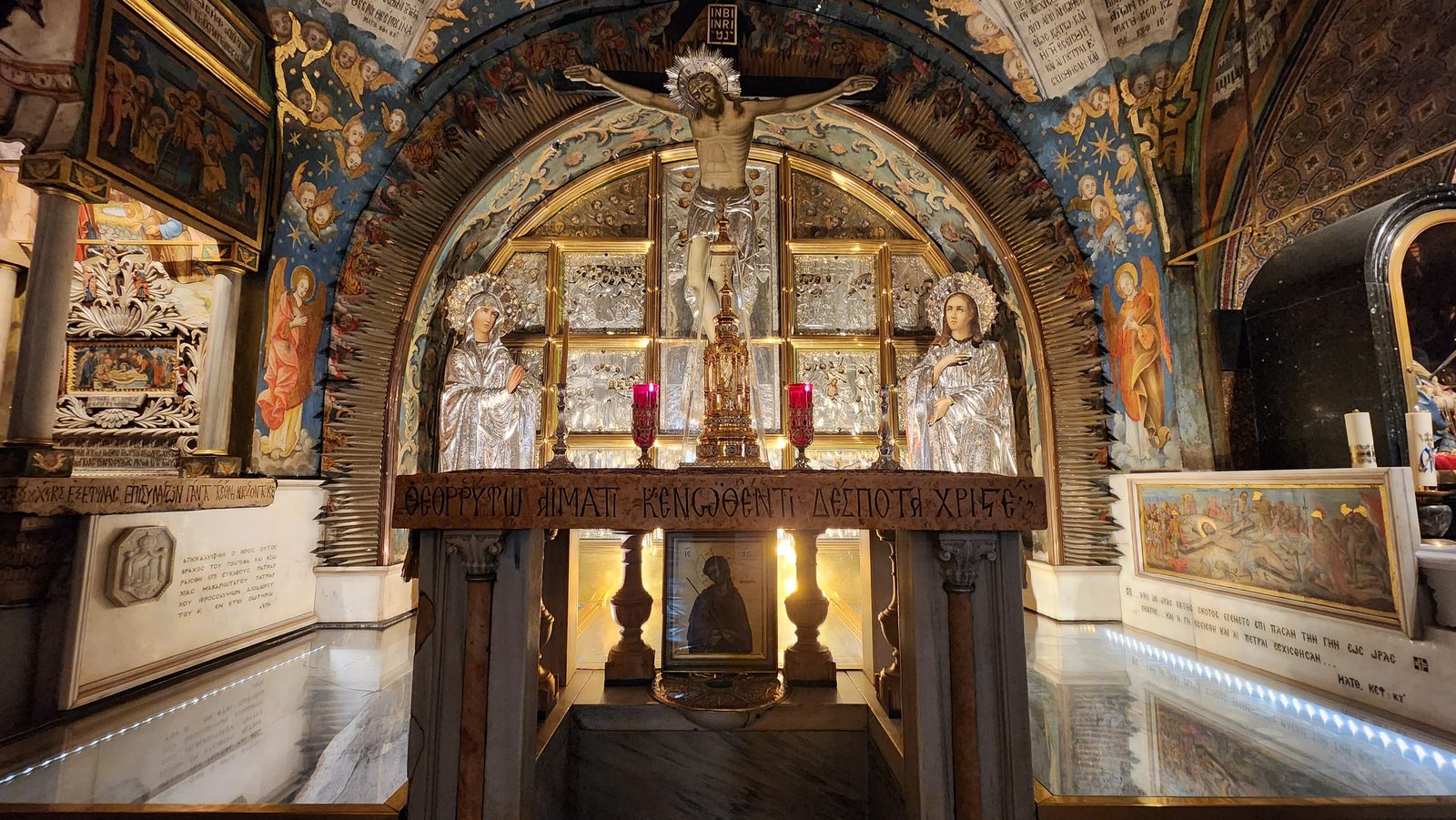
A steep staircase to the right of the entrance leads up to the Chapel of the Crucifixion, built on the rock of Golgotha, the “place of the skull” where tradition holds Jesus was crucified (John 19:17). The name “Golgotha” comes from the Aramaic word for skull; the Latin equivalent, Calvaria, gave us the word Calvary. The Gospels record that Jesus was crucified at “the third hour” (Mark 15:25), about nine in the morning, and that darkness covered the land from the sixth hour to the ninth hour, when he died (Mark 15:33–34).
The chapel is divided between the Catholic Franciscans and the Greek Orthodox. The Catholic side, the Chapel of the Nailing of the Cross (Station 11), marks the place tradition identifies with Jesus being stripped and nailed to the cross. The Greek Orthodox side marks the spot where the cross stood: a silver altar with an opening beneath it allows pilgrims to kneel and touch the bare rock of Golgotha itself. A glass panel in the floor reveals the cracked stone beneath. Tradition holds that the rock split at the moment of Jesus’ death, when “the earth shook, the rocks split, and the tombs broke open” (Matthew 27:51–52). The space is small, dark, crowded, and emotionally overwhelming, exactly the kind of place where the weight of what happened here becomes real.
Stone of Unction
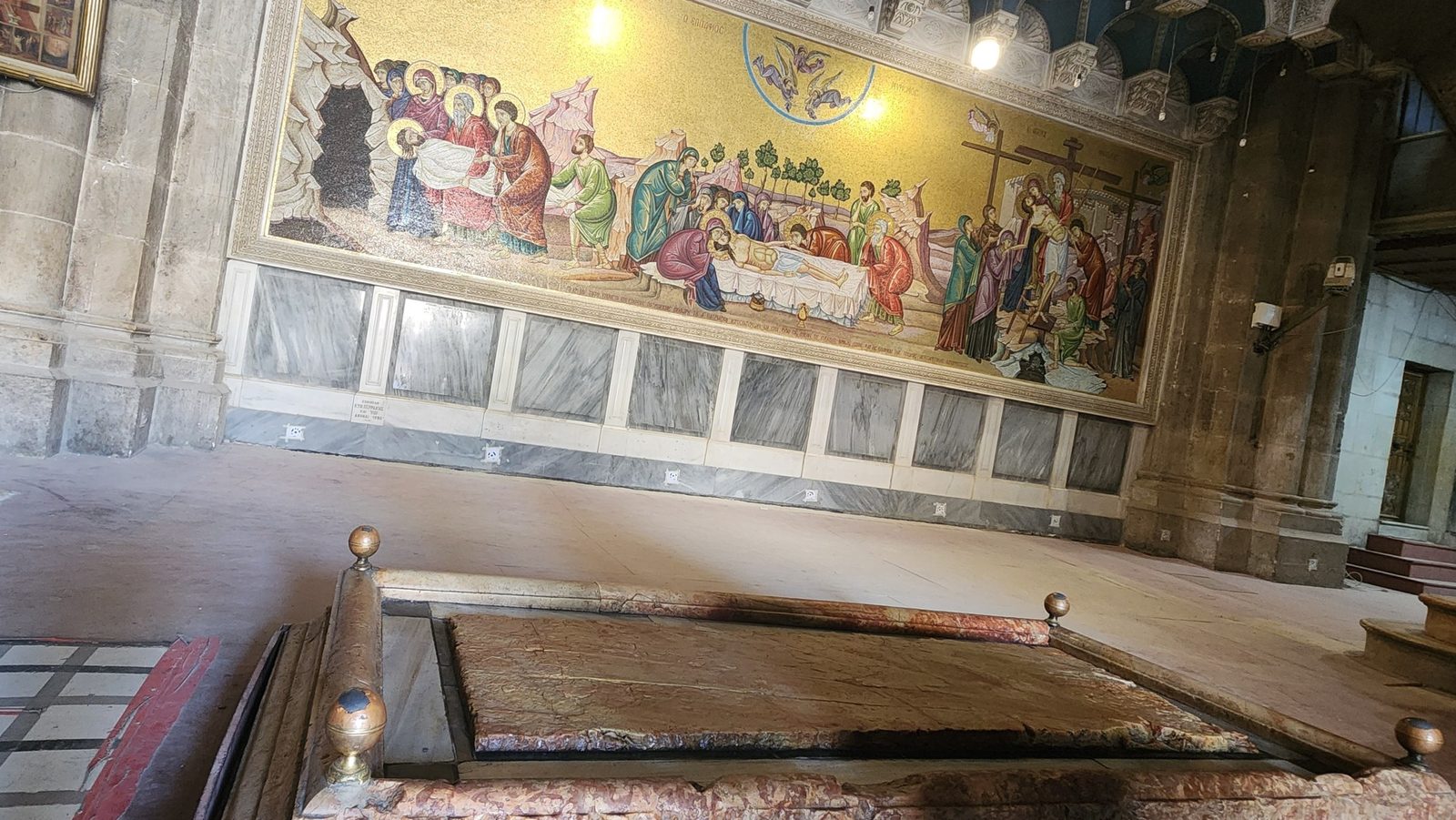
Immediately inside the entrance, a slab of polished pink limestone lies on the floor, surrounded by hanging lamps and flanked by tall candlesticks. This is the Stone of Unction (the Stone of Anointing), marking the place where, according to tradition, the body of Jesus was taken down from the cross and prepared for burial. The Gospel accounts describe the scene: Joseph of Arimathea, a wealthy member of the Sanhedrin who had secretly followed Jesus, went to Pontius Pilate and asked for the body. Nicodemus, who had first come to Jesus by night, brought a mixture of myrrh and aloes, about seventy-five pounds. “Taking Jesus’ body, the two of them wrapped it, with the spices, in strips of linen. This was in accordance with Jewish burial customs” (John 19:39–40).
The current stone dates to the 1810 reconstruction, but the tradition it marks is ancient. Pilgrims kneel to touch and kiss the stone, many pressing scarves, rosaries, and icons against its surface to absorb its holiness. Some pour perfumed oil and wipe it with cloth. The intensity of devotion here, just steps from the entrance, sets the tone for everything that follows inside the church.
Tomb (The Edicule)
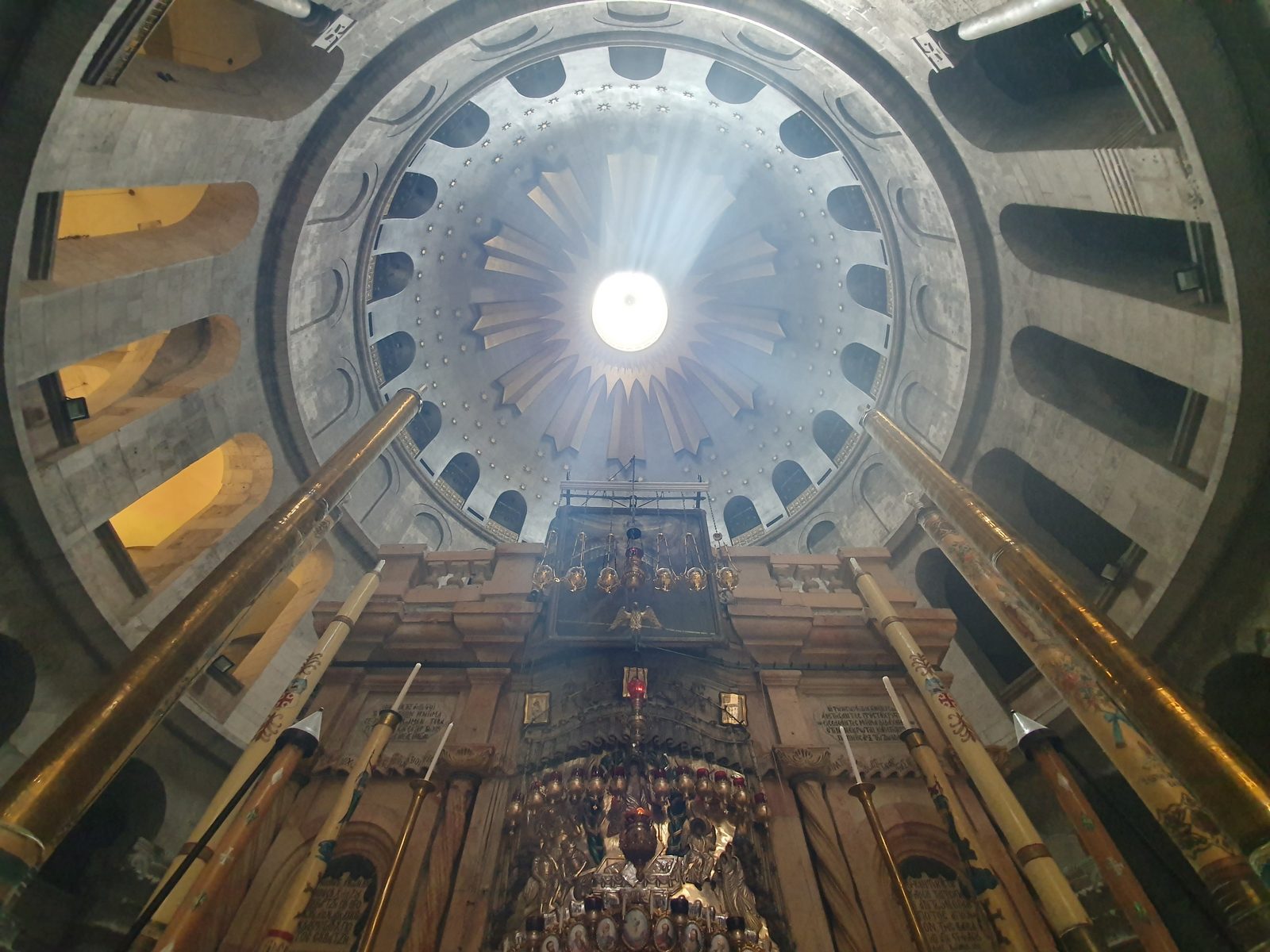
The Edicule, a small ornate structure in the center of the church’s rotunda, encloses what tradition holds is the tomb where Jesus was buried and rose from the dead. The current Edicule was rebuilt in the early 19th century after a fire, but the rock-cut tomb beneath it dates to the first century CE. In 2016, during a major restoration led by a team from the National Technical University of Athens, the tomb was opened for the first time in centuries. The original limestone burial bed was found intact beneath the marble cladding. Mortar sampled from between the original limestone surface and the covering marble slab was dated to approximately 345 CE, confirming that the tomb was identified and protected during the reign of Emperor Constantine, roughly two decades after his mother Helena reportedly discovered it.
Visitors line up to enter the Edicule in small groups. The interior is divided into two chambers: the Chapel of the Angel, containing a fragment of the stone that sealed the tomb, and the burial chamber itself, where pilgrims kneel at the marble slab over the place where Christ’s body lay. The wait can be long, but for believers, this is the most sacred spot on earth.
The 2016 Opening and the Garden Discovery
The 2016 restoration of the Edicule, led by a team from the National Technical University of Athens and documented by National Geographic, was the first time the tomb had been opened in centuries. The restoration team removed the marble cladding that had covered the burial bed since at least 1555, and for a brief period, the original rock surface was exposed to the air. The limestone burial bed was intact, confirming the antiquity of the site. National Geographic’s coverage of the opening brought the Church of the Holy Sepulchre to a global audience and provided the most detailed scientific documentation of the tomb ever conducted.
Archaeological Discoveries
In 2025, the results of the most extensive archaeological excavation at the Church of the Holy Sepulchre in nearly 200 years were published. The excavation, which began in 2022, uncovered evidence that the site was once a quarry, which was later transformed into cultivated fields where olive trees and grapevines grew, and eventually became a burial ground by the 1st century CE. The presence of olive trees and grapevines was confirmed through archaeobotanical and pollen analysis. Low stone walls with soil between them demonstrated the transition from quarry to garden. The Gospel of John states: “At the place where Jesus was crucified, there was a garden, and in the garden a new tomb” (John 19:41). The discovery of garden soil dating to the period of the crucifixion is a remarkable confirmation of the Gospel description, and it strengthens the case that the Church of the Holy Sepulchre stands on the authentic site of the burial and resurrection.
The key to the church has been held by the Joudeh family, a Muslim family, since at least the time of Saladin in the 12th century (the families themselves trace the tradition to the Caliph Umar in the 7th century, though documents confirm the arrangement only from Saladin’s era). A second Muslim family, the Nusseibeh, serves as the doorkeeper. The arrangement was Saladin’s solution to prevent any single Christian denomination from controlling access to the church, and it has worked for over 800 years. Every morning, a member of the Joudeh family opens the church door, and every evening he locks it, with representatives of the denominations watching to ensure the ritual is performed correctly.
Visit with Hoshen Tours
The Church of the Holy Sepulchre is the centerpiece of any walk through Jerusalem’s Old City. With a private guide from Hoshen Tours, you’ll explore not only this sacred church but also trace the path of the Via Dolorosa leading to it, wander through the Christian Quarter with its historic churches and markets, and discover the nearby Muristan with its Crusader-era heritage. For those interested in lesser-known treasures, we can include the Alexander Nevsky Church with its ancient threshold and the rooftop monastery of Deir es-Sultan. A guided visit brings the layers of history and devotion at this extraordinary site to life.
Explore Our Tour Collection
Ready to experience Israel in true colors?
Plan Your TourPrivate tours designed around your interests, schedule, and pace.