



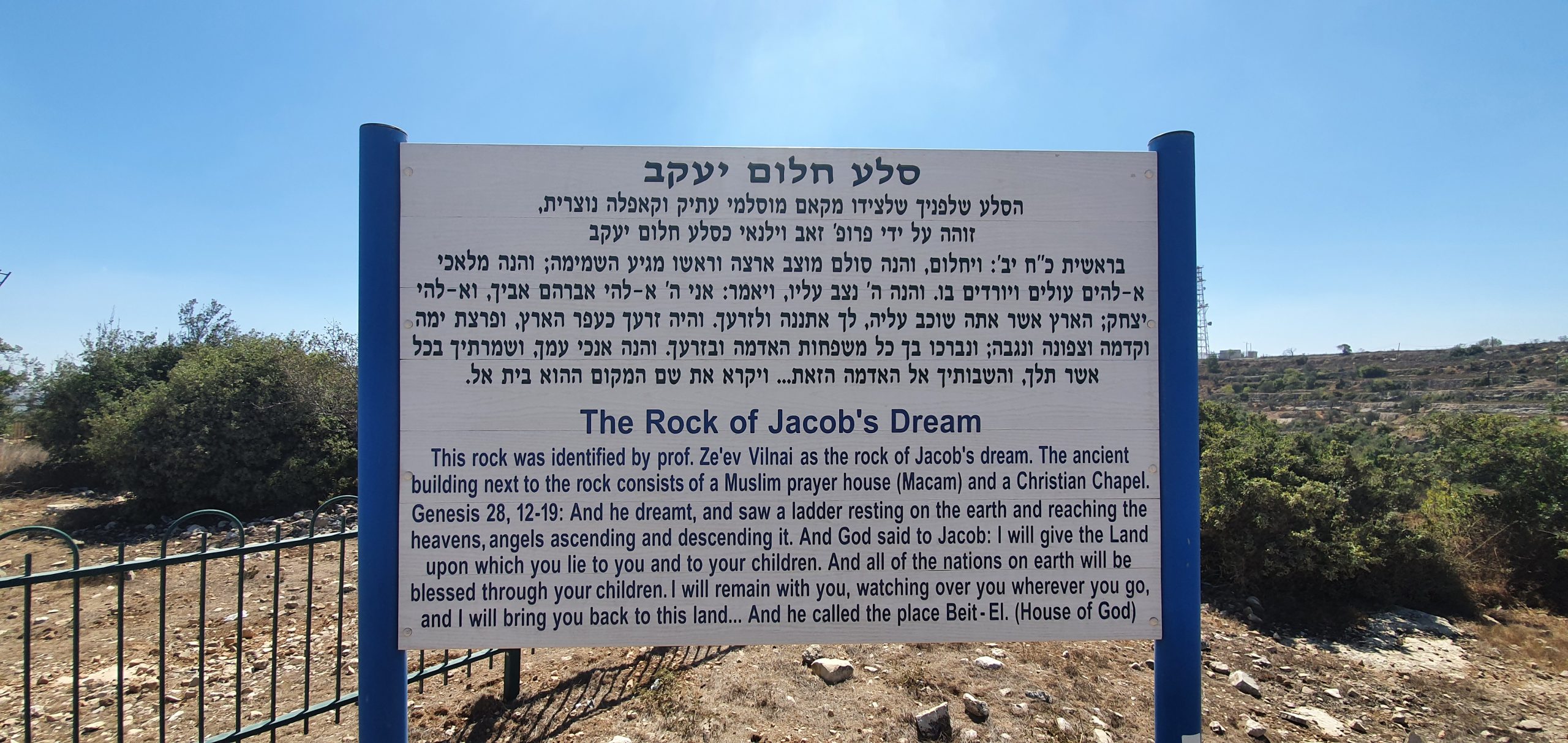
Beit El (Bethel, “House of God”) is one of the most frequently mentioned cities in the Bible, the place where, according to tradition, Jacob dreamed of a ladder reaching to heaven and where God renewed the covenant that had begun with Abraham at Alon Moreh. The site, in the hills of Benjamin north of Jerusalem, is central to the patriarchal narrative and to the later history of Israelite worship. From Abraham’s first altar to Jeroboam’s golden calf, Beit El witnessed both the highest moments of faith and the deepest failures of idolatry.
Abraham Israel
Abraham was the first patriarch to worship at this spot. After arriving in Canaan from Haran, he traveled south from Shechem and pitched his tent in the hill country “with Bethel on the west and Ai on the east. There he built an altar to the Lord and called on the name of the Lord” (Genesis 12:8). Later, after his sojourn in Egypt, Abraham returned to the same place, “to the place between Bethel and Ai where his tent had been earlier and where he had first built an altar. There Abram called on the name of the Lord” (Genesis 13:3-4). Tradition holds that this was the first place of regular worship in the Promised Land, a site Abraham chose because of its commanding hilltop position overlooking the central ridge route.
Jacob’s Dream of the Ladder
Jacob, fleeing from his brother Esau after receiving the blessing, stopped for the night at a place he did not yet know was holy. He took one of the stones at the site and placed it under his head as a pillow. “He had a dream in which he saw a stairway resting on the earth, with its top reaching to heaven, and the angels of God were ascending and descending on it. There above it stood the Lord, and he said: ‘I am the Lord, the God of your father Abraham and the God of Isaac. I will give you and your descendants the land on which you are lying’” (Genesis 28:12-13). When Jacob awoke, he was awed: “Surely the Lord is in this place, and I was not aware of it.
How awesome is this place! This is none other than the house of God; this is the gate of heaven” (Genesis 28:16-17). He set up the stone he had used as a pillow as a sacred pillar, poured oil on it, and made a vow: “If God will be with me and will watch over me on this journey I am taking, and will give me food to eat and clothes to wear so that I return safely to my father’s household, then the Lord will be my God” (Genesis 28:20-21). He named the place Beit El, “House of God.”
Jacob’s Return to Beit El
Years later, after his wrestling at the Jabbok and his reconciliation with Esau, God commanded Jacob to return to Bethel: “Go up to Bethel and settle there, and build an altar there to God, who appeared to you when you were fleeing from your brother Esau” (Genesis 35:1). Jacob told his household to put away their foreign gods, and they buried them under the oak at Shechem. He returned to Beit El, built the altar, and God appeared to him again, renaming him Israel: “Your name is Jacob, but you will no longer be called Jacob; your name will be Israel” (Genesis 35:10). The site thus marks both the beginning of Jacob’s journey and its fulfillment.
The Ark of the Covenant
During the period of the Judges, the Ark of the Covenant rested at Beit El for a time. When the tribes of Israel gathered to fight against Benjamin after the outrage at Gibeah, they came to Beit El to inquire of God. “The Israelites went up and wept before the Lord until evening, and they inquired of the Lord… Phinehas son of Eleazar, the son of Aaron, ministered before it” (Judges 20:26-28). The presence of Phinehas, grandson of Aaron, and the Ark at this location shows that Beit El served as a central worship site before the Ark was eventually moved to Shiloh.
Jesus and Jacob’s Ladder
In the Gospel of John, Jesus alludes directly to Jacob’s vision at Beit El. Speaking to Nathanael, one of his first disciples, Jesus says: “Very truly I tell you, you will see heaven open, and the angels of God ascending and descending on the Son of Man” (John 1:51). The language deliberately echoes Genesis 28:12, the ladder at Beit El with angels going up and down. For Christian pilgrims, this reference transforms the Beit El story from an Old Testament episode into a foreshadowing of Jesus himself as the connection between heaven and earth, the living “ladder” that Jacob saw in his dream.
Jeroboam’s Golden Calf
After the division of the kingdom following Solomon’s death, Jeroboam, the first king of the Northern Kingdom, established a rival sanctuary at Bethel to prevent his people from traveling to Jerusalem. “He made two golden calves. He said to the people, ‘It is too much for you to go up to Jerusalem. Here are your gods, Israel, who brought you up out of Egypt.’ One he set up in Bethel, and the other in Dan” (1 Kings 12:28-29). Jeroboam appointed priests from all sorts of people, even though they were not Levites, and instituted a festival on the fifteenth day of the eighth month to rival the feast in Jerusalem (1 Kings 12:31-33). This act became a defining sin in the biblical narrative, and nearly every king of Israel who followed was judged by whether he continued “the sins of Jeroboam.”
The Prophet Amos
The prophet Amos, a shepherd from Tekoa in Judah, traveled north to Beit El to deliver God’s judgment against the Northern Kingdom’s injustice and false worship. His message was so bold that Amaziah, the priest of Bethel, reported him to King Jeroboam II and then confronted him directly: “Get out, you seer! Go back to the land of Judah. Earn your bread there and do your prophesying there. Don’t prophesy anymore at Bethel, because this is the king’s sanctuary and the temple of the kingdom” (Amos 7:12-13). Amos refused to be silenced, insisting he spoke only what God had commanded. The prophet Hosea later referred to Bethel as “Beth Aven” (House of Wickedness), and King Josiah of Judah eventually destroyed the sanctuary during his reforms (2 Kings 23:15).
The Archaeological Site
Excavations at the site, conducted in the 1930s and 1950s, revealed occupation layers spanning from the Middle Bronze Age through the Byzantine period. Archaeologists uncovered remains of a Canaanite city with thick walls, evidence of destruction layers consistent with the biblical timeline, and later Israelite settlement remains. Visitors today can see the hilltop location with its panoramic views of the surrounding hills of Benjamin. The landscape itself is perhaps the most striking feature. Standing at the site, you look out over the same ridgeline Abraham would have walked, the same hills where Jacob laid his head.
Visit with Hoshen Tours
Beit El is where tradition holds Jacob dreamed of a ladder reaching to heaven. Hoshen Tours pairs it with Joshua’s Altar, the viewpoint at Har Bracha, the first camp of Abraham at Alon Moreh, and the mountains of blessing and curse at Mount Gerizim and Mount Ebal.
Explore Our Tour Collection
Ready to experience Israel in true colors?
Plan Your TourPrivate tours designed around your interests, schedule, and pace.