



There are places in the world that stop you cold before you even step inside. Mar Saba Monastery is one of them. Perched on the sheer face of the Kidron Valley canyon, roughly twelve kilometers southeast of Bethlehem, this ancient community of monks has clung to its cliff without interruption since 483 CE. That is not a typo. The monks of Mar Saba have been chanting, praying, fasting, and living in these same stone cells for over fifteen hundred years, making this one of the oldest continuously inhabited monasteries on the planet. Even in a region where history feels woven into every hilltop, Mar Saba is something else entirely.
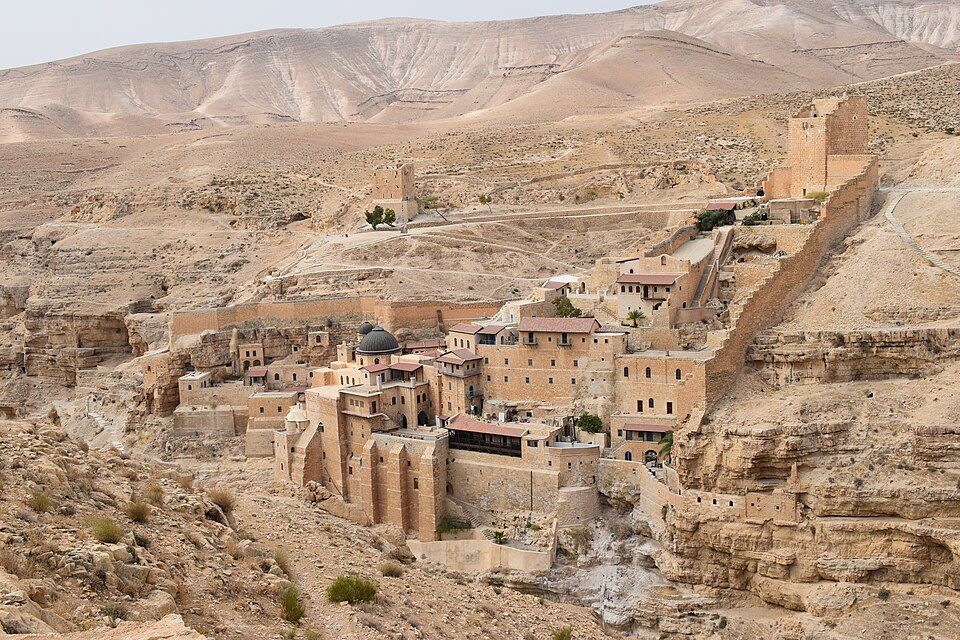
The drive out from Bethlehem takes you through the Judean Desert, where the landscape gradually strips itself of everything soft and comfortable. By the time the road ends and the valley opens up below you, the monastery appears almost impossibly placed, as if someone had dreamed it there, layer upon layer of white and ochre stone cascading down the canyon wall. It is the kind of sight that makes you reach for your camera and then put it back down, because you know the photo will not do it justice.
Saint Sabas: The Man Who Chose the Wilderness
The story of Mar Saba begins with one young man who walked into the desert and never really walked back out. Sabas was born around 439 CE in Mutalaska, a village in Cappadocia in what is now central Turkey. As a child he entered a monastery, and by the time he was a teenager he had made his way to Jerusalem, drawn by the spiritual gravity of the Holy Land. He studied under Euthymius the Great, one of the leading desert fathers of that era, and then, seeking even deeper solitude, he crossed into the Kidron Valley and found a cave in the cliff wall above the seasonal stream.
He lived there alone for years, and tradition holds that the cave itself became his cell, his chapel, and his home. Word spread, as it always does with men of genuine holiness. Other monks came. A community grew up around the cave, and in 483 CE Sabas formally established what became known as the Great Laura, a laura being the particular form of monastic organization where monks live in individual cells but gather together for communal prayer and liturgy. The Patriarch of Jerusalem appointed Sabas as the archimandrite, the head, of all the monks in Palestine, a position of enormous spiritual authority. He died in 532 CE, having spent the better part of a century in the desert he loved, and he is venerated as one of the great saints of Eastern Christianity.
The Monastery: Architecture Born from the Cliff
What you see today at Mar Saba is the result of fifteen centuries of building, rebuilding, and rebuilding again. Earthquakes, Persian invasions, Crusader-era conflicts, and the ordinary passage of time have all left their marks, and the monks have always returned to repair and restore. The result is a compound that looks less like something designed by architects and more like something that grew organically out of the rock itself.
The monastery spreads across multiple levels of the canyon face, connected by staircases and passageways carved directly into the stone. At its heart stands the Church of St. Sabas, built over and around the original cave where the founder lived and prayed. Nearby is the cave itself, still preserved, where tradition holds that an angel appeared to Sabas and revealed the proper layout for his community. There is a charnel house on the grounds, where the skulls of monks who lived and died here over the centuries are kept, a sobering and strangely peaceful reminder of the community’s long, unbroken human chain. Gardens manage to survive in the canyon, watered with care in an environment that receives almost no rain. The whole complex is a testament to what human devotion, patience, and ingenuity can build when given enough centuries.
Today approximately twenty monks make their home here, Greek Orthodox brothers who follow the same rhythms of prayer and work that have defined this place since the fifth century. The monastery belongs to the Greek Orthodox Patriarchate of Jerusalem and remains an active, living community, not a museum.
The Jerusalem Typikon: A Gift to the Whole Church
Mar Saba’s influence on the wider Christian world reaches far beyond its canyon walls. During the centuries when this monastery was at the height of its intellectual and spiritual influence, its monks developed a comprehensive liturgical order governing how divine services should be conducted throughout the year. This document, known as the Jerusalem Typikon or the Typikon of Mar Saba, addressed everything from the sequence of scripture readings to the specific hymns appropriate for each feast day to the daily rhythm of prayer.
Over time, this order was adopted not just by monasteries in Palestine but by the entire Eastern Orthodox world. Whether you attend a Greek Orthodox liturgy in Athens, a Russian Orthodox service in Moscow, or an Antiochian parish in New Jersey, the structure of worship you encounter traces its roots directly back to the monks of this desert canyon. That is a remarkable legacy for a community living in such radical simplicity, and it is one reason Mar Saba holds a place of honor that goes well beyond its size or its remoteness.
Visiting Mar Saba: What to Expect
Visiting Mar Saba requires a bit of planning and a genuine spirit of respect, because this is not a tourist attraction in any ordinary sense. It is a living monastery, and the monks welcome guests on their own terms.
The most important thing to know before you go is that women are not permitted inside the monastery walls. This is not a recent policy or an arbitrary one. It reflects the monastic tradition of the Great Laura, maintained without exception throughout the monastery’s history. Women visitors are welcome to come and to view the monastery from across the valley. A tower on the opposite canyon rim, known as the Women’s Tower, was built specifically for this purpose and offers a genuinely spectacular vantage point. Many visitors find the view from the tower more dramatic than anything they could see from inside. The approach to the tower involves a short walk along the canyon rim and is absolutely worth doing.
Men who wish to enter the monastery should come dressed modestly, with long trousers and covered shoulders. There are no set visiting hours in the usual sense. You ring the bell at the gate and wait. A monk will typically come to the door, assess whether it is a suitable time for visitors, and either welcome you in or ask you to return later. The whole experience has a wonderfully unscheduled, old-world quality that feels entirely appropriate to the place.
Photography inside the monastery is generally not permitted, though policies can vary, and it is always worth asking politely. The monks speak primarily Greek, but they are accustomed to international visitors and manage well enough across the language gap with warmth and patience.
The Crusader Legacy
One of the most meaningful things to know about Mar Saba is the story of its founder’s relics. The body of Saint Sabas was taken from the Holy Land during the Crusader period and eventually came to rest in Venice, where it remained for centuries. In 1965, Pope Paul VI returned the relics to the monastery as a gesture of goodwill during the improving relations between the Catholic and Orthodox churches. The return of St. Sabas to the desert community he founded, after more than eight hundred years away, is the kind of story that reminds you why this part of the world carries so much emotional weight for so many people.
Getting there typically means joining a guided tour from Jerusalem or Bethlehem, as the access road requires a reliable vehicle and local knowledge. Most visits to the area combine Mar Saba with other sites in the Judean Desert: the desert monasteries of the region share a spiritual heritage with this place, and nearby Herodium, Herod’s dramatic palace-fortress, makes for a striking contrast between royal ambition and monastic simplicity on the same day. Together they make for a full and genuinely unforgettable day in the wilderness.
Visit with Hoshen Tours
Mar Saba is one of the most dramatic monasteries in the world, and Hoshen Tours knows the access, the timing, and the story. Combine it with a broader exploration of the Judean Desert, the traditions of the desert monasteries, a hike through Wadi Qelt, or a visit to St. George Monastery clinging to the cliff on the other side of the desert. Hoshen Tours often combines this site with Mount Sodom, Good Samaritan Museum, and Desert Monasticism for a memorable day exploring the region.
Ready to experience Israel in true colors?
Plan Your TourPrivate tours designed around your interests, schedule, and pace.