Mishkenot Sha’ananim (“Peaceful Dwellings”) was the first Jewish neighborhood built outside the walls of the Old City of Jerusalem, founded in 1860 by the British Jewish philanthropist Sir Moses Montefiore. The long stone building, facing the Old City walls across the Hinnom Valley, was a revolutionary act: for the first time in modern history, Jews were willing to live outside the protection of the city walls. The residents had to be persuaded, and at first, paid, to move in. The fear of bandits, the distance from the synagogues and markets inside the walls, and the sheer psychological weight of leaving the only safe space Jews had known in Jerusalem for centuries made the first tenants reluctant pioneers. Montefiore installed a heavy iron gate and hired a guard, and even so, many of the first residents slept inside the walls and only came to Mishkenot during the day.
Montefiore’s Vision at Mishkenot Sha’ananim: The First Neighborhood Outside the Walls Jerusalem
Moses Montefiore was born in 1784 in Livorno, Italy, to a Sephardic Jewish family. He grew up in London, made his fortune as a stockbroker and brother-in-law of Nathan Mayer Rothschild, was knighted by Queen Victoria in 1837, and devoted the last decades of his extraordinary long life, he died in 1885 at the age of 100, to philanthropy and the defense of Jewish communities worldwide. He visited Jerusalem seven times between 1827 and 1875, and each visit strengthened his conviction that the Jewish community needed to expand beyond the overcrowded, unsanitary conditions inside the Old City walls. The project was made possible by the bequest of Judah Touro, a wealthy American Jewish philanthropist from New Orleans who left a substantial portion of his estate for the welfare of the poor of the Holy City of Jerusalem.
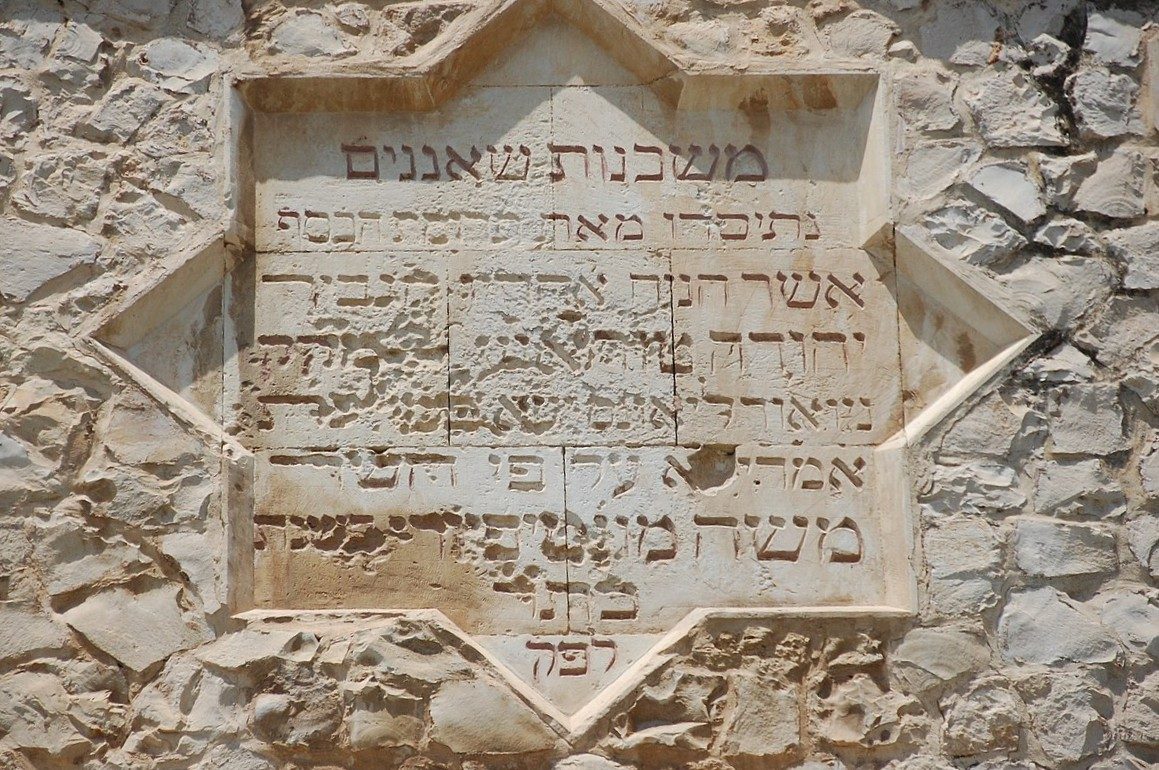
Touro never visited the Land of Israel, but his will, executed in 1854, entrusted the funds to Montefiore, who used them to build the long row of apartments facing the Old City, along with a windmill to provide the residents with an independent source of income through flour production. A stone dedication plaque on the building, set within a Star of David, records the gift in Hebrew: “Mishkenot Sha’ananim, established from the money bequeathed by Judah Touro… under the supervision of Moses Montefiore.” It is one of the earliest monuments to Jewish philanthropy in the modern Land of Israel.
The Buildings
The complex consists of two long, parallel stone buildings set into the hillside facing the Old City walls across the Hinnom Valley. The larger building, completed in 1860, contained 20 apartments of one and a half rooms each. A second, shorter building was added above it in 1866. The apartments were divided equally: eight for Ashkenazi families and eight for Sephardi families, with one apartment designated as an Ashkenazi synagogue and one as a Sephardi synagogue, plus a clinic. An apartment was also set aside for Rabbi Shmuel Salant, the chief rabbi of Jerusalem, though he never moved in.
The roofline is crenelated to echo the battlements of the Old City walls on the other side of the valley, a deliberate architectural gesture that visually linked the new neighborhood to the ancient city it faced. Above each apartment door, a Hebrew letter was carved, one letter for each family. The compound also included a water cistern with an iron pump (revolutionary for Jerusalem at the time), a communal oven, and a ritual bath.
The apartments were intended for the Jewish poor of Jerusalem, funded by Touro’s will which directed the money for “the relief of the poor.” But persuading anyone to move in proved almost impossible. The fear of living outside the walls was overwhelming. Montefiore offered stipends to the first residents, and even so, many would come during the day and return to sleep inside the Old City at night. Montefiore had originally planned to build a hospital on the site, but was told that Jews would not travel so far for medical care, so he built homes instead, hoping to draw them out of the overcrowded, disease-ridden quarters within the walls.
The Windmill
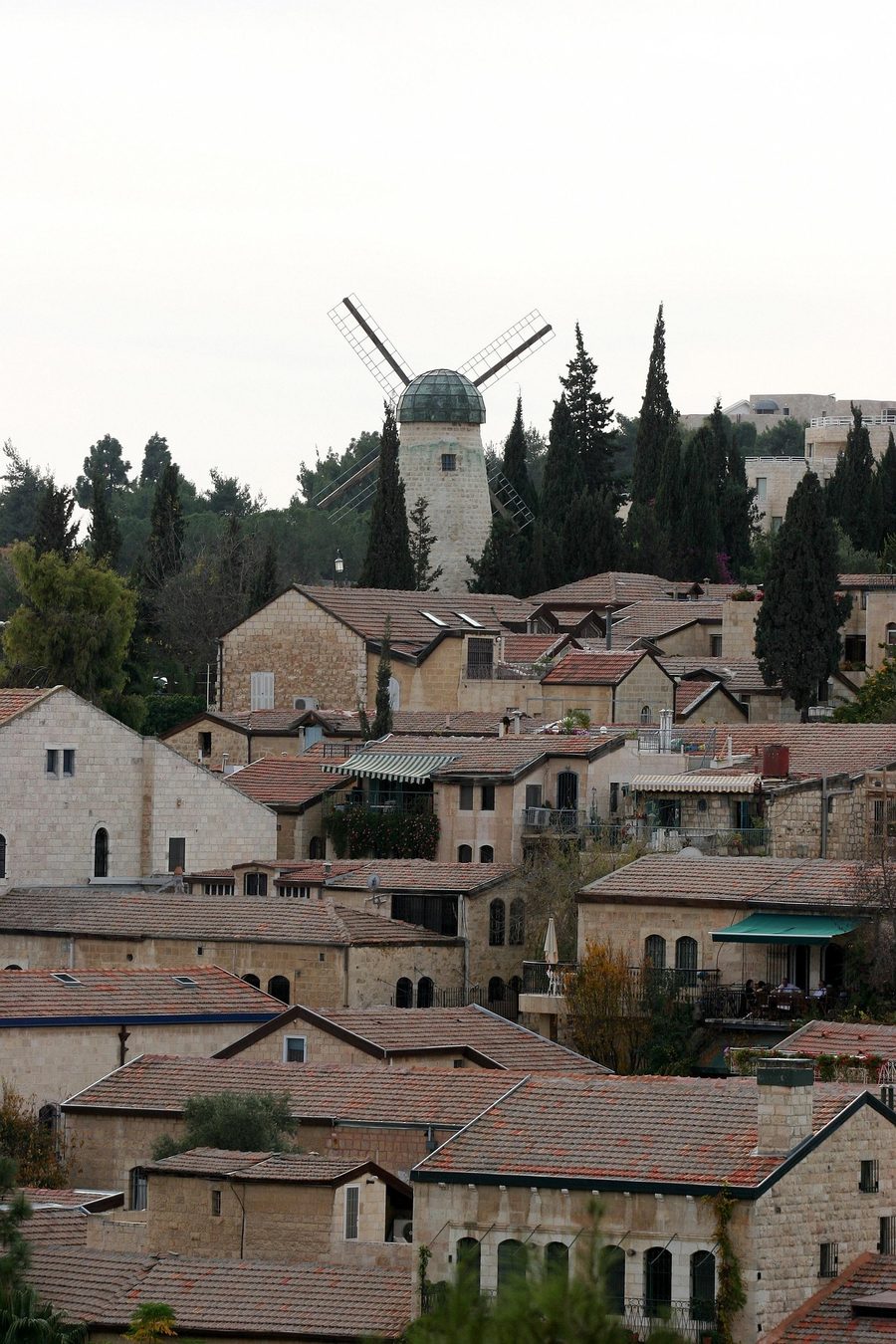
The Montefiore Windmill, standing on the ridge beside Mishkenot Sha’ananim, is one of Jerusalem’s most recognizable landmarks. The windmill was designed to grind grain and provide employment, but the local winds proved too inconsistent for regular operation. The windmill ground its last grain within a few years, and Montefiore replaced it with a steam-powered mill. But the windmill itself endured, it became a symbol of the neighborhood, of Montefiore’s dream, and eventually of Jerusalem itself. During the 1948 war, the building served as an Israeli military position on the front line facing the Old City walls. Bullet holes from that period were visible on the structure for decades. Today, the windmill has been restored and serves as a museum dedicated to Montefiore’s life and his contributions to the Jewish community in the Land of Israel. Its silhouette against the Jerusalem sky has become one of the city’s most photographed images.
The Artists’ Residency
Today, Mishkenot Sha’ananim operates as a cultural center and guesthouse for visiting artists, writers, and intellectuals. The Jerusalem Music Center, founded by the violinist Isaac Stern, hosts concerts and masterclasses. The combination of the historic building, the views of the Old City, and the cultural programs makes Mishkenot Sha’ananim one of the most distinguished cultural institutions in Israel. Among the artists and writers who have stayed here are Saul Bellow, Simone de Beauvoir, and Marc Chagall. The terrace offers one of the most iconic views in Jerusalem: the Old City walls, the Temple Mount, and the Mount of Olives framed across the Hinnom Valley, the same view that Montefiore’s first tenants saw when they gathered the courage to step outside the walls.
Visit with Hoshen Tours
Mishkenot Sha’ananim was the first Jewish neighborhood built outside the Old City walls, and its long stone buildings still overlook the Valley of Hinnom and the Old City beyond. With Hoshen Tours, visitors walk through Sir Moses Montefiore’s vision of a new Jerusalem, seeing the windmill, the almshouses, and the artists’ residences. The neighborhood connects to the German Colony to the south, the First Station complex nearby, and the Rehavia neighborhood to the west.
Explore Our Tour Collection
Ready to experience Israel in true colors?
Plan Your TourPrivate tours designed around your interests, schedule, and pace.