



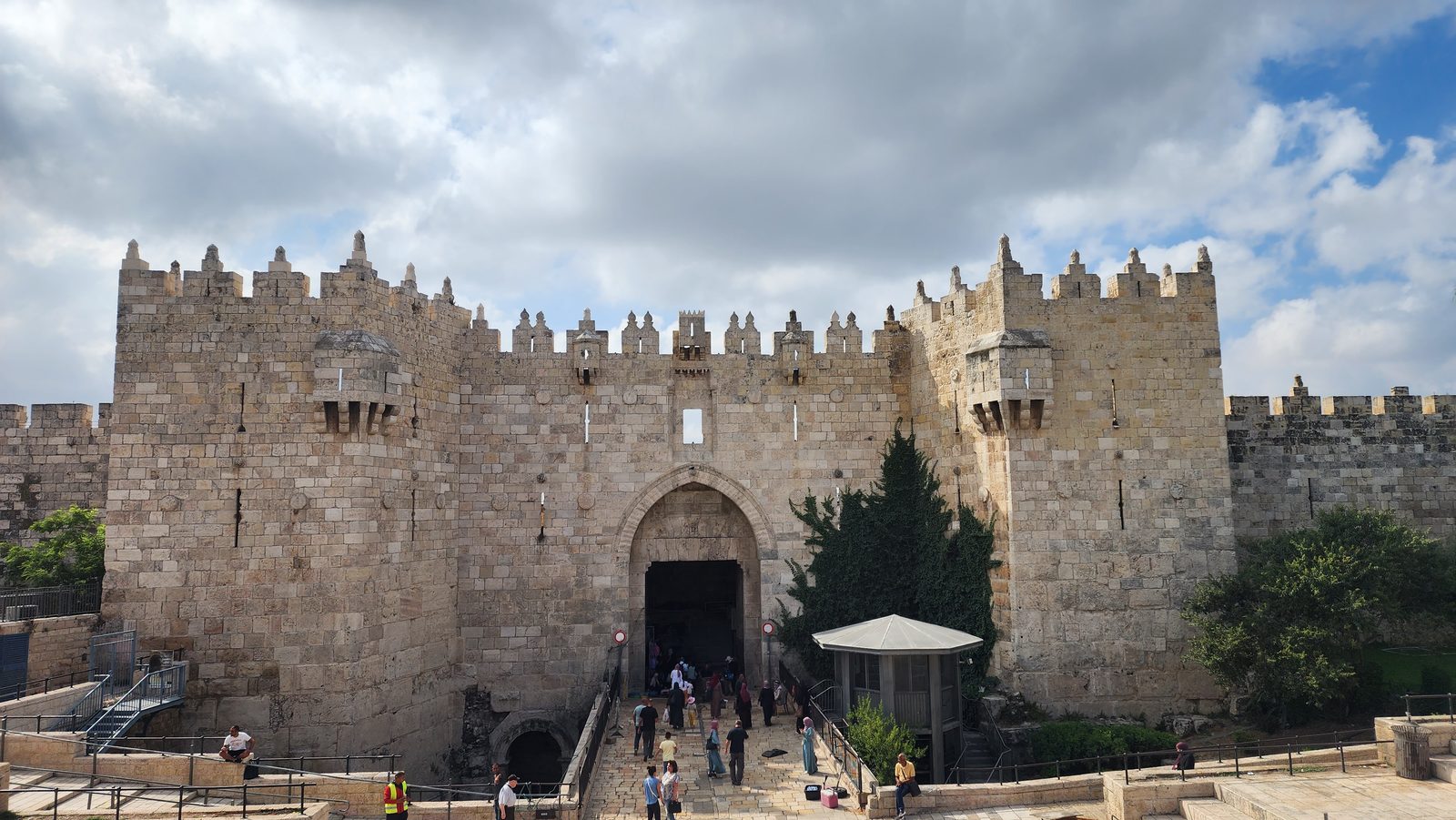
The Damascus Gate is the grandest and most imposing of the Old City’s eight gates. Located on the northern wall, facing the road that once led to Damascus, the gate is the busiest entrance to the city, a swirling junction of commerce, pilgrimage, and daily life. The gate’s Arabic name, Bab al-Amud (Gate of the Column), refers to a tall column that once stood inside the gate during the Roman period, visible on the 6th-century Madaba Map.
Roman Square Jerusalem
Beneath the Ottoman gate, excavations have revealed the remains of the original Roman gate built by Emperor Hadrian in the 2nd century CE, when he rebuilt Jerusalem as the Roman city Aelia Capitolina after crushing the Bar Kokhba revolt in 135 CE. The Roman gate was a triumphal triple-arched entrance, and the excavated plaza in front of it, the Roman Square, preserves the paving stones and column bases from Hadrian’s city. It was atop one of these column bases that the tall column shown on the Madaba Map once stood, giving the gate its Arabic name. A museum in the excavated space displays the remains and explains the Roman redesign of Jerusalem. The excavated square, accessible by stairs below the modern street level, reveals the original Roman gate and a section of the Cardo that led south into the city. A Roman milestone and guard room are visible, and the scale of the Roman construction makes clear how important this entrance was in the layout of Aelia Capitolina.
Ottoman Gate
The current gate was built by Sultan Suleiman the Magnificent in 1537, as part of his complete reconstruction of the Old City walls. Suleiman built the gate directly above the Roman foundations, incorporating the ancient layout into his 16th-century design. The gate is decorated with crenellations and arrow slits, and the entrance includes the characteristic right-angle turn designed to slow attackers. The two towers flanking the gate give it a fortress-like appearance that is more military than welcoming, a reminder that the walls of Jerusalem were built for defense as much as for grandeur. The inscription above the gate, now worn, originally identified Suleiman as the builder and dated the construction.
The Market and the Steps
The broad stone steps leading down to the Damascus Gate form a natural amphitheater that is always filled with people. Vendors sell coffee, bread, and fruit on the steps. Families rest in the shade of the walls. The atmosphere is closer to a Middle Eastern souk than to a European monument. Entering through the gate, you descend into the beginning of the Muslim Quarter’s main market street, which follows the route of the ancient Roman cardo southward through the city. The market is loud, crowded, and alive with vendors selling everything from fresh produce and spices to clothing and electronics. The sensory experience of entering the Old City through the Damascus Gate, descending the stone steps into the noise and color of the market, is one of the most vivid moments in any Jerusalem visit.
Visit with Hoshen Tours
Damascus Gate is one of the most impressive entrances to Jerusalem’s Old City and the natural starting point for exploring the Muslim Quarter with its bustling souks and historic architecture. From here, your Hoshen Tours guide can lead you along the Ramparts Walk atop the Ottoman walls for sweeping views, or through the gate into the heart of the Old City toward the Christian Quarter and the Austrian Hospice with its rooftop panorama. A guided visit reveals the Roman-era gate buried beneath the current Ottoman structure.
Explore Our Tour Collection
Ready to experience Israel in true colors?
Plan Your TourPrivate tours designed around your interests, schedule, and pace.