



Tel Arad is a large archaeological site on the eastern edge of the Negev desert, remarkable for two distinct cities separated by nearly 2,000 years: a Canaanite city from the Early Bronze Age (3rd millennium BCE) and an Israelite fortress from the Iron Age (10th, 6th centuries BCE). The Israelite fortress contains one of the most extraordinary finds in biblical archaeology: a Judahite temple with an altar, standing stones, and a Holy of Holies, the only Israelite temple ever discovered outside of Jerusalem. In 2020, analysis of residue on the altars revealed traces of cannabis and frankincense, adding yet another layer to one of the most fascinating sites in the country.
The Canaanite City
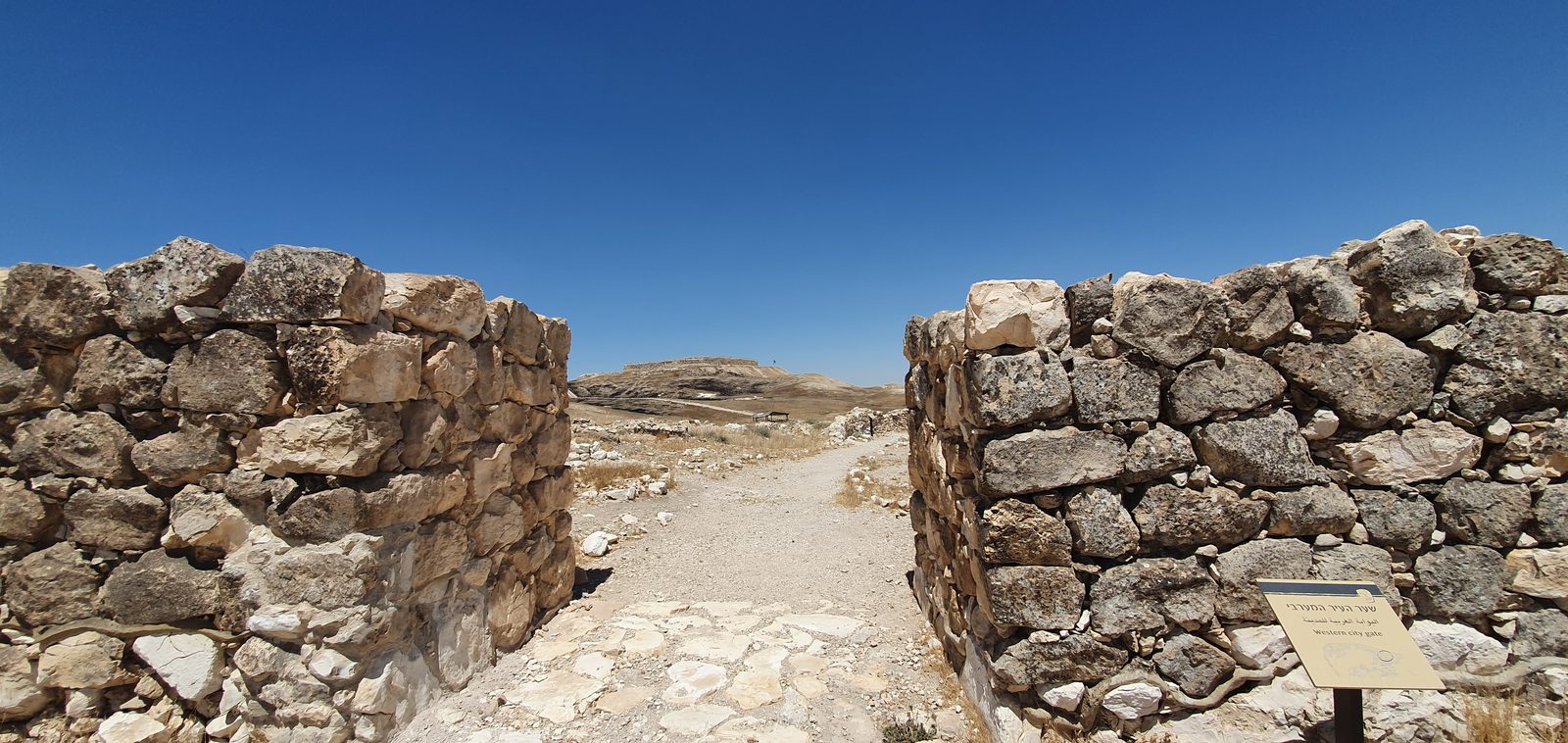
The lower city at Tel Arad dates to the Early Bronze Age (approximately 2950–2650 BCE) and is one of the best-preserved early urban sites in Israel. The city was well planned, with a fortification wall enclosing roughly 25 acres, residential quarters, public buildings, and a sophisticated water system. What makes Arad exceptional is that the Early Bronze remains are not buried beneath later layers, the Canaanite city was abandoned and never built over, leaving the 5,000-year-old street plan fully visible on the surface.
The houses at Arad follow a distinctive design known as the “Arad house” or “broad house”, a rectangular structure entered through the long wall, with a stone bench running along the interior. This house type became so characteristic of the site that archaeologists named it after Arad. The uniformity of the houses suggests a society with centralized planning. The city maintained significant trade connections with Egypt, likely tied to the copper industry and access to the copper mines of the Arabah to the south.
Around 2650 BCE, the city was abandoned, possibly due to a prolonged drought that affected the entire region. It would not be reoccupied for over a thousand years.
The King of Arad
Arad appears in the Bible in a dramatic episode during the Israelite wandering in the desert. The Book of Numbers records: “When the Canaanite king of Arad, who lived in the Negev, heard that Israel was coming along the road to Atharim, he attacked the Israelites and captured some of them” (Numbers 21:1). The Hebrew word “Atharim” is connected by rabbinic commentators to “tarim”, spies, suggesting that the king of Arad learned of Israel’s approach through the same route the spies had taken.
In response, the Israelites made a vow to God: if He delivered the Canaanites into their hands, they would utterly destroy their cities. God listened, and the Israelites defeated the king of Arad and destroyed the towns. The place was named Hormah, meaning “destruction” (Numbers 21:2–3). Whether this biblical Arad is the same site as Tel Arad remains a question, the Canaanite city had already been abandoned for over a millennium by the time of the Exodus narrative, but the name and the Negev setting connect the two.
The Israelite Fortress
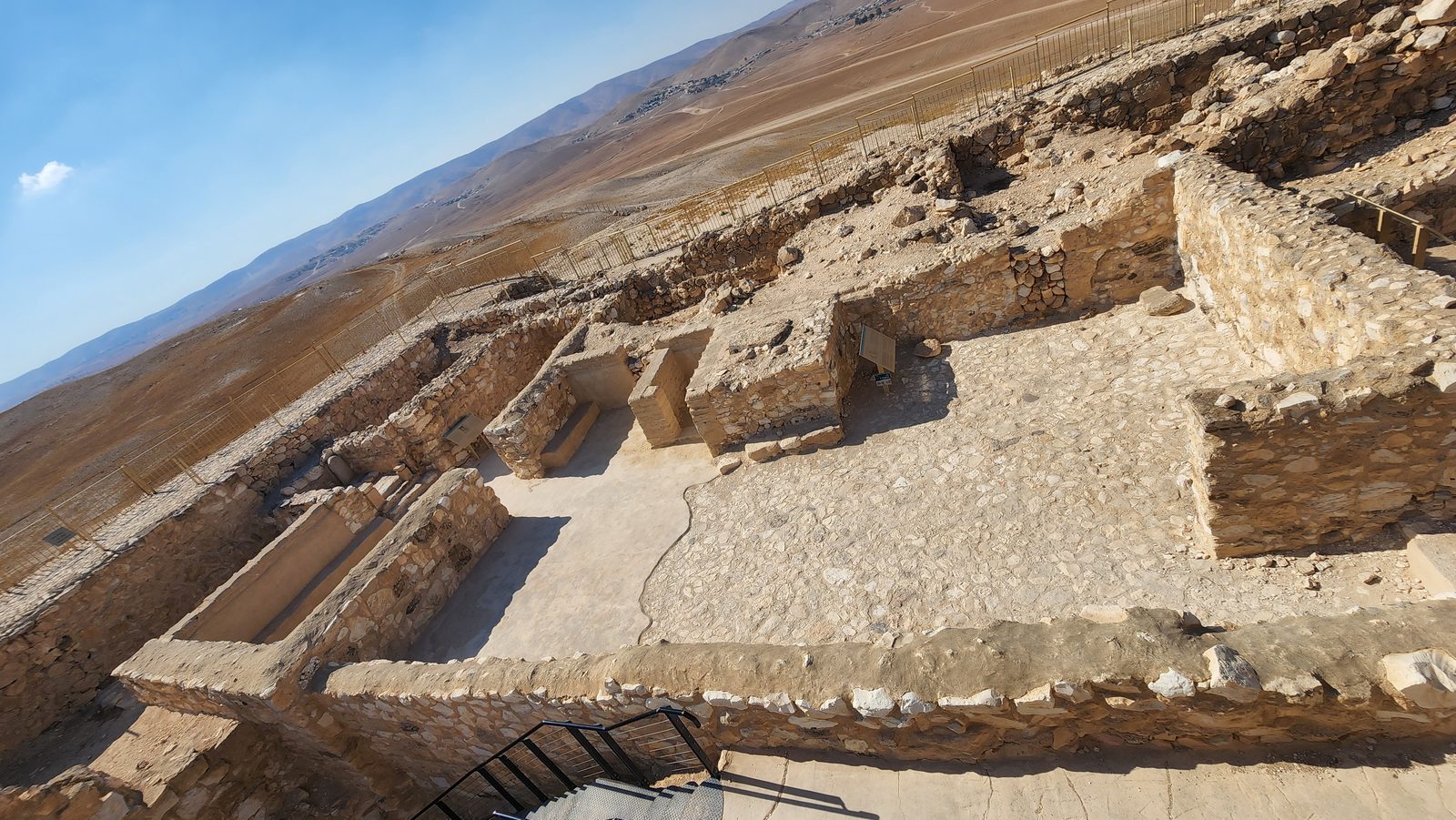
On the hilltop above the Canaanite city, a series of Israelite fortresses was built and rebuilt over roughly four centuries, from the 10th to the 6th century BCE. Archaeologists identified six main fortress phases (Strata XI through VI), spanning from the period of the United Monarchy under Solomon through the destruction by the Babylonians in 586 BCE. The fortress served as a military outpost on the southern border of the Kingdom of Judah, guarding the road from the Negev toward the Judean hills and the approaches to Beer Sheva.
The fortress was a compact, walled enclosure with storerooms, a water cistern, and living quarters for the garrison. Its strategic position gave it a commanding view of the surrounding desert, any movement from the south or east could be spotted from the hilltop long before it reached the settled areas of Judah.
The Judahite Temple
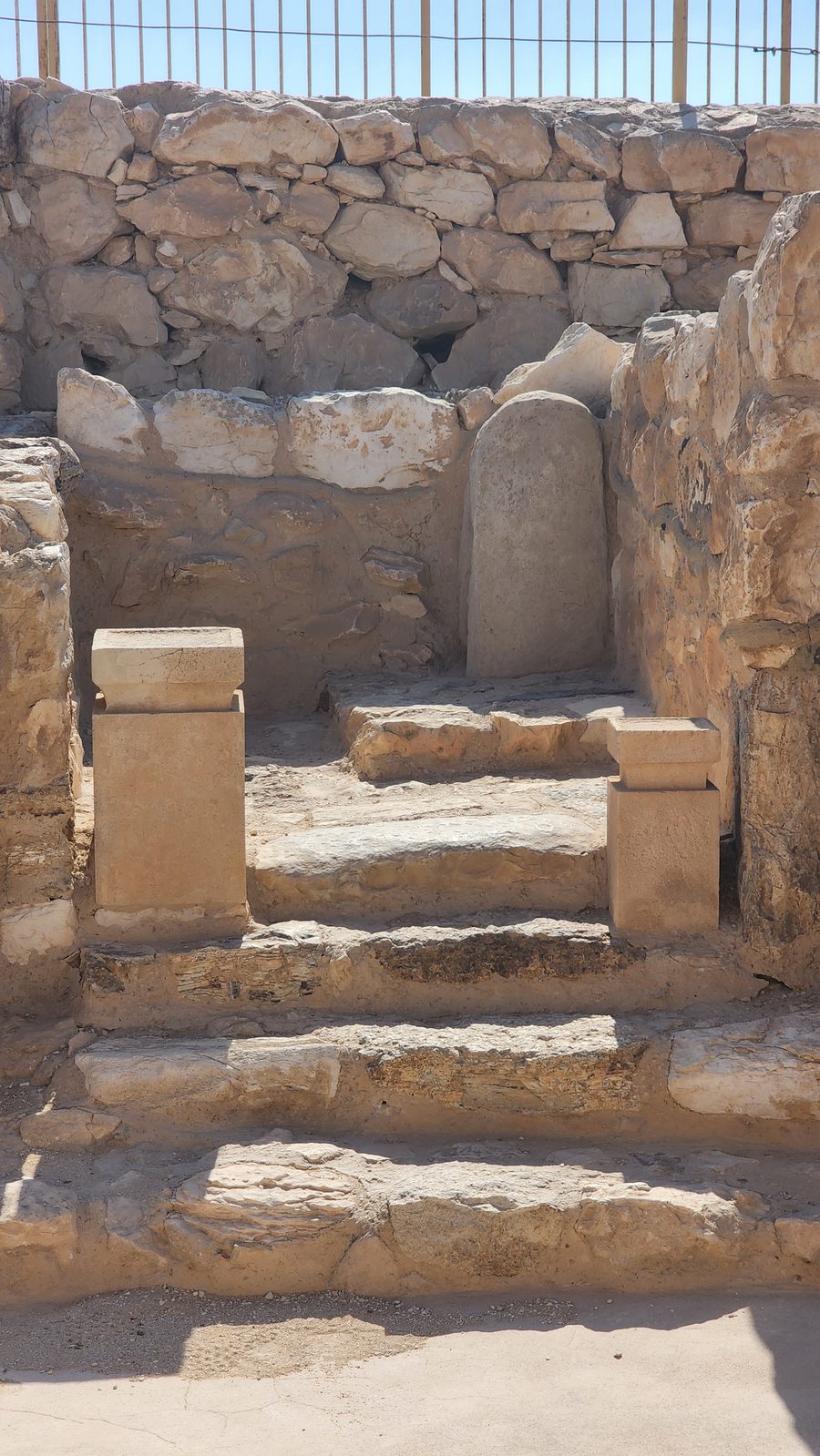
In the northwestern corner of the fortress, archaeologists discovered what remains the most significant find at Tel Arad: a Judahite temple that mirrors the layout of Solomon’s Temple in Jerusalem as described in the Bible. The temple had three parts: an outer courtyard with a large altar for burnt offerings built of unhewn stone (exactly as commanded in Exodus 20:25), a main hall (heikhal), and an inner chamber, the Holy of Holies (dvir), where two standing stones (massebot) were found, possibly representing the presence of God. Two small incense altars flanked the entrance to the Holy of Holies.
The temple at Arad is the only Israelite temple with a Holy of Holies ever found by archaeologists. Its existence raises important questions about Israelite worship before the centralization reforms: was it acceptable, perhaps even normal, for Israelites to worship God at local temples outside Jerusalem?
Cannabis and Frankincense
In 2020, a team of researchers from the Israel Museum and the Volcani Center published a groundbreaking study. Chemical analysis of residue preserved on the two small incense altars at the entrance to the Holy of Holies revealed that one altar contained traces of frankincense mixed with animal fat (to promote evaporation), while the other contained cannabis (Cannabis sativa) mixed with animal dung (to facilitate burning). The cannabis included THC, CBD, and CBN, confirming that it was a psychoactive strain.
This was the first time cannabis had been identified at any ancient Near Eastern site. The researchers concluded that the cannabis was burned deliberately as part of the cultic rituals, likely to induce an altered state of consciousness among the worshippers or priests. The frankincense, meanwhile, confirmed that Judah participated in the south Arabian incense trade as early as the 8th century BCE. The discovery transformed the understanding of what actually happened inside an Israelite temple: alongside prayer and sacrifice, there was the deliberate use of psychoactive substances in the service of God.
The Decommissioning
The Arad temple appears to have been deliberately and respectfully shut down rather than violently destroyed. The sacred standing stones were carefully laid on their sides, and the altar was buried. The Bible records two waves of religious reform that centralized all worship in Jerusalem: King Hezekiah in the late 8th century BCE (“He removed the high places, smashed the sacred stones, and cut down the Asherah poles,” 2 Kings 18:4) and King Josiah in the late 7th century BCE (“He broke down the shrines at the gates,” 2 Kings 23:8). Scholars debate which reform led to the closure of the Arad temple, the original excavator Yohanan Aharoni attributed it to Josiah, while later analysis by Ze’ev Herzog suggests it may have been Hezekiah, but the careful manner of the closure suggests reverence, not destruction. The temple was holy; it was simply no longer permitted.
The Eliashib Letters
Over 200 ostraca (inscribed pottery shards) were found at the fortress, making Arad one of the richest sources of Hebrew writing from the biblical period. The most famous are the Eliashib ostraca, military correspondence addressed to the fortress commander Eliashib ben Eshiyahu. The letters provide a vivid picture of daily life at a frontier military post: requests for wine and flour rations, instructions regarding the movement of troops, and dealings with the “Kittim”, likely Greek mercenaries serving in the Judahite army. One ostracon mentions “the house of YHWH,” possibly referring to the temple at the site or to the Temple in Jerusalem. Together, the letters read like dispatches from a border garrison on the edge of the known world, which is exactly what Arad was.
Visit with Hoshen Tours
Tel Arad and its unique Israelite temple are essential stops for anyone interested in biblical archaeology. The temple, a rare example of a sanctioned Israelite worship site outside Jerusalem, raises fascinating questions about religious practice in the biblical period. Hoshen Tours explains the significance of the finds and walks visitors through the reconstructed temple and the impressive Bronze Age city below. Combine it with Tel Be’er Sheva, Negev Bedouin hospitality, the Makhteshim, and the Nabatean ruins at Avdat.
Explore Our Tour Collection
Ready to experience Israel in true colors?
Plan Your TourPrivate tours designed around your interests, schedule, and pace.