


Call us today!
+1-917-9055850

Magazine
Beneath the Church: What Science Found at the Tomb of Jesus
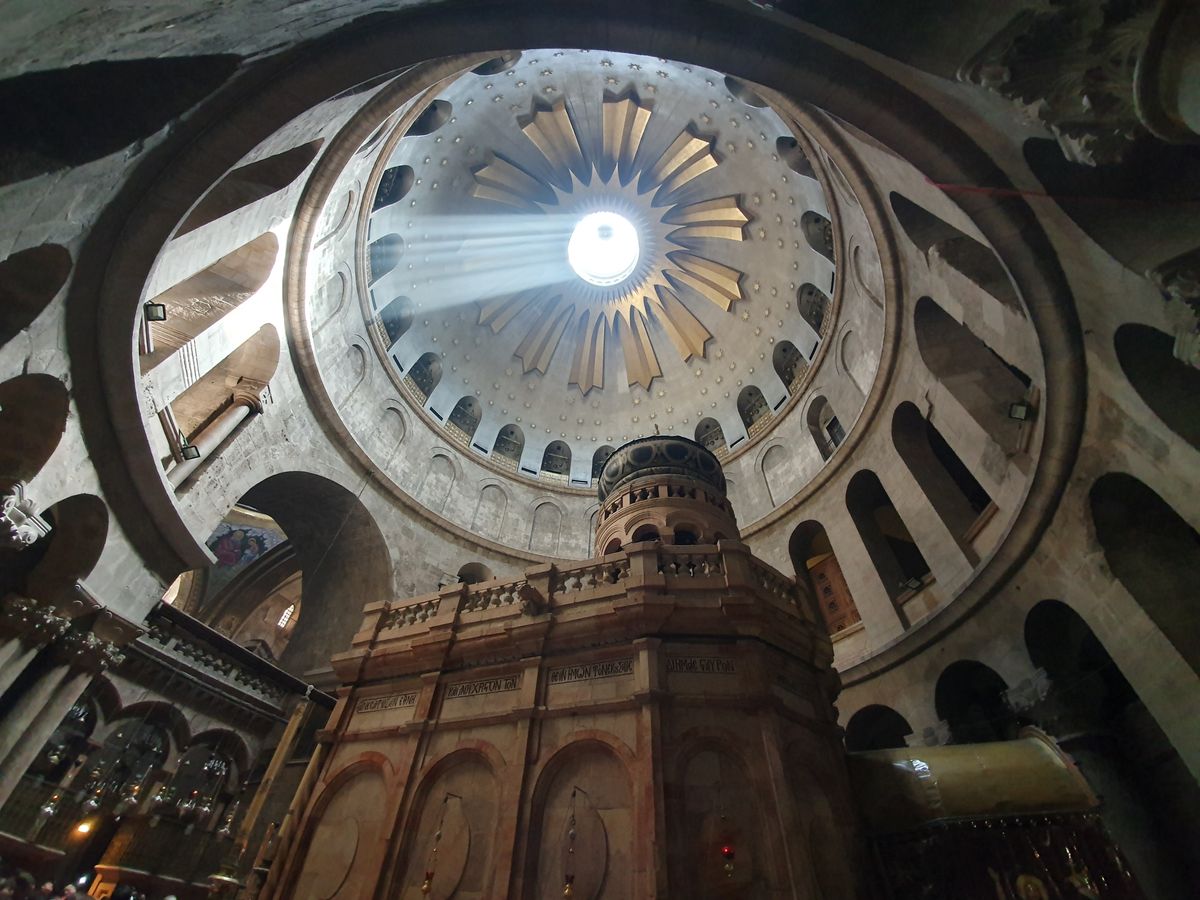
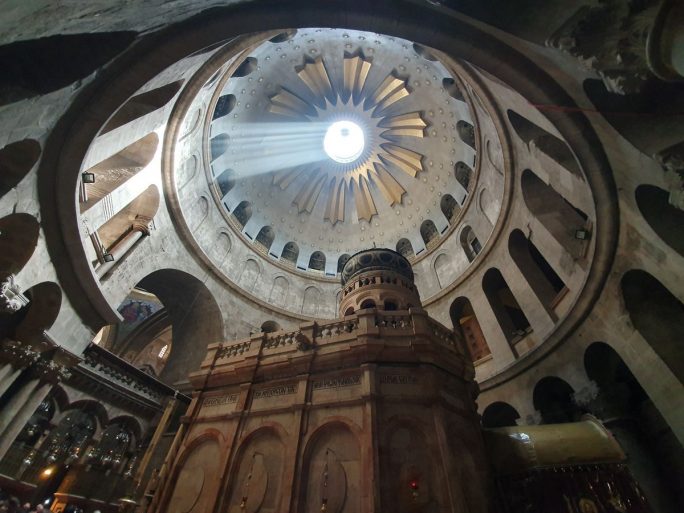
In October 2016, for the first time in centuries, the marble slab covering the traditional burial place of Jesus Christ was pulled back. In 2025, archaeologists announced they had found traces of an ancient garden beneath the church floor, with olive trees and grapevines growing where the Gospels said they would. Two scientific investigations, nine years apart, and between them a story of stone, soil, and the slow, patient work of understanding the most sacred site in Christianity.
The marble slab covering the burial bed inside the Edicule, the small shrine at the heart of the Church of the Holy Sepulchre, had not been moved since at least 1555. Some believed it had not been disturbed since the Crusader period. Beneath the marble, no one knew for certain what remained of the original rock-cut tomb.
In 2016, with the agreement of the three major religious communities that hold primary custodial rights in the church (the Greek Orthodox, the Roman Catholics, and the Armenian Apostolic, who share the space alongside three smaller communities: the Copts, the Ethiopians, and the Syriac Orthodox), a team from the National Technical University of Athens, led by Professor Antonia Moropoulou, began a $4 million restoration of the Edicule. The project was documented by National Geographic, and when the moment came to lift the marble slab, the world was watching.
“The marble covering of the tomb has been pulled back, and we were surprised by the amount of fill material beneath it,” said Fredrik Hiebert, archaeologist-in-residence at the National Geographic Society. Beneath layers of fill, the team found a second, broken grey marble slab with a small cross etched into its surface, believed to date to the 12th century and likely placed there by Crusaders. And beneath that, after 60 continuous hours of work, they reached the original limestone burial bed. It was intact.
The grey-beige limestone surface, roughly 3 by 5 feet, was the rock on which, according to Christian tradition, the body of Jesus was laid after the crucifixion: “Joseph took the body, wrapped it in a clean linen cloth, and placed it in his own new tomb that he had cut out of the rock” (Matthew 27:59-60). For the first time in centuries, that rock was visible.
The restoration team took mortar samples from between the original limestone surface and the marble slab that covered it. Two independent laboratories, the Laboratory of Materials Science at the National Technical University of Athens and the Laboratory of Archaeometry at the University of the Peloponnese, analyzed the samples using optically stimulated luminescence (OSL), a technique that determines when quartz sediment was most recently exposed to light.
The result: the mortar was dated to approximately 345 CE.
The significance of this date is hard to overstate. Historical records tell us that the Roman Emperor Constantine’s mother, Helena, traveled to Jerusalem around 326 CE and identified the site of the crucifixion and burial. Constantine ordered the pagan temple that the Emperor Hadrian had built over the site demolished and a grand church constructed in its place. The Martyrium, the original Church of the Holy Sepulchre, was dedicated in 335 CE.
The mortar date of 345 CE falls squarely within the Constantinian period. It means that the marble slab was placed over the burial bed within a decade or two of the church’s construction, and that the tomb identified by Helena in 326 CE is the same tomb that pilgrims visit today. Before this test, the earliest physical evidence at the tomb dated to the Crusader period, over a thousand years later. The mortar dating pushed the confirmed history of the site back by seven centuries, connecting the modern church directly to the decisions of Rome’s first Christian emperor.
Nine years after the tomb was opened, a different team made a different kind of discovery. Professor Francesca Romana Stasolla of Sapienza University in Rome had been leading excavations beneath the church floor since 2022, with permission from all three religious communities. It was the most extensive archaeological excavation at the Church of the Holy Sepulchre in nearly 200 years.
What Stasolla’s team found was not a tomb or a relic. It was dirt. Specifically, it was soil that had been cultivated approximately 2,000 years ago, with traces of olive trees and grapevines identified through archaeobotanical and pollen analysis. Low stone walls separated garden plots, demonstrating a deliberate agricultural layout. The site, the team established, had progressed through a clear sequence: it was first a quarry (dating back to the Iron Age, 1200-586 BCE), then transformed into cultivated fields, and finally became a burial ground by the 1st century CE.
“The archaeobotanical findings have been especially interesting for us,” said Professor Stasolla, “in light of what is mentioned in the Gospel of John.”
What the Gospel of John says is this: “At the place where Jesus was crucified, there was a garden, and in the garden a new tomb in which no one had yet been laid” (John 19:41).
A garden. With a new tomb in it. That is exactly what the archaeology now shows: cultivated soil with olive trees and grapevines, transitioning to a burial area, in the 1st century CE, at the precise location where the Church of the Holy Sepulchre stands.
Archaeology does not prove theology. The mortar date of 345 CE does not prove that Jesus rose from the dead. The garden soil does not prove that the crucifixion happened at this specific spot. What they do is something more modest and, in its own way, more remarkable: they confirm that the Church of the Holy Sepulchre stands on a site that was identified as the place of the crucifixion and burial within living memory of the events themselves, and that the physical description in the Gospels, a garden with a tomb, outside the city walls, near the place of execution, matches what the ground actually looked like 2,000 years ago.
The site was a quarry that became a garden that became a graveyard. The Gospel of John, written in the late 1st century CE, described it as a garden with a new tomb. And the archaeology, conducted with 21st-century scientific methods, confirms that description with soil samples, pollen, and stone walls.
For believers, this is confirmation. For skeptics, it is evidence that needs to be weighed. For everyone, it is a reminder that the ground beneath one of the most visited buildings in the world still has secrets to reveal, and that sometimes the most important discoveries are not gold or jewels but ordinary soil that once grew olive trees.
Among the other finds, Stasolla’s team uncovered a circular marble base beneath the Edicule shrine that may be part of Constantine’s original 4th-century structure. Early 5th and 6th century depictions of the church show a circular monument at the tomb, and the newly discovered base may correspond to these descriptions. Further testing is underway to determine the marble’s origin and confirm the identification.
The Church of the Holy Sepulchre is the holiest site in Christianity and one of the most complex buildings in Jerusalem. Six denominations share the church under a fragile arrangement called the Status Quo, and the key to the front door has been held by a Muslim family since the time of Saladin. Walking through the church without a guide can be overwhelming. Walking through it with a guide who understands both the archaeology and the faith transforms the experience.
Hoshen Tours designs Jerusalem itineraries that include the Church of the Holy Sepulchre as a centerpiece, connecting the Edicule, the Golgotha chapel, the Stone of Unction, and the hidden chapels into a journey through the death, burial, and resurrection story. Because this church was built on a garden, and the garden was built on a quarry, and beneath it all is the rock that has drawn pilgrims for seventeen centuries.
The excavations at the Church of the Holy Sepulchre are ongoing, and the findings described in this article reflect the state of research as of May 2026. New discoveries may emerge as the work continues.
Contact Us
Related articles
Tours and Activities
Best Israeli Souvenirs to Bring Home
One of the joys of traveling in Israel is discovering unique products that capture the essence of the land. From…
The Desert Kingdom That Was Never Desolate: Israel and Egypt Through the Ages
The Desert Kingdom That Was Never Desolate: Israel and Egypt Through the Ages Egypt is often imagined as an endless…
The Dead Sea Is Disappearing: What's Happening and Can It Be Saved?
The Lowest Place on Earth Is Getting LowerThe Dead Sea — the lowest point on the surface of the earth,…