



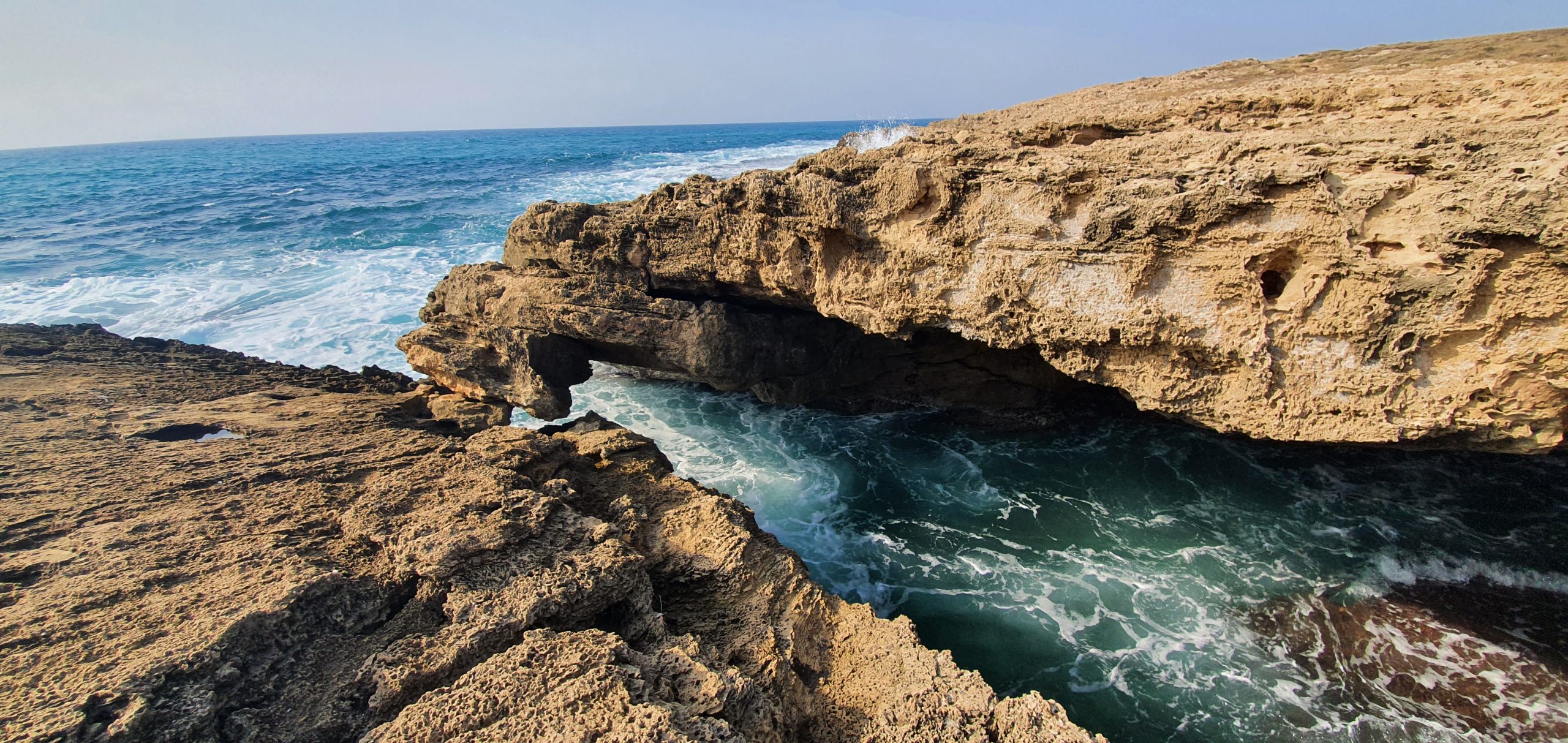
Habonim Beach is a stretch of wild Mediterranean coastline on the Carmel coast, south of Haifa. Managed by the Israel Nature and Parks Authority, the beach is unlike anywhere else on the Israeli coast: no boardwalk, no high-rises, no urban backdrop. Instead, the kurkar (calcareous sandstone) ridge creates a labyrinth of rocky coves, tidal pools, and sheltered bays where the sea meets the stone in forms that feel more like a Greek island than the Levant.
Kurkar Geology and the Carved Coast
The kurkar sandstone that defines Habonim was formed millions of years ago when this region was underwater. Over time, sea-level changes and tectonic movements exposed the sandstone ridge, and the Mediterranean has been carving it ever since. The result is a maze of natural formations: sea caves, rocky outcrops, and narrow passages where the stone has been sculptured by waves and tides. The kurkar landscape is highly porous, giving the rock a distinctive light-tan color and a texture that feels almost organic. This same kurkar ridge extends along much of the Carmel coast, but nowhere is it more dramatically carved and more accessible to visitors than at Habonim.
Nature Reserve Status and Deliberate Non-Development
Habonim Beach is protected as a nature reserve by the Israel Nature and Parks Authority, which means no urban development, no commercial beach clubs, and no intensive infrastructure. This intentional restraint is remarkable in Israel, where most Mediterranean beaches have been heavily developed. The reserve protects not just the beach but the entire ecosystem: the tidal pools with their endemic species, the coastal habitats for migratory birds, and the underwater archaeology zone that extends offshore. The result is one of the last stretches of the Israeli coast that feels genuinely wild.
Blue Cave
At the southern end of the beach, a sea cave carved into the kurkar ridge glows with intense blue-turquoise light when the morning sun enters at the right angle. The Blue Cave (HaMe’ara HaKchula) is reached by wading along the rocky shoreline at low tide and swimming through a narrow entrance into the grotto’s interior chamber. The effect is stunning: the water inside glows like liquid sapphire, a miniature version of Capri’s famous Blue Grotto. The cave is best visited in calm seas and morning light. In rough conditions, the entrance can be dangerous.
Snorkeling and Underwater Archaeology
The waters off Habonim are among the richest for snorkeling on the Israeli coast. The rocky shallows support abundant marine life, and the clarity of the water is excellent on calm days. More significantly, the Dor-Habonim zone is one of the most important underwater archaeological sites in the Mediterranean. The University of Haifa’s Leon Recanati Institute for Maritime Studies has documented dozens of ancient shipwrecks in these waters, spanning from the Bronze Age to the Ottoman period. On calm days with good visibility, snorkelers can sometimes spot ancient artifacts and geological features on the seafloor.
A rusted cargo vessel sits on the rocky reef close to shore, its hull and metal framework partially visible above the waterline depending on the tide. The wreck, a 20th-century vessel that ran aground on the reef, has become a local landmark and snorkeling spot.
The kurkar formations create a network of natural tidal pools teeming with marine life: sea anemones, small fish, crabs, sea urchins, chitons, and colorful algae. The pools are among the best on the Israeli coast for observing Mediterranean biodiversity up close, and the rocky coves create small, semi-private beach areas with calm, shallow water.
Seasonal Conditions and Planning Your Visit
Habonim is best visited between May and October, when seas are calmer and the weather is warm and stable. Winter storms can make the rocky shoreline treacherous and reduce visibility in the water. Tides matter significantly here: many features are only accessible at low tide, and timing your visit with a low-tide window is essential for exploring the Blue Cave and the deepest tidal pools. The beach has minimal facilities, so bring water and sun protection.
Visit with Hoshen Tours
A visit to Habonim Beach pairs beautifully with nearby destinations along your route. Consider combining it with a stop at Tel Dor or Nahal Taninim, both just a short drive away. Many travelers also enjoy exploring Caesarea and Caesarea Aqueduct on the same day, while Ramat HaNadiv offers another worthwhile addition to your itinerary. Your Hoshen Tours guide will craft a seamless route that brings each destination to life with expert commentary and insider knowledge.
Explore Our Tour Collection
Ready to experience Israel in true colors?
Plan Your TourPrivate tours designed around your interests, schedule, and pace.