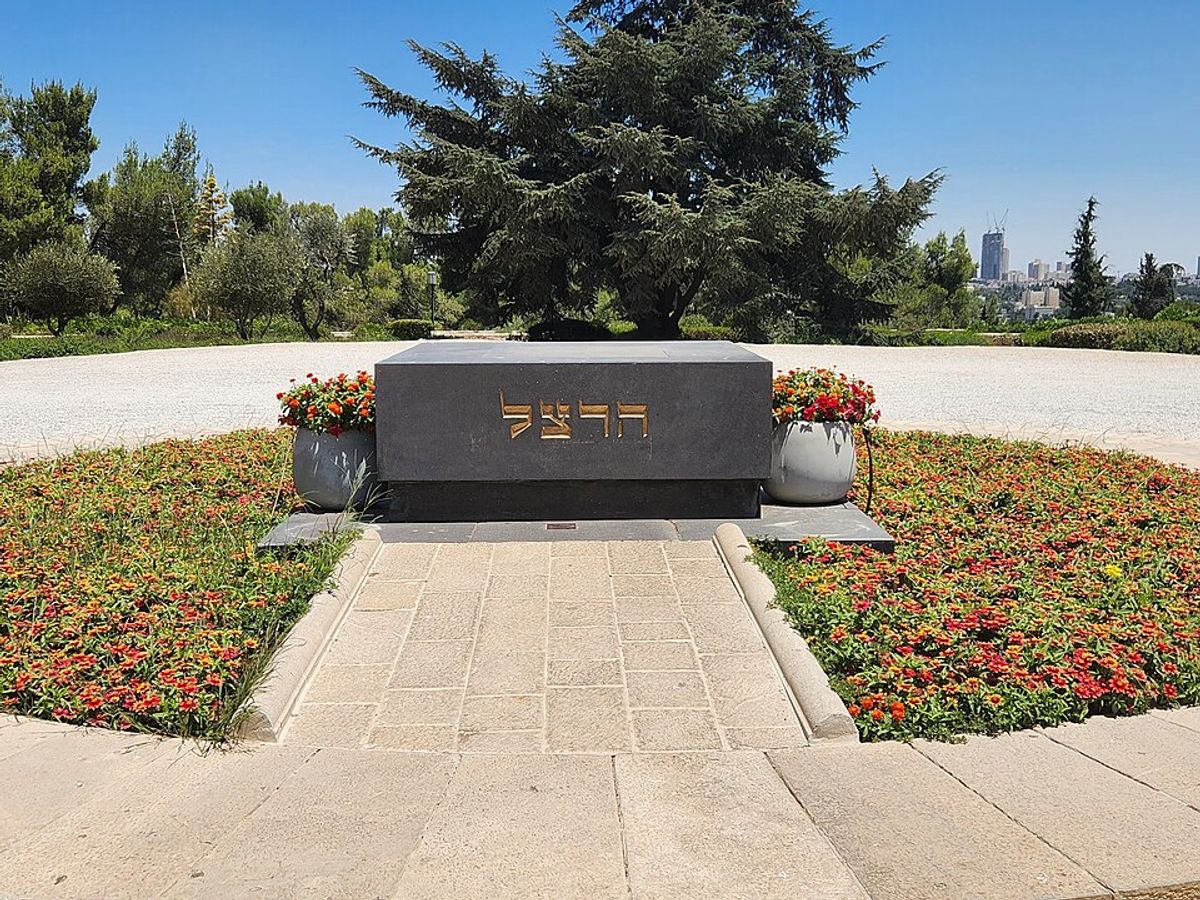
Mount Herzl is Israel’s national cemetery and memorial, the place where the country buries its leaders and honors its fallen soldiers. Named after Theodor Herzl, the founder of modern political Zionism, the mountain occupies a prominent hilltop in western Jerusalem, and a visit here is a journey through the history and values of the State of Israel.
Herzl’s Grave
Theodor Herzl was a journalist and playwright born in Budapest, who grew up in Vienna and who might have lived a comfortable European life had it not been for the Dreyfus affair. In 1894, Captain Alfred Dreyfus, a French Jewish army officer, was falsely convicted of treason in a trial fueled by antisemitism. Herzl covered the trial as a correspondent and watched the Paris crowds chanting “Death to the Jews.” The experience transformed him. In 1896 he published Der Judenstaat (“The Jewish State”), arguing that the only solution to European antisemitism was the establishment of a Jewish homeland. In 1897 he organized the First Zionist Congress in Basel, Switzerland, and wrote in his diary afterward: “At Basel I founded the Jewish State. If I said this out loud today, I would be answered by universal laughter. In five years, perhaps, and certainly in fifty years, everyone will perceive it.”
He died in 1904, at the age of just 44, more than four decades before the state he envisioned would be established. In his will, he asked to be buried beside his father in Vienna until the Jewish people would carry his remains to the Land of Israel. His remains were reinterred on this mountaintop in 1949, one year after the founding of the state. His grave, a simple black stone slab, sits at the highest point of the mountain, and the simplicity of the grave is deliberate: Herzl envisioned a state, not a monument to himself.
The Leaders’ Plots
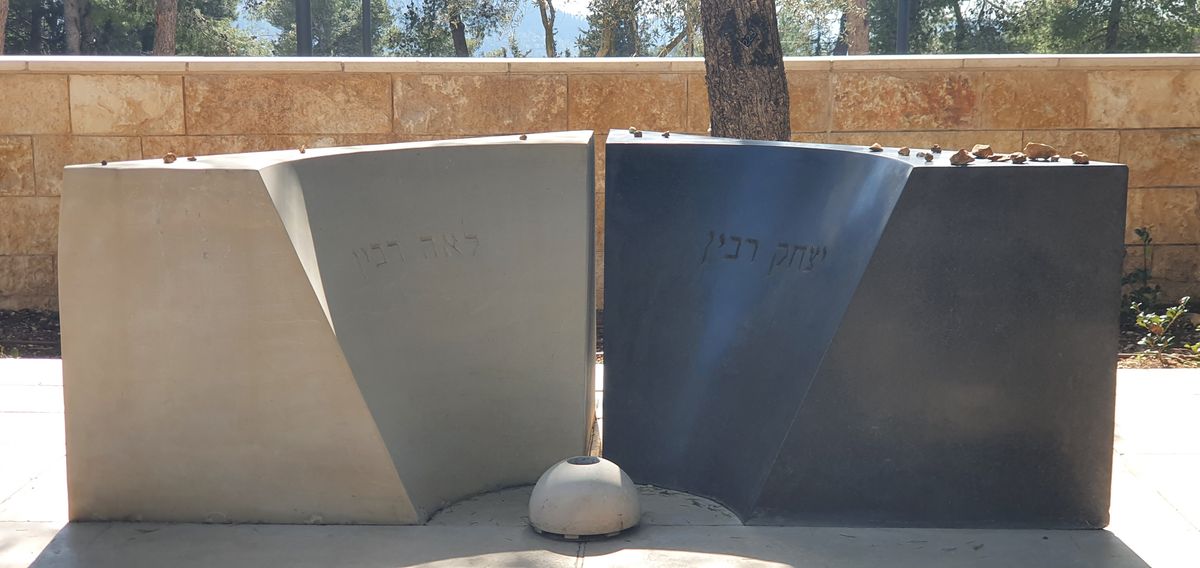
The graves of Israel’s prime ministers and presidents surround Herzl’s plot. Golda Meir, Yitzhak Rabin, Shimon Peres, Levi Eshkol, Yitzhak Shamir, and others are buried here, each grave marked with a simple stone in keeping with Jewish tradition. The graves of Yitzhak Rabin and his wife Leah, side by side, are among the most visited. Rabin was assassinated on November 4, 1995, and his grave became a site of national mourning and reflection. Walking among the graves of the leaders is like walking through a timeline of the state itself. Each name a chapter, each stone a decision that shaped the country.
The Military Cemetery
The military section of Mount Herzl holds the graves of soldiers who fell in Israel’s wars, from the War of Independence in 1948 through every conflict since. The cemetery is arranged in rows of identical white headstones, and the uniformity of the markers creates a visual impact that grows with each row. The quiet here is striking. A weight settles over visitors as they walk the paths between the graves, reading names and dates, each stone representing a life cut short. Among those buried here is Hannah Senesh, the young poet and paratrooper who jumped into Nazi-occupied Europe in 1944 to try to rescue Hungarian Jews and was captured, tortured, and executed at the age of 23. Her poem “Blessed Is the Match” became one of the most recited poems in Israel.
Among the graves that draw the most visitors from North America is that of Michael Levin, a young paratrooper from Philadelphia who grew up attending Jewish summer camps, made aliyah alone at the age of 18, and joined an elite IDF paratrooper unit. When the Second Lebanon War broke out in the summer of 2006, Levin cut short a visit home and flew back to Israel to fight alongside his unit. He was killed in combat in southern Lebanon on August 1, 2006, at the age of 22. Thousands of people, most of whom had never met him, attended his funeral on Mount Herzl. His grave has become a gathering point for lone soldiers and for American Jewish visitors, and his story, of a young man who chose to leave a comfortable life and come to defend a country he believed in, resonates deeply with the North American groups who visit Mount Herzl with Hoshen Tours.
The View from the Summit
The cemetery also holds the graves of soldiers from every war and operation in Israel’s history, from the paratroopers who fell capturing the Old City in 1967 to the soldiers lost in the most recent conflicts. On Yom HaZikaron (Memorial Day), families come to the graves, and the cemetery fills with flowers, candles, and grief. The views from the military cemetery look out across the Jerusalem hills, a landscape of beauty that stands in stark contrast to the losses recorded in the stone. The proximity of the military cemetery to Yad Vashem, which is on the same mountain, is not a coincidence. A walking path, the Connecting Path, established in 2003 on the initiative of Holocaust survivor Yehuda Szternfeld, links the two sites.
The path is lined with approximately thirty milestones that tell the story of the journey from the Holocaust to the founding of the state: the liberation of the camps, the “illegal” immigration ships that brought survivors to Palestine, the pre-state fighting units, and the declaration of independence on May 14, 1948. Walking the path from Yad Vashem to Mount Herzl is walking from destruction to rebirth, from the lowest point in Jewish history to the mountaintop where the state that rose from the ashes buries its leaders and its fallen.
The Herzl Museum
The museum at the entrance to the site tells Herzl’s story through a guided, interactive multimedia experience that takes visitors through his life, from his comfortable Vienna study, through his encounters with world leaders and skeptics, to the dramatic moment at the First Zionist Congress in Basel. The experience recreates the atmosphere of late 19th-century Europe and makes Herzl’s transformation from journalist to visionary leader vivid and personal. The state was founded 51 years after that congress, almost exactly as Herzl predicted.
Visit with Hoshen Tours
Mount Herzl connects the vision of Zionism to its human cost, and Hoshen Tours walks visitors through both dimensions: the graves of the nation’s founders and prime ministers on the upper plaza, and the military cemetery below where thousands of fallen soldiers are buried. The Herzl Museum offers an immersive multimedia experience telling the story of Theodor Herzl’s vision. This is one of the most emotionally powerful sites in Jerusalem. Combine it with Yad Vashem nearby, the Israel Museum, and the Mahane Yehuda market.
Explore Our Tour Collection
Ready to experience Israel in true colors?
Plan Your TourPrivate tours designed around your interests, schedule, and pace.