



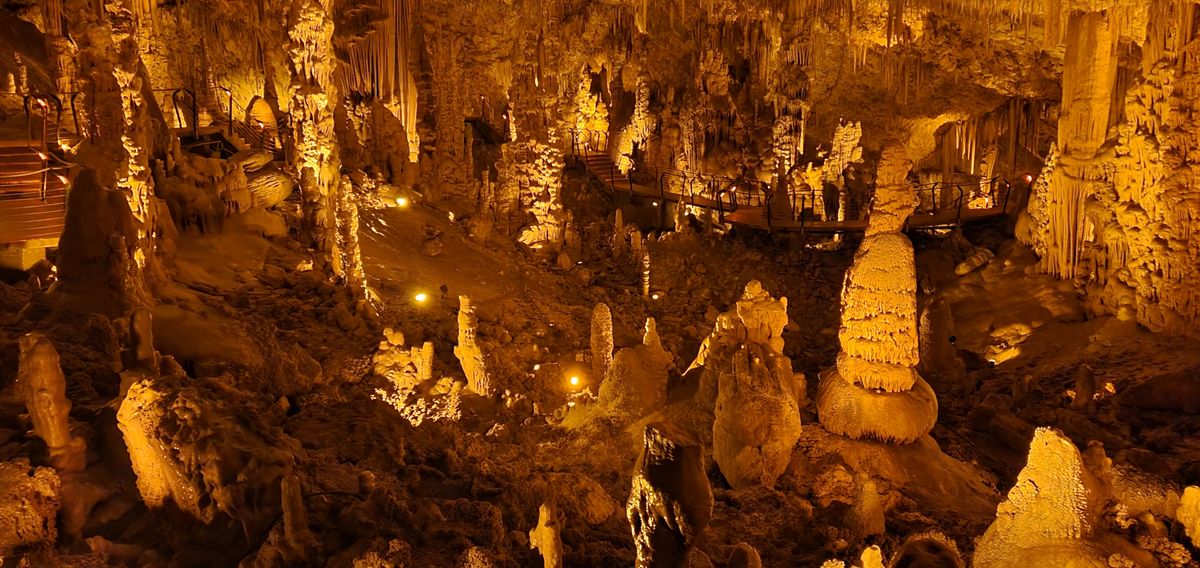
The Stalactite Cave (Soreq Cave, Me’arat HaNetifim) is a spectacular underground world of stalactites and stalagmites in the Judean hills, 20 minutes west of Jerusalem. Discovered accidentally in 1968 during quarrying operations, the cave contains an extraordinary collection of cave formations (speleothems) that have been growing for over 185,000 years, making it one of the finest show caves in the Middle East.
The 1968 Quarry Blast That Revealed the Cave
A dynamite blast in the Hartuv quarry in 1968 broke through the ceiling of an unknown chamber, revealing a pristine cave that had been sealed from the outside world for hundreds of thousands of years. The cave was immediately recognized as significant, and the quarrying was stopped. The Israel Nature and Parks Authority developed the cave as a nature reserve, installing walkways, lighting, and climate controls to protect the delicate formations. The discovery was a stroke of luck: a few meters in either direction, and the blast would have missed the cave entirely, leaving it hidden underground indefinitely. The hole created by the blast is still visible in the ceiling of the cave, now sealed with glass to maintain the internal climate.
Stalactites and Stalagmites
The cave contains stalactites (hanging from the ceiling), stalagmites (rising from the floor), columns (where stalactites and stalagmites have met), curtains (thin, wavy sheets of stone), flowstone, and soda straws (thin, hollow tubes of calcite). Some formations are pure white; others are tinted orange, yellow, or brown by iron and manganese minerals in the water. The variety and density of the formations are remarkable: the cave is relatively small (approximately 5,000 square meters) but packed with features. Guides point out formations that resemble familiar shapes, including one that looks like a snow-capped mountain and another that resembles a cluster of grapes, though the real attraction is the sheer density and variety of the natural sculptures. The carefully designed lighting inside the cave enhances the colors and textures of the formations, creating a dramatic visual experience at every turn.
A Natural Time Capsule
The cave maintains a constant temperature of 22 degrees Celsius and nearly 100% humidity year-round, creating a stable environment that has allowed the formations to develop undisturbed. The formations continue to grow, albeit slowly: stalactites grow at a rate of approximately one centimeter per 1,000 years. The cave’s climate is carefully monitored, and visitor numbers are controlled to prevent damage from body heat and carbon dioxide. Scientists have used the cave’s formations to study past climate conditions in the region, since the chemical composition of each layer of calcite records the temperature and rainfall at the time it was deposited. This research has produced some of the most detailed records of ancient climate in the eastern Mediterranean.
Visit with Hoshen Tours
The Stalactite Cave at Soreq is a natural wonder in the Jerusalem Hills. Hoshen Tours pairs it with the ancient terraces at Sataf, the Crusader spring at Ein Hemed, the biblical landscape reserve at Neot Kedumim, and the nature reserve at HaMasrek Nature Reserve.
Explore Our Tour Collection
Ready to experience Israel in true colors?
Plan Your TourPrivate tours designed around your interests, schedule, and pace.