



Sderot is a city of approximately 30,000 people in the northwestern Negev, one kilometer from the Gaza border. For over 20 years, Sderot has lived under the constant threat of rocket fire, and for most of that time the world barely noticed. But Sderot is not defined by the rockets. It is a city with a vibrant cultural life, a growing college, a diverse immigrant population, and a determination to live normally in the most abnormal of circumstances.
The City of Sderot
Sderot was founded in 1951 as a transit camp (ma’abara) for Jewish immigrants from Iran, Kurdistan, and North Africa. Like many development towns of the 1950s, it struggled with poverty and neglect for decades. But Sderot has produced more than its share of cultural contributions to Israel. The city is known as a birthplace of Israeli rock music: bands like Teapacks (who represented Israel at Eurovision) and musicians like Kobi Oz emerged from Sderot’s working-class neighborhoods. The Sapir Academic College, located in the city, has grown into a respected institution with over 10,000 students. And the Sderot Media Center has become a hub for independent media and community journalism.
The population is a mosaic of Israeli society: Moroccan and Kurdish families from the founding generation, Ethiopian immigrants who arrived in the 1990s, Russian-speaking immigrants, Bedouin families from the surrounding area, and young people who came for the college and stayed for the community. Sderot is small enough that everyone knows everyone, and the shared experience of living under fire has created bonds that outsiders find hard to understand.
Life Under Rockets
Since 2001, thousands of rockets have been fired at Sderot from Gaza. The residents have, on average, 15 seconds to reach a shelter after the “Tseva Adom” (Color Red) warning siren sounds. Fifteen seconds. That is the time between hearing the siren and the impact. It means that every public space in Sderot is designed around the need to reach shelter in 15 seconds. Bus stops are built as reinforced concrete shelters. Playgrounds have shelters built into them, designed to look like colorful caterpillars so children will run toward them rather than away from them. Schools have sheltered corridors. The 15-second reality has shaped the architecture, the daily routines, the psychology, and the childhood of an entire city.
Battle of the Sderot Police Station, October 7, 2023
On the morning of October 7, 2023, Sderot became one of the first targets of the Hamas attack. Dozens of terrorists infiltrated the city, attacking civilians on the streets, in their homes, and in their cars. The Sderot police station, a two-story building near the center of the city, became the site of one of the fiercest battles of the day.
The station was defended by a small force of police officers, led by station commander Chief Superintendent Dvir Arubas. The terrorists attacked with RPGs, grenades, and automatic weapons. The police had handguns and a few rifles. The battle was fierce and chaotic, with fighting room to room and floor to floor. Approximately 11 officers were killed in the fighting. Arubas himself survived the battle. Surviving officers retreated to the roof, where they were eventually rescued by a firefighting crane in the early afternoon.
The terrorists who had seized the building were later eliminated when Israeli forces destroyed the structure with tank fire and a bulldozer. The battle of the Sderot police station became one of the defining stories of October 7: police officers outgunned and overwhelmed, fighting to protect their city at the cost of their lives.
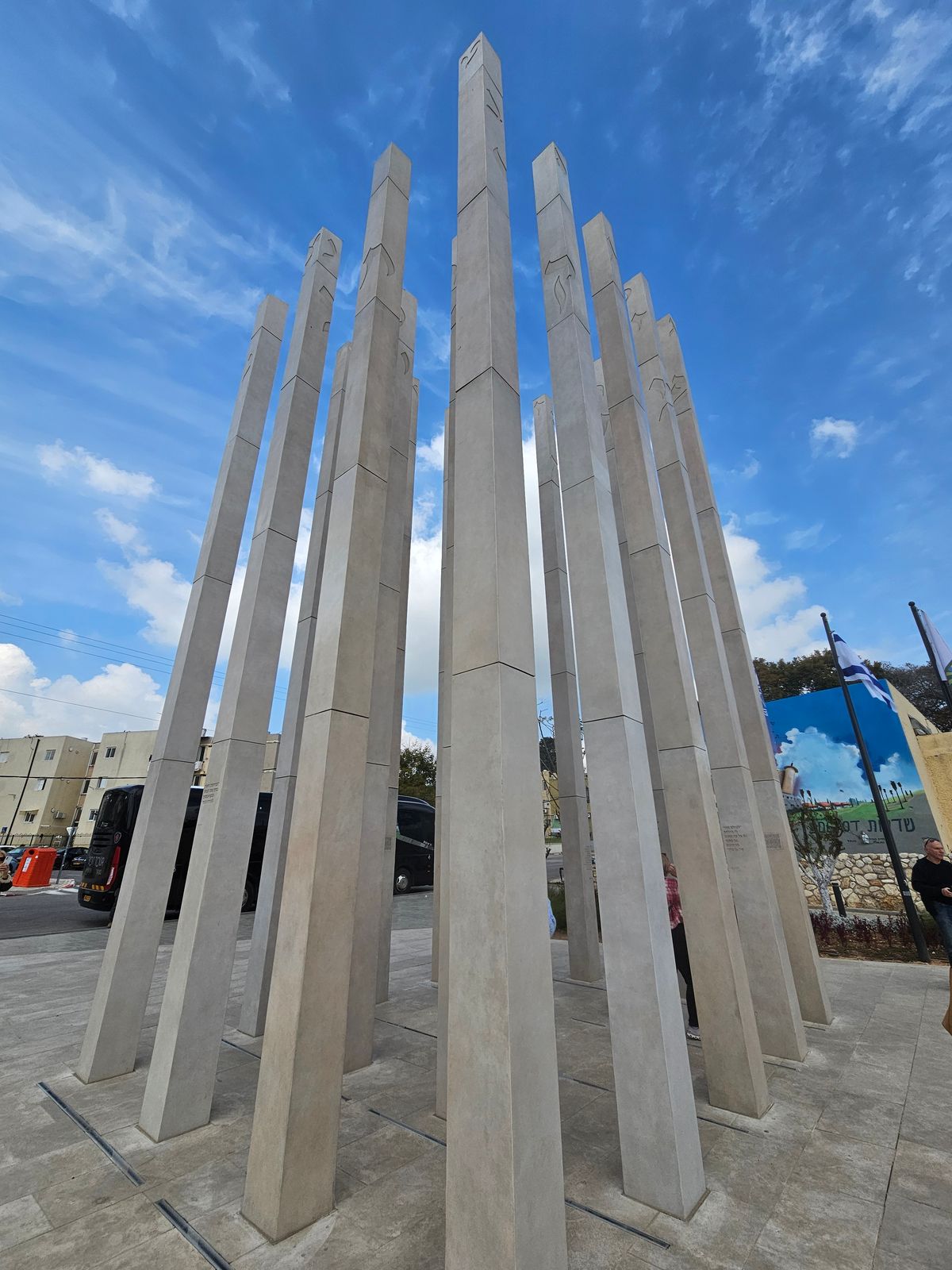
Memorial: 18 Pillars
The memorial at the site of the Sderot police station is built around 18 pillars. The number 18 is not arbitrary: in Hebrew, the number 18 is represented by the letters chet and yod, which spell the word “chai” (חי), meaning “alive” or “life.” The 18 pillars are a declaration: despite everything, we are alive.
The memorial incorporates the concept from the Talmud: “Givilin nisrafin ve’otiyot porchot” (the parchments are burning but the letters are flying upward). The phrase, originally describing the martyrdom of Rabbi Hanina ben Teradion, who was wrapped in a Torah scroll and burned alive by the Romans, has become a metaphor for Jewish resilience: you can destroy the physical form, but the spirit, the letters, the meaning, escapes upward and survives. At the Sderot memorial, the burning parchment is the station, the city, the people who were murdered. The flying letters are the community that survived, rebuilt, and refuses to leave.
The memorial includes the names of the officers and civilians who were killed on October 7, personal objects recovered from the battle, and a space for contemplation. It has become one of the most visited memorials in the Gaza Envelope, and for many visitors it is the moment when the statistics of October 7 become human.
Shelters as Art
One of the most distinctive features of Sderot is the transformation of rocket shelters into art. Local and international artists have painted, sculpted, and decorated the city’s shelters, turning instruments of survival into works of beauty. The caterpillar-shaped playground shelters are perhaps the most famous: structures designed to save children’s lives that look like toys. The tension between the function (shelter from rockets) and the form (a colorful caterpillar) captures something essential about Sderot: the refusal to let fear determine the appearance of daily life.
Visit with Hoshen Tours
Sderot is where the reality of life on the Gaza border is most visible. Hoshen Tours visits with respect and sensitivity, telling the story of a city that has endured more than most people can imagine, and that insists on living, creating, and building despite it all. Hoshen Tours often combines this site with Yad Mordechai, Steel Division Memorial, and Black Arrow Memorial for a memorable day exploring the region.
Explore Our Tour Collection
Ready to experience Israel in true colors?
Plan Your TourPrivate tours designed around your interests, schedule, and pace.