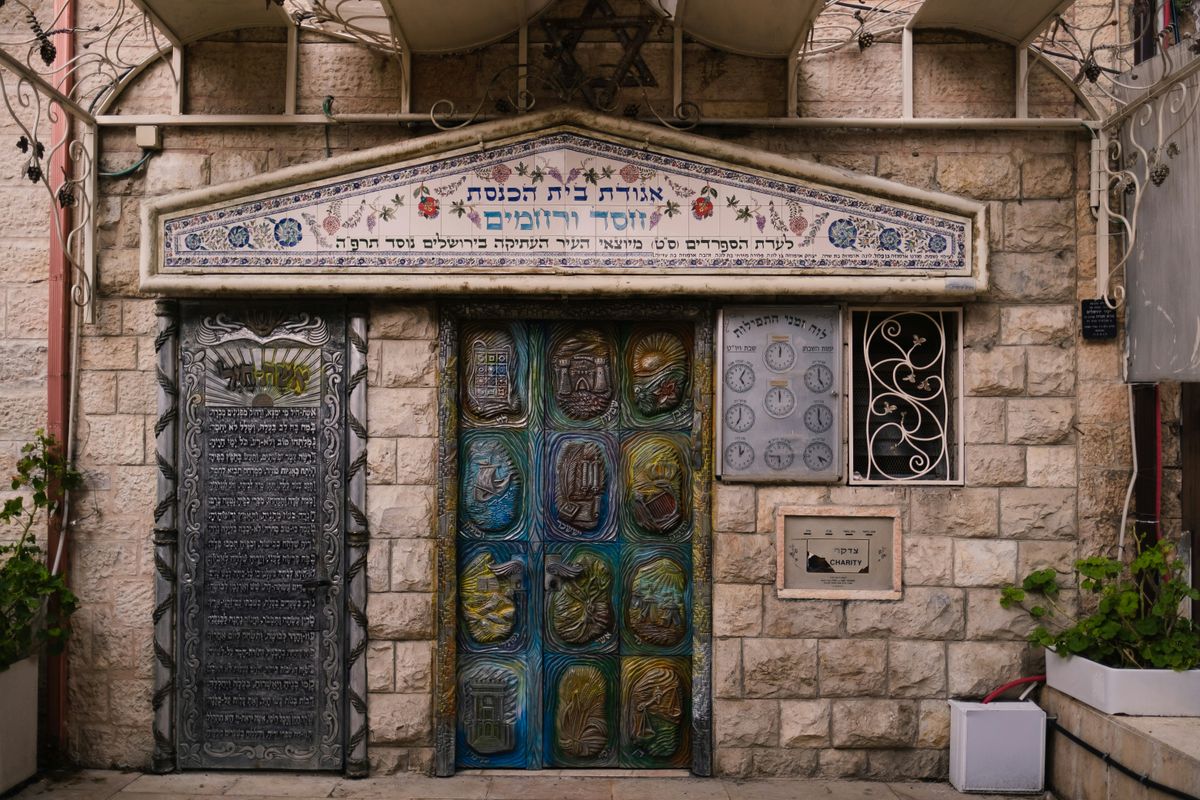
Nachlaot is not one neighborhood but dozens, a tangle of narrow alleys, hidden courtyards, and tiny synagogues pressed together in the heart of Jerusalem between Mahane Yehuda market and the city center. The name means “estates” or “inheritances,” and each of its roughly thirty sub-neighborhoods was once a self-contained world: a courtyard of families from the same community, sharing a well, a synagogue, and a gate that locked at night. Yemenite Jews, Kurdish Jews, Persian Jews, Sephardic families from Aleppo and Istanbul, Ashkenazi immigrants from Poland and Lithuania, all built their small courtyards side by side in the decades after the 1860s, when Jews first began settling outside the Old City walls. Today, Nachlaot is one of the most atmospheric, photogenic, and spiritually intense neighborhoods in Jerusalem, a place where the past is not preserved in a museum but lived in daily.
The Courtyards
The defining feature of Nachlaot is the chatzer, the courtyard. A typical Nachlaot courtyard consists of six to twenty small homes, originally single-room dwellings, arranged around a shared open space. The homes face inward. The exterior walls form a continuous perimeter, with one or two arched gates providing entry from the street. The courtyard was the center of communal life: cooking, laundry, socializing, celebrations, and the daily rhythm of neighbors who shared everything from water cisterns to childcare. Each courtyard typically housed a single ethnic community, which reinforced communal bonds and allowed distinct customs to survive. Many courtyards had their own small synagogue or prayer room, making each one a miniature Jewish village within the city.
Among the earliest courtyards were Ohel Moshe (1883), named after Sir Moses Montefiore and built for poor Jewish families, and Mazkeret Moshe (1883), established for Ashkenazi families. Nachalat Tzion was founded for Yemenite immigrants. Over the following decades, more courtyards appeared: Nachalat Tzion, Zichron Tuvia, Even Yisrael, Nachalat Ya’akov, Shevet Achim, and many others. The architecture is Ottoman-era Jerusalem stone, thick walls, arched doorways, flat rooftops where families slept in summer, and iron grillwork on the windows. Today, many of these courtyards have been lovingly renovated, though some remain accessible only to residents. Walking through Nachlaot means ducking through archways, climbing narrow stairs, and stumbling upon spaces that feel unchanged since the Ottoman period.
The People Who Shaped the Neighborhood
Rabbi Aryeh Levin (1885-1969), known as the Prisoners’ Rabbi, lived on Etz HaChaim (Tree of Life) Street in Nachlaot for decades. Every Shabbat during the British Mandate, he walked to the Central Prison in Jerusalem to visit Jewish underground fighters from the Irgun and Lehi, providing spiritual comfort to men awaiting trial and, in some cases, execution. He became legendary for his compassion and humility. The most famous story about him, recorded in Simcha Raz’s biography A Tzaddik in Our Time, tells of the time he accompanied his wife to a doctor and said, “Doctor, my wife’s foot is hurting us.” He was known for visiting the sick and elderly throughout the neighborhood on foot, crossing communal boundaries between Sephardic and Ashkenazi communities at a time when others rarely did.
President Yitzhak Navon (1921-2015), Israel’s fifth president and the first of Sephardic origin, grew up in the Nachlaot area. His family were Ladino-speaking Sephardic Jews with deep roots in Jerusalem going back generations. The multicultural Sephardic world of Nachlaot shaped him profoundly. In 1970, he wrote Bustan Sephardi (The Sephardic Garden), a musical play that drew on the Ladino culture and Jerusalem Sephardic life he had known as a child. The Banai family, one of Israel’s most famous artistic dynasties, are also rooted in Nachlaot’s world. Persian Jews from Shiraz who settled in Jerusalem, the family produced Yossi Banai the actor, Gavri Banai of the legendary comedy troupe HaGashash HaHiver, and musicians Meir Banai and Ehud Banai, whose songs are steeped in the spiritual atmosphere of Jerusalem’s old neighborhoods.
Bracha Zefira (1910-1990), a singer of Yemenite parentage born in Jerusalem and raised in its old neighborhoods, became one of Israel’s first great vocalists, carried the neighborhood’s musical traditions onto the national stage. David Raziel (1910-1941), commander of the Irgun, was active in Jerusalem during the Mandate years, when Nachlaot’s narrow alleys provided cover for the Jewish underground. He was killed in Iraq during a British military mission at the age of 30.
Seventy Synagogues and the Selichot Nights
Nachlaot contains roughly seventy synagogues, many of them small rooms tucked inside courtyards or residential buildings, serving twenty or thirty worshippers each. Each preserves the specific liturgical customs of its founding community: Kurdish melodies, Moroccan piyyutim, Yemenite Torah chanting, Persian traditions, and Ashkenazi nusach all exist within a few hundred meters of each other. The most famous is the Ades Synagogue on Beer Sheba Street, founded in 1901 by the Syrian Jewish community from Aleppo. Ades is renowned for the Baqashot tradition, an ancient practice of singing liturgical poems set to elaborate maqam melodies (the modal music system of the Arab and Ottoman world) in the predawn hours of Shabbat morning (typically beginning around 3:00-4:00 AM) during the winter months, from Shabbat Bereshit (after Sukkot) through Shabbat HaGadol (before Pesach). The Baqashot at Ades are considered one of the most authentic surviving examples of this Aleppo tradition and attract visitors from across Israel and beyond.
During the Selichot period (the season of penitential prayers asking for forgiveness, recited in the weeks before the Jewish New Year), Nachlaot becomes the most sought-after destination in Jerusalem. Thousands of people stream into the neighborhood to walk from synagogue to synagogue from late evening into the early morning hours, experiencing different communities’ melodies and prayer styles. The extraordinary density of synagogues means you can visit a dozen services in a single evening: Aleppo Selichot at Ades, Yemenite chanting a few doors away, Kurdish traditions around the corner, and Ashkenazi services in between. The narrow alleys, old stone buildings, and candlelit courtyards create an atmosphere that is impossible to manufacture. The Selichot nights have become a cultural event that draws secular Israelis, religious Jews, and tourists alike, and organized tours now guide visitors through the route, explaining the different traditions at each stop.
The Neighborhood Today
Nachlaot sits directly adjacent to Mahane Yehuda market. The two bleed into each other, and walking from the heart of the neighborhood to the bustle of the shuk takes only a few minutes. For generations, market vendors lived in Nachlaot, and many longtime residents still shop at the shuk daily in the old pattern of neighborhood life organized around the marketplace. Since the late 1990s, Nachlaot has undergone significant gentrification. Courtyard homes that were once considered undesirable are now among the most coveted addresses in Jerusalem. The neighborhood has become a magnet for young religious Jews, particularly those drawn to the neo-Hasidic and spiritual renewal movements. Students of Breslov Hasidism, followers of Rav Kook’s philosophy, and devotees of the Carlebach-style prayer movement have made Nachlaot their home. Artists, musicians, and writers have followed, drawn by the beauty of the old stone architecture and the neighborhood’s character. The result is a place that feels like a village within a city: guitar music drifting from rooftops, spontaneous singing in courtyards, bougainvillea climbing over walls, cats everywhere, and a quiet that contrasts sharply with the noise of Mahane Yehuda just meters away.
The walls of Nachlaot tell their own stories. Visitors will notice hand-painted signs, small murals with Kabbalistic imagery, quotes from Psalms stenciled on stone, and above all the ubiquitous Na Nach Nachma Nachman graffiti of the Breslov Hasidic movement. Friday night Carlebach-style services, with their joyful singing and hand-clapping, spill out of courtyard synagogues and draw participants from across the city. The neighborhood’s creative energy is visible in painted doors, ceramic tile work, potted plants crammed into every available space, and the sound of multiple prayer services overlapping on a Shabbat morning, each in a different tradition.
Visit with Hoshen Tours
Nachlaot is a patchwork of tiny courtyards, hidden synagogues, and community ovens that tells the story of Jerusalem’s earliest neighborhoods outside the Old City walls. Hoshen Tours navigates the maze of alleyways, revealing the ethnic enclaves that each immigrant community established. The neighborhood borders Machane Yehuda market to the north, connects to Rehavia to the south, and sits within walking distance of Mishkenot Sha’ananim and the Russian Compound to the east.
Explore Our Tour Collection
Ready to experience Israel in true colors?
Plan Your TourPrivate tours designed around your interests, schedule, and pace.