



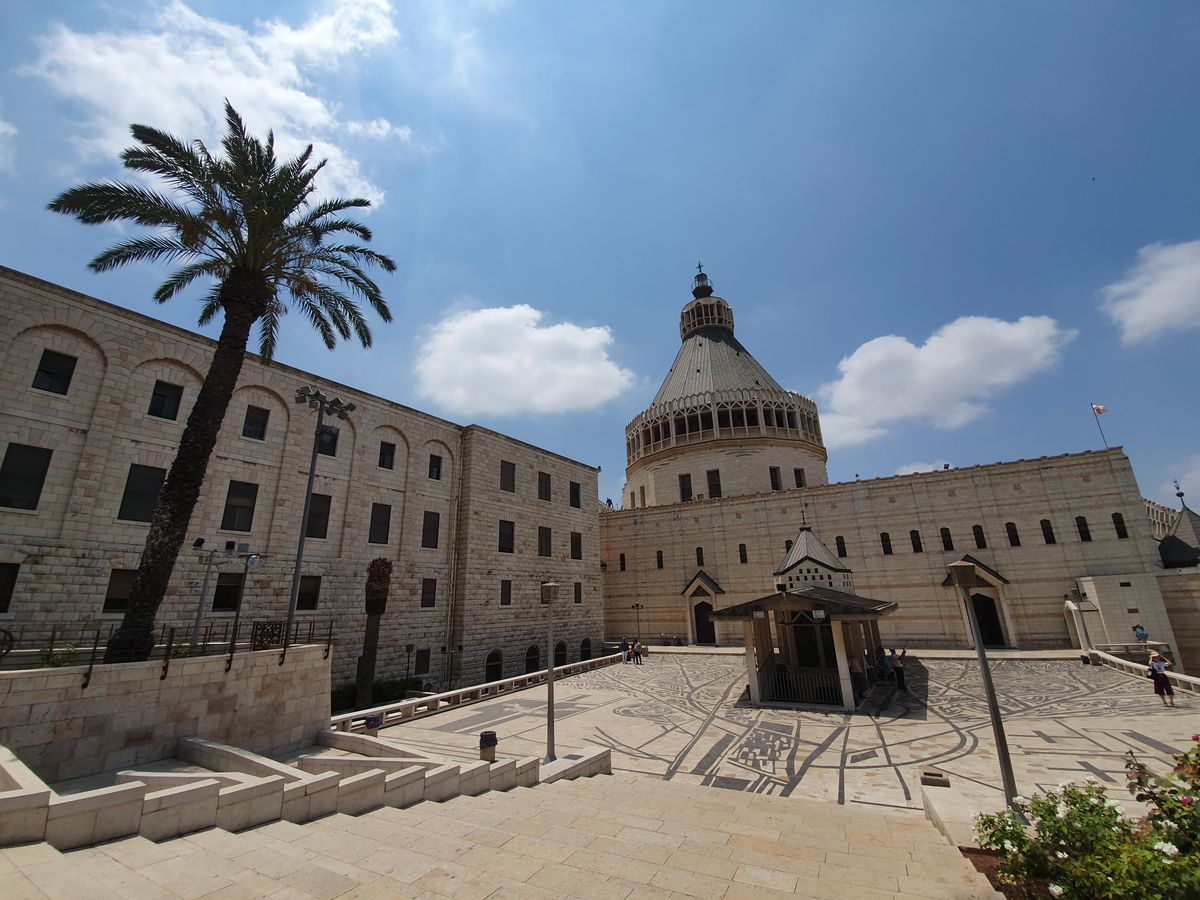
The Basilica of the Annunciation in Nazareth is built over the grotto where, according to Catholic tradition, the angel Gabriel appeared to the Virgin Mary and announced that she would conceive and bear the Son of God. This is where the Christian story begins, not in Jerusalem, not in Bethlehem, but in a cave in a small Galilean village, with a young woman’s answer: “I am the Lord’s servant. May your word to me be fulfilled” (Luke 1:38).
In the first century, Nazareth was a small Jewish village of perhaps 200 people, tucked into a valley in the lower Galilee hills. It was not important. It was not on any major road. When the disciple Nathanael heard that Jesus was from Nazareth, he famously asked: “Can anything good come out of Nazareth?” (John 1:46). And yet this insignificant village became the childhood home of the man who would change the world. According to Christian tradition, Jesus grew up here, learned his father’s trade here, attended the local synagogue here, and drank from the village spring. Today, at the heart of what is now the largest Arab city in Israel, one of the largest churches in the Middle East marks the spot where, according to Christian tradition, the story began.
The Annunciation
Luke 1:26–38 describes the moment. God sent the angel Gabriel to Nazareth, “to a virgin pledged to be married to a man named Joseph.” Gabriel told Mary she would conceive by the Holy Spirit and bear a son named Jesus, who would be called “the Son of the Most High” and whose kingdom would never end. Mary’s response is understood by Christians as the moment of the Incarnation, God becoming human. Everything that follows in the Gospel narrative, Bethlehem, the ministry, the Cross, the Resurrection, begins with this “yes” in this grotto.
The Facade and Courtyard
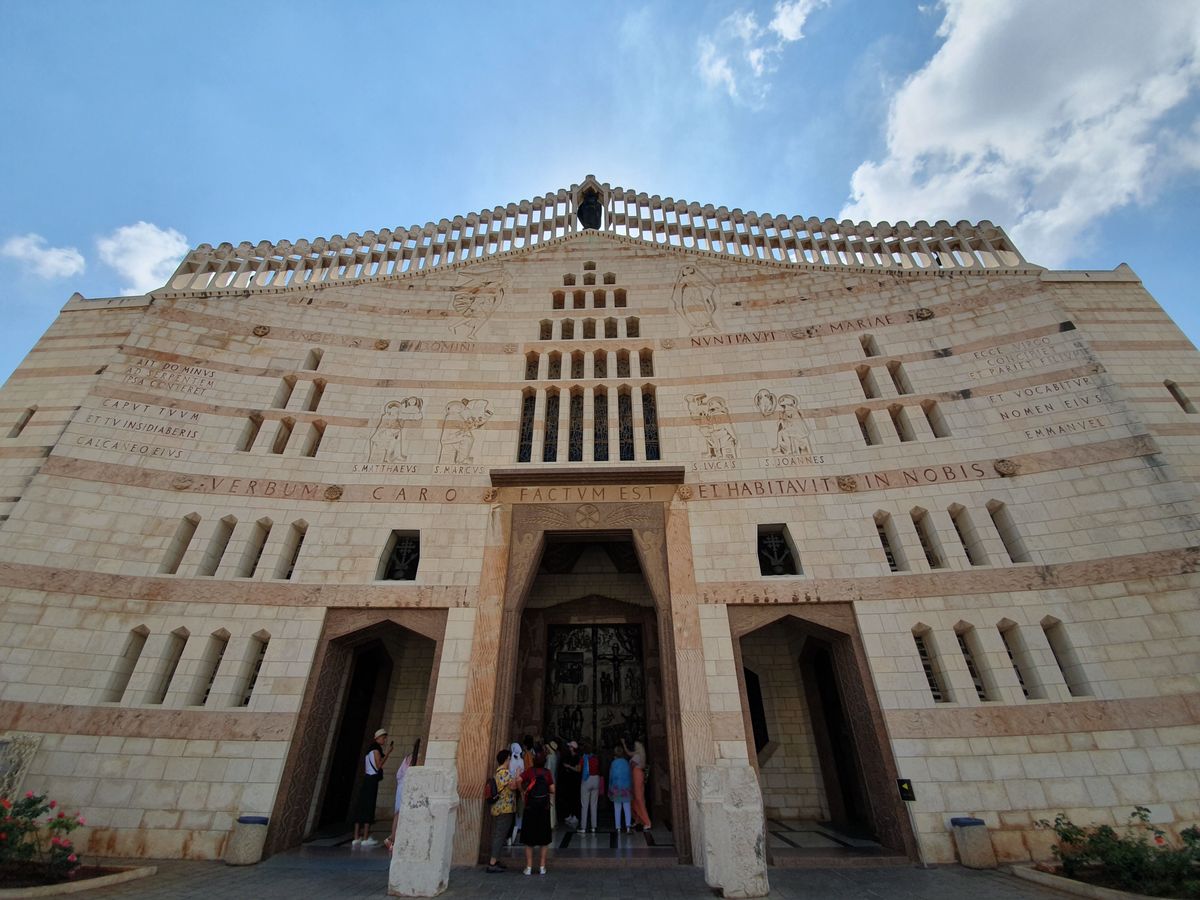
The current basilica was designed by the Italian architect Giovanni Muzio and completed in 1969. The facade tells the story before you enter. Two Latin inscriptions flank the entrance. On one side, Genesis 3:15, God’s punishment of the serpent in the Garden of Eden: “He will crush your head, and you will strike his heel.” Christians read this as the first prophecy of redemption in the Bible: the seed of the woman will defeat the serpent. On the other side, Isaiah 7:14: “Behold, the virgin shall conceive and bear a son, and shall call his name Immanuel”, God is with us. The two inscriptions frame the entrance like bookends of a promise: in Genesis, the announcement that a savior will come; in Isaiah, the announcement that he will be born of a virgin; and inside, in the grotto, the place where it happened.
Above them, a large relief sculpture depicts the Annunciation scene, and the building’s dome, shaped like an inverted lily, the flower associated with Mary, rises 55 meters above the floor, dominating the skyline of Nazareth’s Old City. The courtyard in front of the church is one of the most visited spaces in the city, its walls lined with mosaic and painted panels donated by Catholic communities from around the world, each depicting Mary and the Christ Child in the artistic style and cultural dress of the donating country. The panels transform the courtyard into a gallery of global Christianity. Across the courtyard, the Church of St. Joseph, built over what tradition identifies as Joseph’s carpentry workshop, adds another layer to the site.
The Grotto and Lower Church
The lower level of the basilica is the older, darker, more intimate space, and the spiritual heart of the building. Stairs descend to the Grotto of the Annunciation, a small, rough-hewn cave preserved beneath the modern structure, with an altar and the Latin inscription “Verbum caro hic factum est”, “Here the Word was made flesh.” Around the grotto, the remains of earlier churches are visible: foundations from a Byzantine basilica (5th century) and walls and columns from the grand Crusader cathedral (12th century), which was one of the largest churches in the Holy Land outside Jerusalem. Carved Crusader capitals, among the finest Romanesque sculpture ever found in the Levant, are displayed in a museum adjacent to the basilica. The layers of construction tell the story of more than 1,600 years of continuous worship on this spot, each generation building over the one before, always keeping the grotto at the center.
Upper Church

The upper level serves as the main parish church for the Catholic community of Nazareth, and stepping into it is a dramatic shift from the intimate darkness of the grotto below. The space is vast, the dome, rising 55 meters above the floor, floods the interior with natural light through its crown-shaped opening, which is designed to be visible from across the city.
The walls of the upper church are lined with large mosaic and painted panels donated by Catholic communities from dozens of countries around the world, each interpreting the Virgin Mary and the Annunciation through its own cultural lens. The Japanese panel depicts Mary in a kimono. The Thai panel shows her in traditional Southeast Asian style. The American panel presents a modern, stylized Madonna. The Irish contribution features Celtic knotwork. The panels are a visual argument: the story that began in this grotto has reached every continent, every culture, every artistic tradition on earth. Together, they form one of the most remarkable collections of contemporary religious art anywhere in the world.
The Italian ceramic mural behind the altar, by Salvatore Fiumara, depicts the history of the Church from the Annunciation through the modern era. Above it, the massive dome interior is decorated with a mosaic of the Trinity surrounded by saints and angels. The overall effect is one of light, space, and universality, a deliberate contrast to the small, dark, ancient cave below, as if the architect wanted to show how a moment that happened in a tiny grotto in an insignificant village grew to embrace the entire world.
The upper church is where Nazareth’s living Catholic community worships today, and Mass is celebrated here daily in multiple languages. On Sundays, the church fills with local Arab Christian families, pilgrims, and religious communities, connecting the ancient event in the grotto to the living faith above it.
Visit with Hoshen Tours
The Basilica of the Annunciation is where the Christian story begins. Hoshen Tours visits the grotto, the archaeological layers of the lower church, the Crusader capitals, and the international gallery of the upper church, telling the story of Gabriel’s announcement, Mary’s response, and the 2,000 years of veneration that turned a cave in Nazareth into one of the most important churches in the world.
Explore Our Tour Collection
Explore this site and 65 more in Sacred Steps in the Holy Land
225 pages · The Life, World, and Footsteps of Jesus · Maps, photos, and Scripture references
Ready to experience Israel in true colors?
Plan Your TourPrivate tours designed around your interests, schedule, and pace.