



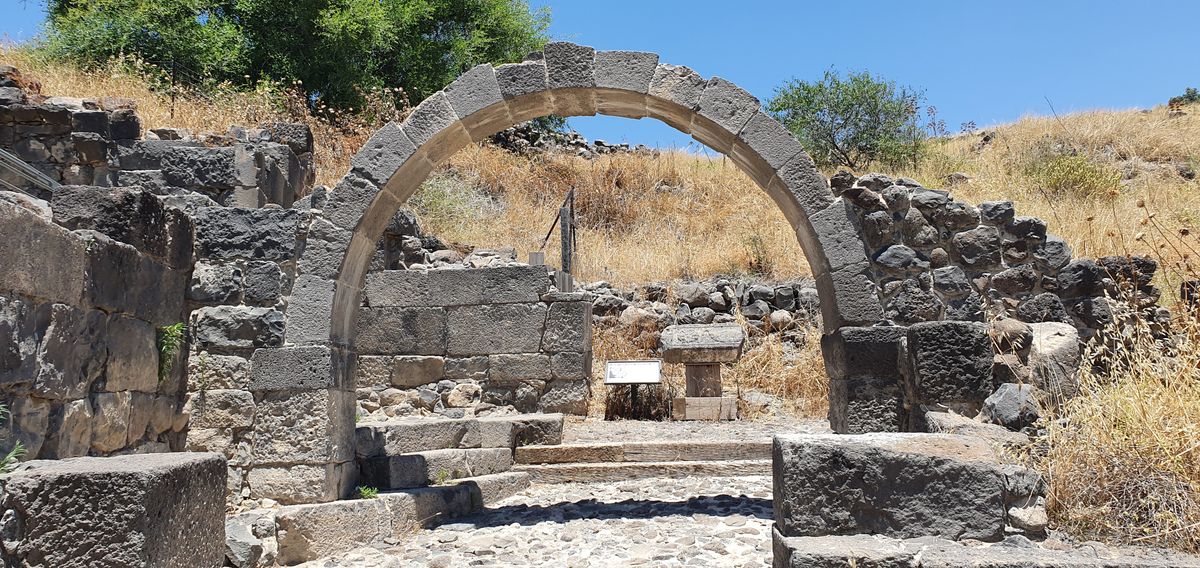
The Golan Heights contains one of the densest concentrations of ancient synagogues in the world. Over 25 synagogues have been identified across the plateau, dating from the first century BCE through the Byzantine period, a span of nearly 800 years of continuous Jewish communal life. Their presence tells a story that many visitors do not expect: for centuries after the destruction of the Temple, a thriving Jewish civilization flourished on this volcanic plateau, building grand public monuments from the hardest stone available.
From the First Century: The Synagogue at Gamla
The oldest synagogue identified on the Golan, and one of the oldest synagogues ever discovered anywhere, is at Gamla. Built in the first century BCE, it predates the destruction of the Temple in 70 CE and stands as evidence that communal prayer in a dedicated building was already established practice during the Second Temple period. Gamla’s synagogue was used simultaneously with the Temple itself, a reminder that synagogues did not arise as a substitute for the Temple but as a complement to it. The building follows an early plan: a rectangular hall with stone benches along the walls and columns supporting the roof, simple and functional, without the elaborate carved decoration that would characterize later Golan synagogues.
The Golan Architectural Style
The synagogues of the Golan share distinctive architectural characteristics that set them apart from Galilean synagogues. They are built entirely of local black basalt, a hard, dark volcanic stone that gives them a somber, powerful appearance. Most follow the basilica plan: a rectangular hall with columns creating a nave and side aisles, stone benches along the walls, and an entrance oriented toward Jerusalem. The facades are the most elaborately decorated element, with carved basalt lintels, doorframes, and window surrounds featuring menorahs, Torah arks, eagles, vine scrolls, lions, and geometric patterns. The quality of the basalt carving is remarkable given the difficulty of working with this brittle stone, craftsmen clearly trained specifically in this demanding medium.
How Many Were Found
Surveys have identified remains of more than 25 synagogues across the Golan, though the exact count depends on how tentative identifications are classified. Not all have been excavated, many are known only from surface remains: a carved lintel half-buried in the ground, a basalt column drum, or foundation walls visible through the grass. Of those systematically excavated, the most significant are the Katzrin synagogue, which has been partially reconstructed and can be visited today; and Umm el-Kanatir in the southern Golan, rebuilt using pioneering 3D scanning and robotic technology that matched each stone to its original position. Others, including Horvat Kanaf, Deir Aziz, and Ein Nashut, remain as atmospheric ruins embedded in the landscape, their carved lintels still visible in the grass and undergrowth.
Why So Many Synagogues?
The concentration of synagogues on the Golan reflects broader historical forces at work throughout the Roman and Byzantine periods. After the destruction of the Temple in 70 CE, Jewish communal and religious life reorganized around the synagogue as its central institution. Communities that had once oriented themselves toward Jerusalem now built their own local sanctuaries. The Golan, relatively isolated and less densely administered than lowland regions, offered space for Jewish communities to establish themselves and prosper. The plateau’s fertile volcanic soil supported agriculture; its distance from major urban centers meant less disruption. Over the following centuries, as the rabbinical academies of the Galilee produced the Mishnah and early components of the Jerusalem Talmud, the Golan’s Jewish communities were part of that same cultural and religious world, linked by trade, travel, and shared scholarship.
What They Tell Us
The synagogues demonstrate that Jewish communities on the Golan were prosperous, well-organized, and deeply committed to their religious identity long after the conventional narrative suggests Jewish life in the land had ended. These were not marginal communities clinging to survival, they were towns wealthy enough to build grand public buildings from the hardest stone on the plateau, decorated with artwork that combined Jewish symbols with Greco-Roman aesthetics. The Golan’s relative isolation also helped preserve these ruins: many sites were abandoned rather than built over, leaving ruins that survived beneath the surface for archaeologists to uncover. Most of the synagogues flourished until the devastating earthquake of 749 CE, which destroyed many of them simultaneously and effectively ended the ancient Jewish presence on the Golan.
Visit with Hoshen Tours
Hoshen Tours visits the reconstructed synagogue at Katzrin and the rebuilt Umm el-Kanatir, and points out the remains of unexcavated synagogues visible from the roadside, carved lintels and basalt columns emerging from the grass, waiting for the archaeologists who may never come. Seeing these sites together gives visitors a sense of how widespread and rooted Jewish life on the Golan once was, not a single impressive ruin but a pattern repeated across an entire landscape.
Nearby destinations worth combining with this stop include Gamla and Safed. Hoshen Tours often combines this site with Mitzpe Gadot, Mitzad Ateret, and Yehudiya for a memorable day exploring the region.
Explore Our Tour Collection
Ready to experience Israel in true colors?
Plan Your TourPrivate tours designed around your interests, schedule, and pace.