



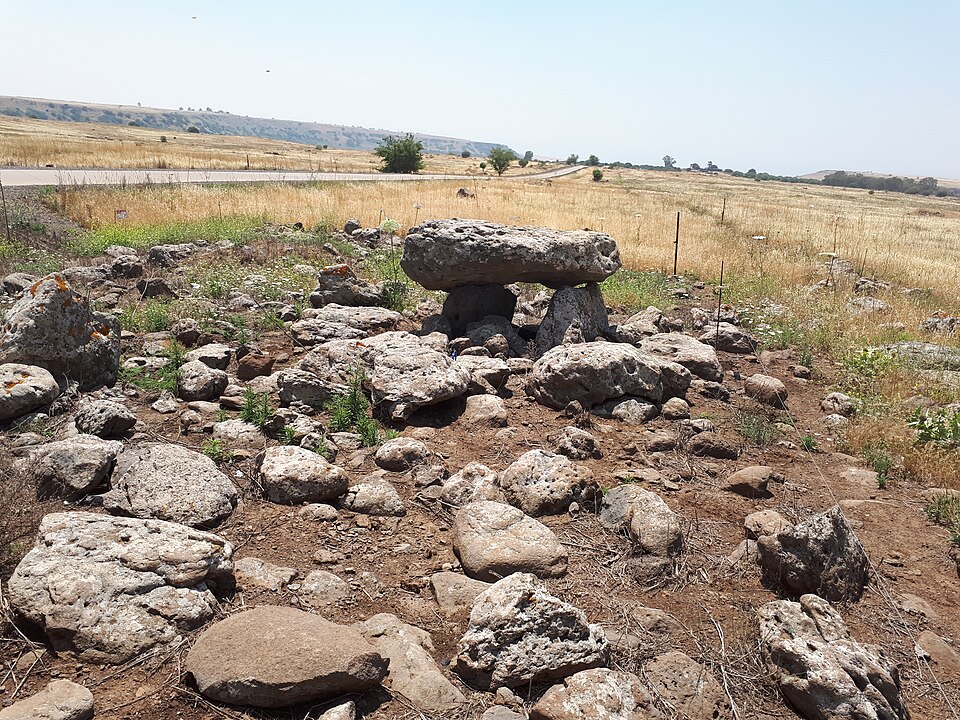
 landscape of the Golan Heights, thousands of stone structures known as dolmens stand as monuments to a civilization that left no written record. These megalithic burial chambers, built from massive basalt slabs, date to the Intermediate Bronze Age (approximately 2300-2000 BCE) and represent one of the largest concentrations of dolmens anywhere in the world. Over 5,000 dolmens have been documented on the Golan alone, with many more in the Galilee, the Jordan Valley, and across the Levant. Who built them and why remains one of the great unsolved questions of Near Eastern archaeology.
What Is a Dolmen?
A dolmen is a type of megalithic structure typically consisting of a large flat capstone supported by two or more upright stones, creating a chamber beneath. The word comes from Breton (the Celtic language of Brittany) and means “stone table,” which describes their appearance. On the Golan, the dolmens are constructed from local basalt, and the capstones can weigh several tons. Many dolmens are surrounded by stone tumuli (cairns) that originally covered the structure, though erosion and centuries of stone-robbing have exposed most of them. The chambers inside frequently contained burials, sometimes multiple individuals, along with pottery, jewelry, and weapons that help archaeologists date the sites.
The Golan Dolmen Fields
The concentration of dolmens on the Golan is remarkable. Major dolmen fields can be found near Gamla, on the Daliyot Plateau, around Shamir, and in the area of Kibbutz El Rom. Some dolmen fields contain hundreds of structures spread across hillsides and plateaus. The largest dolmens have capstones weighing over 50 tons, raising the question of how a prehistoric society organized the labor and engineering to move and place such massive stones. Recent excavations led by Gonen Sharon of Tel Hai College at the Shamir Dolmen (discovered in 2012) revealed something unprecedented: carved decorations on the ceiling of the burial chamber. These carvings, the first rock art found inside a Levantine dolmen, show a series of lines forming geometric patterns. The Shamir Dolmen’s capstone weighs approximately 50 tons, making it one of the largest in the region.
Who Built Them?
The builders of the dolmens left no inscriptions and no settlements that can be definitively linked to the structures. The Intermediate Bronze Age on the Golan was a period of pastoral, semi-nomadic societies, and the dolmens may represent the only permanent structures these communities built, suggesting that burial and ancestor veneration were central to their culture. The sheer number of dolmens and the effort required to build them indicate an organized society with the ability to mobilize significant communal labor. Some scholars have suggested connections to similar megalithic traditions in Europe, India, and East Asia, though direct links are difficult to establish.
Og of Bashan and the Giants
The Bible describes the Bashan region (the Golan Heights) as the land of giants. Og, king of Bashan, was “the last of the Rephaim,” and Deuteronomy 3:11 describes his enormous bed (or sarcophagus): “His bed was decorated with iron and was more than nine cubits long and four cubits wide.” Jewish and early Christian tradition connected Og’s giants to the mysterious stone builders whose massive dolmens dot the landscape. The connection is not archaeological, but it is evocative: standing among these massive stone structures, built by people whose identity has been lost to time, it is easy to understand why ancient travelers imagined that only giants could have moved such enormous stones.
Walking Among the Dolmens
Visiting a dolmen field on the Golan is unlike any other archaeological experience in Israel. There are no ticket booths, no visitor centers, no roped-off areas. The dolmens stand in open fields of wild grass and basalt boulders, scattered across hillsides grazed by cattle. In spring, the fields are green and covered with wildflowers. In summer, the basalt absorbs the heat and the landscape turns golden. The silence is striking. Walking from dolmen to dolmen, ducking under capstones, peering into dark chambers that have been empty for four thousand years, visitors encounter a past that offers no answers, only questions.
Visit with Hoshen Tours
The dolmens are best visited as part of a Golan Heights itinerary. Hoshen Tours includes the dolmen fields near Gamla and the Daliyot Plateau, combining the prehistoric structures with the natural landscape of the Golan, including stops at Katzrin Ancient Village and other Golan highlights. Standing among these ancient stone monuments, surrounded by wild grasses and basalt boulders, visitors encounter a mystery that archaeology has only begun to unravel.
Ready to experience Israel in true colors?
Plan Your TourPrivate tours designed around your interests, schedule, and pace.