



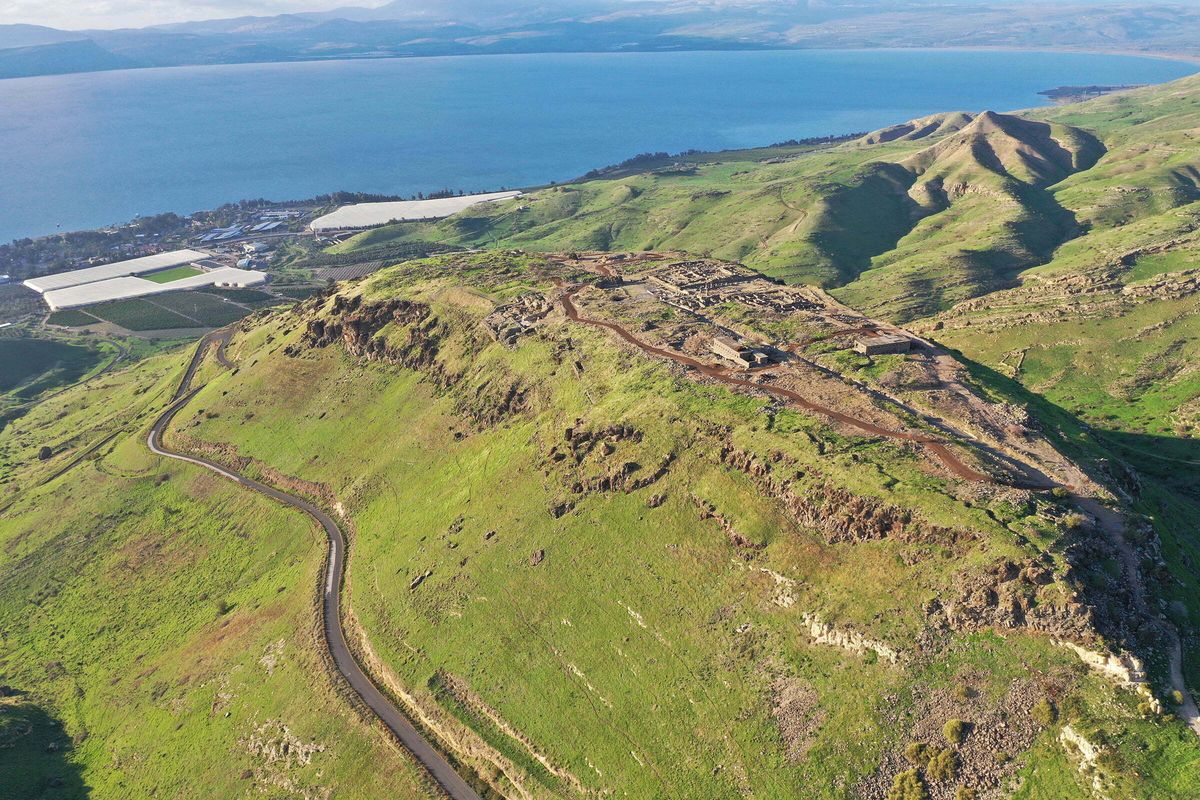
On a flat-topped mountain overlooking the eastern shore of the Sea of Galilee sits one of the most impressive and least visited archaeological sites in Israel. Hippos, known in Hebrew as Susita (both names mean “horse”), was a major Greco-Roman city that thrived for over a thousand years before being destroyed by an earthquake in 749 CE. The ruins are extensive, the views are extraordinary, and on most days, you will share them with nobody but the wind.
A City of the Decapolis
Hippos was one of the ten cities of the Decapolis, a league of Greco-Roman cities in the eastern Mediterranean that included Damascus, Philadelphia (modern Amman), and Scythopolis (Beit She’an). Founded in the 3rd century BCE, Hippos was a center of Hellenistic culture in a region that was otherwise predominantly Jewish, and the tension between the city and its Jewish neighbors is documented in both historical sources and archaeological evidence.
The city was laid out on a classic Roman grid, with a main street (the decumanus) running east-west across the mountaintop, flanked by columns, shops, and public buildings. At the center, a forum served as the civic heart of the city. Temples, a basilica, a cathedral, and bathhouses filled out the urban landscape. For a city perched on a mountain in the Golan Heights, Hippos was remarkably sophisticated.
Saddle and the Climb
Reaching Susita requires a hike up a steep path from the shore of the Sea of Galilee or a drive to the saddle that connects the mountain to the Golan plateau. The climb is part of the experience. As you ascend, the lake drops away below, and by the time you reach the summit, the 360-degree panorama includes the entire Sea of Galilee, Tiberias on the opposite shore, the Galilee hills to the west, and the Golan Heights rolling away to the east. The isolation of the mountaintop, surrounded by sky and water, explains why a city was built here and why it feels so powerful even in ruins.
Seven Churches
After the Roman period, Hippos became an important Christian center. Archaeologists have uncovered no fewer than seven churches within the city walls, each with its own architectural character and several with well-preserved mosaic floors. The most spectacular discovery was a mosaic depicting the baskets of bread and fish, echoing the Gospel miracle tradition associated with the nearby western shore, a direct reference to the miracle that took place on the opposite shore of the Sea of Galilee, visible from the church where the mosaic was found.
The churches span the Byzantine period and reflect the wealth and devotion of the Christian community that lived here. The Northwest Church, the Northeast Church, and the Cathedral are the most extensively excavated, and the quality of their mosaics, architectural details, and liturgical furnishings indicates a city of considerable importance in the Christian world of late antiquity.
Mask of Pan
Among the most striking finds at Susita is a bronze mask of the god Pan, discovered in one of the Roman-era buildings. The mask, with its wild hair and impish expression, is a reminder that before Hippos became a Christian city, it was a pagan one. The presence of Pan at Susita connects it to the broader cult of Pan in the region, centered at nearby Banias (Paneas) at the foot of Mount Hermon.
Earthquake of 749 CE
On January 18, 749 CE, a massive earthquake struck the region, destroying cities across the Galilee and the Golan. Hippos was devastated. Buildings collapsed, walls fell, and the city was abandoned virtually overnight. The earthquake was so destructive that the city was never rebuilt, and the ruins were left on the mountaintop, slowly buried by centuries of soil and grass.
The sudden destruction is, paradoxically, what makes Hippos such a valuable archaeological site. Like Pompeii, the city was frozen in time, with its buildings, streets, and artifacts preserved in the moment of catastrophe. Excavations have uncovered objects in their original positions, giving archaeologists an unusually detailed picture of daily life in a Byzantine-era city.
Ongoing Excavations
The University of Haifa has been excavating Susita since 2000, and the site continues to produce remarkable discoveries each season. The combination of a dramatic setting, rich archaeological layers, and the ongoing nature of the excavation makes Susita one of the most exciting archaeological sites in the country. Visitors who come here are not visiting a finished museum. They are walking through a city that is still being uncovered.
Visit with Hoshen Tours
Hippos/Susita is a hidden gem of the Golan Heights. Hoshen Tours includes it in itineraries that combine the archaeological wonders of the region with the Sea of Galilee, the wineries, and the natural beauty of the southern Golan. Because some ruins speak louder in silence. And Susita, on its mountaintop above the Sea of Galilee, has been waiting 1,300 years for someone to listen.
Nearby destinations worth combining with this stop include Bethsaida, Gamla, and Katzrin Ancient Village.
Ready to experience Israel in true colors?
Plan Your TourPrivate tours designed around your interests, schedule, and pace.