



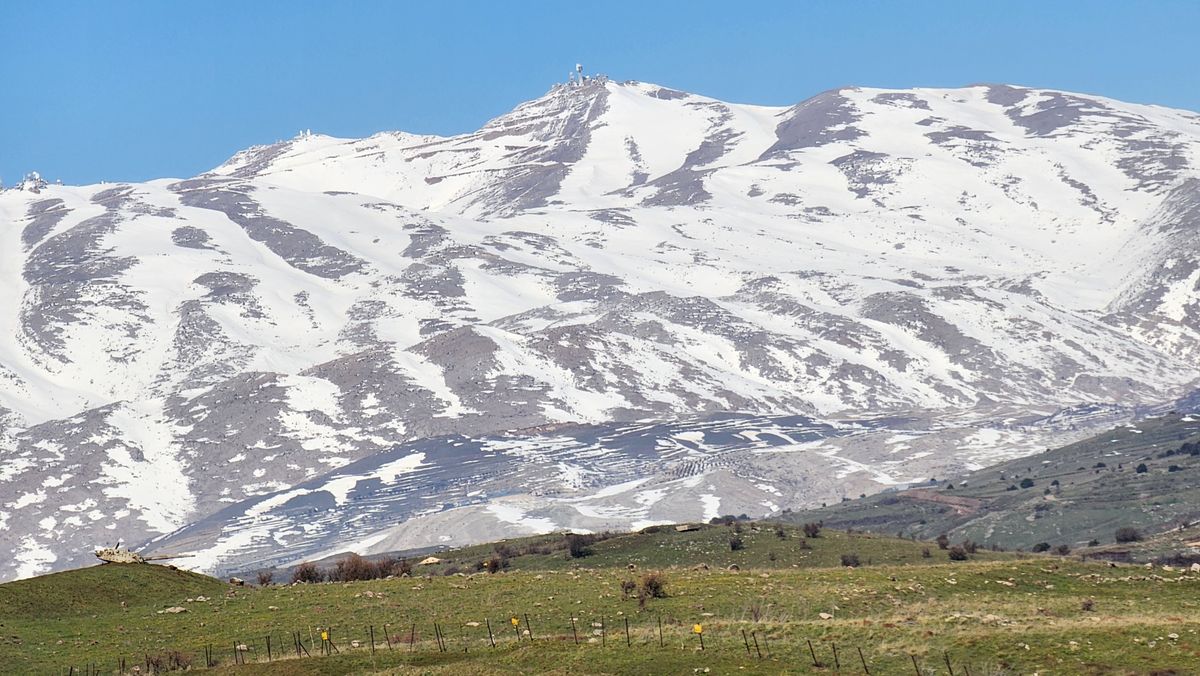
Yes, you can ski in Israel. No, it is not a joke. Mount Hermon, the highest point in the country, reaches 2,814 meters (the Israeli-controlled summit reaches 2,236 meters) at its peak and receives enough snow each winter to operate a ski resort. It is a small resort, it is open for a short season, and the slopes would not intimidate anyone coming from the Alps. But it exists, and Israelis love it with the fierce devotion of a country that gets very little snow and treasures every flake.
Mount Hermon is much more than a ski slope, though. It is a water source, a military observation post, a biblical landmark, and one of the most fought-over mountains in the modern Middle East. Standing at the top, you can see Syria, Lebanon, and the entire northern half of Israel spread out below you, and you begin to understand why every army in the region has wanted this mountain.
Eyes of the Nation
The Israeli-controlled summit of Mount Hermon, at approximately 2,224 meters, is home to one of the most important military observation posts in the country. The IDF calls it “the eyes of the nation,” and for good reason. From the top of the Hermon, Israeli intelligence can monitor military movements deep inside Syria and Lebanon, making it one of the most strategically valuable pieces of real estate in the Middle East.
During the Yom Kippur War of 1973, the Hermon was the site of one of the war’s fiercest battles. Syrian commandos captured the observation post in a surprise attack on the first day of the war, and the fight to recapture it was brutal. Israeli forces eventually retook the position, but the battle cost dozens of lives on both sides. The memorial at the summit honors the soldiers who fell in the fighting, and the bunkers and fortifications from the battle are still visible.
Syrian Hermon
As of this writing, Israel also controls the Syrian side of Mount Hermon, which it seized during military operations against Hezbollah. The position provides a critical vantage point for monitoring and disrupting attempts by Hezbollah to smuggle weapons through Syria into Lebanon. The strategic importance of the Hermon, already immense during the Yom Kippur War, has only grown as the threats along Israel’s northern border have evolved.
Snow and Water
Mount Hermon’s snow is not just a recreational asset. It is a critical water source. The snowmelt from the Hermon feeds the springs at the mountain’s base, including the Dan, Banias, and Hasbani, the three sources of the Jordan River. Without the Hermon’s snow, the Jordan River would be significantly diminished, and the Sea of Galilee would receive far less water.
The mountain creates its own microclimate. While the rest of Israel bakes in Mediterranean sunshine, the Hermon can be cold, wet, and foggy, with temperatures well below freezing in winter. The ski season typically runs from January to March, depending on snowfall, and when conditions are right, the resort draws thousands of Israelis who make the drive north to experience what most of them see only once or twice a year: actual snow.
A Sacred Mountain
Mount Hermon has been considered sacred since antiquity. The Book of Psalms mentions the Hermon by name, and the mountain has been identified by some scholars as a possible site of the Transfiguration of Jesus, though Mount Tabor in the Galilee is the more traditional candidate.
The mountain’s slopes are dotted with the remains of ancient temples and shrines, evidence that the Hermon’s spiritual significance long predates the biblical period. The sheer size of the mountain, visible from much of northern Israel and covered in snow when the lowlands are green, must have seemed otherworldly to ancient peoples. It is easy to see why they considered it a dwelling place of the gods.
Druze Villages
The lower slopes of Mount Hermon are home to several Druze villages, including Majdal Shams, Mas’ade, Buq’ata, and Ein Qiniyye. The Druze of the Golan Heights have a unique and complex identity. When Israel captured the Golan in 1967, the local Druze population found itself separated from Syria and offered Israeli citizenship. Most declined, maintaining their Syrian identity while living under Israeli sovereignty.
The villages are known for their apple orchards, their hospitality, and their distinctive cuisine. Visitors to the Hermon area often stop for a meal of Druze pita, labneh, and grilled meats, and the combination of mountain scenery, warm hospitality, and excellent food makes the Druze villages a highlight of any Golan Heights visit.
Visit with Hoshen Tours
Mount Hermon anchors any tour of the Golan Heights and upper Galilee. Hoshen Tours includes the Hermon in itineraries that combine the mountain with Banias, Tel Dan, the wineries of the Golan, and the Druze villages, creating an experience that spans nature, history, culture, and cuisine.
Because Mount Hermon is where Israel touches the sky. And on a clear day, the view from the top is worth every meter of the climb.
Nearby destinations worth combining with this stop include Nimrod Fortress and Birkat Ram.
Explore Our Tour Collection
Ready to experience Israel in true colors?
Plan Your TourPrivate tours designed around your interests, schedule, and pace.