



How Nimrod Fortress Israel Got Its Name
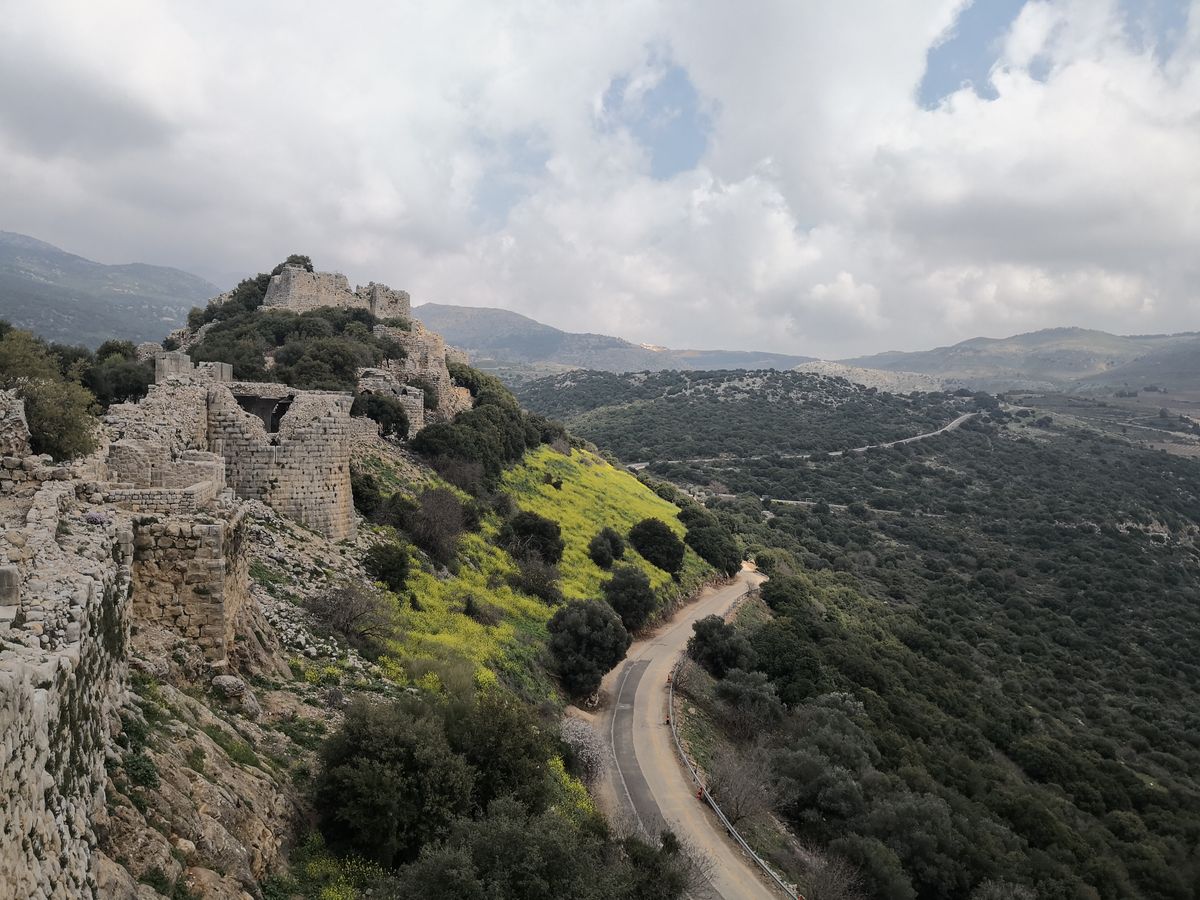
The fortress is named after Nimrod, the biblical hunter and king described in Genesis as “a mighty hunter before the Lord” (Genesis 10:9). The connection between the biblical Nimrod and this medieval fortress is entirely legendary, but the name has stuck. Local tradition holds that Nimrod hunted on these slopes, and the fortress’s commanding position and martial character seem to suit the name.
Perched on a ridge above Banias, overlooking the road from the Galilee to Damascus, sits the largest medieval fortress in Israel. Nimrod Fortress is massive, dramatic, and wildly undervisited. While tourists crowd the castles of Jordan’s Karak and Syria’s Crac des Chevaliers, Nimrod sits quietly on its hilltop, offering the same scale, the same medieval atmosphere, and better views, without the lines.
A Muslim Castle Built to Fight Crusaders
Unlike most of the famous castles in the region, Nimrod Fortress was not built by Crusaders. It was built against them. In the 1220s, the Ayyubid ruler al-Aziz Uthman, a nephew of Saladin, constructed the fortress to block a potential Crusader advance from the coast toward Damascus. The location was chosen with precision: the fortress commands the narrow valley between Mount Hermon and the Golan Heights, the only practical route for an army moving between the Mediterranean and inland Syria.
The castle was expanded significantly by the Mamluk sultan Baybars in the 1260s, who added massive towers, elaborate inscriptions, and a series of defensive features that made the fortress virtually impregnable. Baybars, who had already defeated the Mongols at Ain Jalut and was systematically dismantling the remaining Crusader strongholds, turned Nimrod into one of the most impressive military installations of the medieval Islamic world.
Walking the Fortress
Nimrod Fortress stretches over 420 meters along its ridge, and exploring it takes at least an hour of climbing stairs, ducking through vaulted passages, and emerging onto walls and towers that offer views in every direction. The scale is impressive. The walls are thick enough to drive a car through. The towers rise three and four stories above the valley floor. And the construction, using the local basalt stone, gives the entire fortress a dark, imposing presence that photographs cannot quite capture.
The eastern tower, the keep, is the oldest part of the fortress and the most atmospheric. A narrow staircase winds up through the interior to the roof, where the view extends from Mount Hermon to the north, Banias and the Hula Valley below, and the Galilee hills to the west. It is one of the best panoramic views in northern Israel, and you earn it by climbing.
Arabic inscriptions are carved into the walls at several points, recording construction work by various sultans and governors. The inscriptions are beautifully executed and serve as a reminder that this fortress was built by some of the most powerful rulers of the medieval Islamic world.
After the Crusades
Nimrod Fortress lost its military significance after the final defeat of the Crusaders in 1291. The Mamluks used it as a prison for a time, and the Ottomans allowed it to fall into disrepair. Earthquakes damaged parts of the structure, and local villagers carried off stones for their own building projects. But the sheer mass of the fortress meant that most of it survived, and the Israeli Parks Authority has done excellent work stabilizing and preserving the ruins.
Visit with Hoshen Tours
Nimrod Fortress combines naturally with nearby Banias, Tel Dan, and the Druze villages of Mount Hermon. Hoshen Tours includes it in Golan Heights itineraries that pair the fortress with the region’s natural beauty, creating a day that moves from a medieval hilltop castle to a waterfall in a nature reserve to a Druze feast on the slopes of a mountain.
Because some castles are worth the climb. And the one at Nimrod has been waiting 800 years for you to see the view from the top.
Nearby destinations worth combining with this stop include Birkat Ram and Druze villages of the Golan.
Explore Our Tour Collection
Ready to experience Israel in true colors?
Plan Your TourPrivate tours designed around your interests, schedule, and pace.