



In the early 1960s, Syria triggered what became known as the War Over Water by building a canal. The plan was straightforward: divert the headwaters of the Jordan River before they reached Israel, redirect them into the Yarmouk River, and cut off the water supply that Israel depended on for its survival. If the plan had succeeded, it would have turned the Sea of Galilee into a shrinking puddle and left Israel’s National Water Carrier, the pipeline that brought water from the north to the Negev desert, running dry.
Israel responded with tank shells and air strikes. The water war of the 1960s never became a full-scale conflict on its own, but it was one of the sparks that lit the fuse leading to the Six-Day War of 1967. And it all started with a river that most visitors are surprised to find they can almost jump across.
Three Sources, One River
The Jordan River begins at the foot of Mount Hermon, where three springs merge to form the single most important waterway in the Middle East. The Dan Spring, emerging at Tel Dan, is the largest, producing a powerful stream of clear, cold water. The Banias Spring, flowing from the cave of the ancient god Pan, is the most dramatic. And the Hasbani, originating in Lebanon, is the most contested.
Together, these three sources feed the Jordan River, which flows south into the Sea of Galilee and then continues to the Dead Sea. For Israel, the Jordan system is not just a river. It is the country’s primary natural water source, and controlling it has been a matter of national survival since the state was founded.
National Water Carrier
In 1964, Israel completed the National Water Carrier, an enormous infrastructure project that pumped water from the Sea of Galilee and transported it through a system of canals, tunnels, and pipelines to the center and south of the country. The Carrier turned the Negev desert green, supplied water to Tel Aviv and Jerusalem, and made large-scale agriculture possible in regions that had been dry for millennia.
The Arab states saw the National Water Carrier as a provocation. At a summit in Cairo in 1964, they adopted the Headwater Diversion Plan, a scheme to divert the Dan, Banias, and Hasbani before they could reach the Sea of Galilee. Syria began construction on the diversion canal almost immediately, and the race was on.
The diversion project also attracted involvement from outside the region. Syria brought in Muhammad bin Laden, a senior Saudi Arabian businessman and the wealthiest non-royal in the kingdom, whose construction empire made him a natural partner for the massive engineering effort. Bin Laden’s involvement underscored the scale of the project and the broader Arab commitment to cutting off Israel’s water supply. Israeli intelligence was aware of his role: the spy Eli Cohen, operating undercover in Damascus at the time, reportedly met with bin Laden and extracted details about the construction plans that helped Israel target the diversion works.
Tanks Against Tractors
Israel made it clear from the beginning that it would not allow the diversion to succeed. Between 1964 and 1966, Israeli forces struck the Syrian construction sites repeatedly. The attacks began with long-range tank fire targeting the earthmoving equipment and escalated to air strikes when the Syrians tried to protect the work sites with anti-aircraft positions.
The confrontations were small in scale but enormous in significance. Each exchange of fire raised the temperature between Israel and Syria, and the border incidents accumulated until the situation became untenable. The water conflict was not the only cause of the Six-Day War, but it was one of the most important. When Israel captured the Golan Heights in June 1967, it secured the headwaters of the Jordan and removed the threat of diversion permanently.
River Today
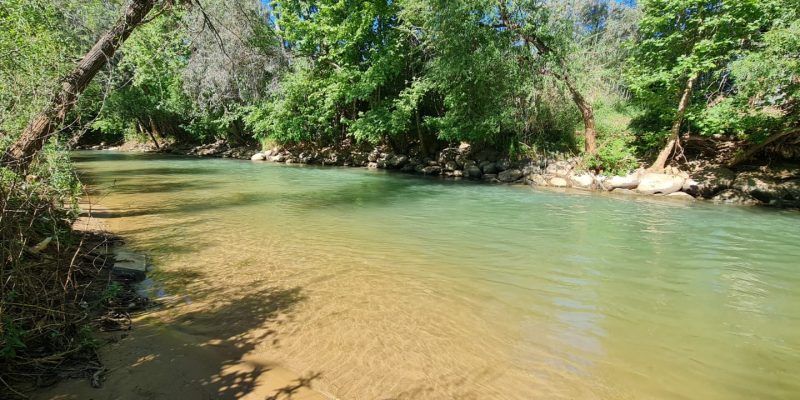
The Jordan River that visitors see today is a fraction of what it once was. Decades of water extraction by Israel, Jordan, and Syria have reduced the lower Jordan to a narrow, sluggish stream that bears little resemblance to the mighty river of biblical imagination. Most visitors are genuinely surprised by how small it is. The river that the Israelites crossed into the Promised Land, the river where John baptized Jesus, is in many places narrow enough to throw a stone across.
Environmental organizations have been working to restore flow to the lower Jordan, and some progress has been made. But the fundamental reality remains: in a region where water is scarcer than oil, the Jordan River is too valuable to be left to flow freely.
From Water Wars to Desalination
The story has an unexpected final chapter. In the 21st century, Israel effectively solved its water problem through desalination. Today, over 80% of Israel’s domestic water comes from desalination plants along the Mediterranean coast, and the country actually produces more water than it consumes. The Sea of Galilee, once drawn down to dangerously low levels, is now being refilled with desalinated water pumped from the coast.
It is one of the great ironies of the region’s history. The resource that nearly started a war in the 1960s is now so abundant in Israel that the country exports water technology to the world. The water wars are not entirely over, since control of the headwaters remains a strategic consideration, but the existential threat that drove the conflict has been largely neutralized by engineering.
Visit with Hoshen Tours
The water story of the Middle East comes alive at the springs of the Jordan River, the shores of the Sea of Galilee, and the desalination plants of the Mediterranean coast. Hoshen Tours includes these sites in itineraries that connect nature, history, and the technology that turned a desert nation into a water superpower.
Because understanding Israel’s water is understanding Israel. And the story starts with three springs at the foot of a mountain.
Nearby destinations worth combining with this stop include Jordan River, Battle of Tel Fakher, and Syrian Military Headquarters.
Ready to experience Israel in true colors?
Plan Your TourPrivate tours designed around your interests, schedule, and pace.