



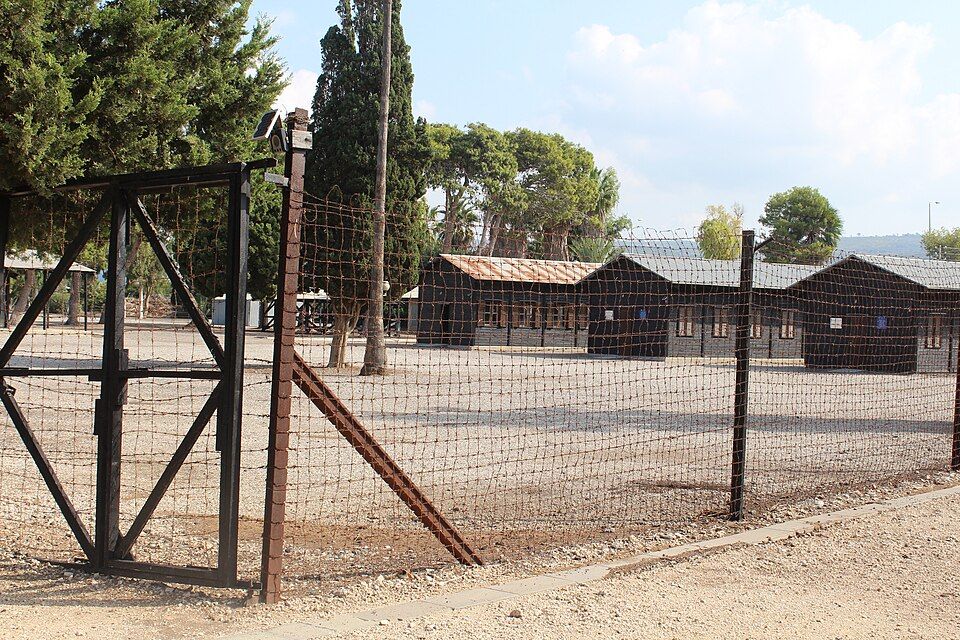
 The Atlit Detention Camp, on the Mediterranean coast south of Haifa, is one of the most emotionally powerful museums in Israel. The camp was built by the British Mandatory authorities in 1938 to detain Jewish immigrants who had arrived in the Land of Israel without British-issued immigration certificates. Between 1939 and 1948, tens of thousands of Jewish refugees, many of them Holocaust survivors, were intercepted at sea and imprisoned here behind barbed wire, within sight of the land they had risked everything to reach. Today the site operates as the Clandestine Immigration and Naval Museum, preserving the camp, a period immigrant vessel, and the stories of the people who passed through.
The British White Paper and the Birth of Ha’apala
In May 1939, with war in Europe looming and Nazi persecution of Jews already well advanced, the British government issued a policy document known as the White Paper. It capped Jewish immigration to Mandatory Palestine at 75,000 people over five years, after which no further Jewish immigration would be permitted without Arab agreement. For the Jewish community in Europe, the timing was catastrophic: at the very moment millions of Jews desperately needed a place of refuge, the door to the one land where they had a recognised claim was being shut. The Zionist leadership and the Haganah responded by organising an underground immigration operation called the Ha’apala, a Hebrew word meaning “ascent,” denoting the spiritual and physical effort of coming up to the Land of Israel. Old cargo ships and fishing vessels were purchased across Europe and the Mediterranean, outfitted with makeshift bunks and minimal sanitation, and packed with hundreds or even thousands of refugees willing to risk the journey.
The Ships and the Crossing
Dozens of vessels participated in the Ha’apala between 1934 and 1948, ranging from small fishing boats carrying a few dozen passengers to converted cargo ships carrying thousands. Conditions on board were extraordinarily difficult: passengers lived below decks in tiered wooden bunks with barely room to sit, sharing a handful of toilets among hundreds of people, surviving on minimal rations for voyages that could last weeks. Many immigrants arrived already weakened by years of persecution, hunger, and displacement. British Royal Navy warships patrolled the coast of Palestine to intercept them, and when a ship was caught, the passengers were transferred at sea or in Haifa port and transported under guard to Atlit. The camp received its first detainees in 1939 and remained in operation until the British departed in 1948.
Life Behind the Wire
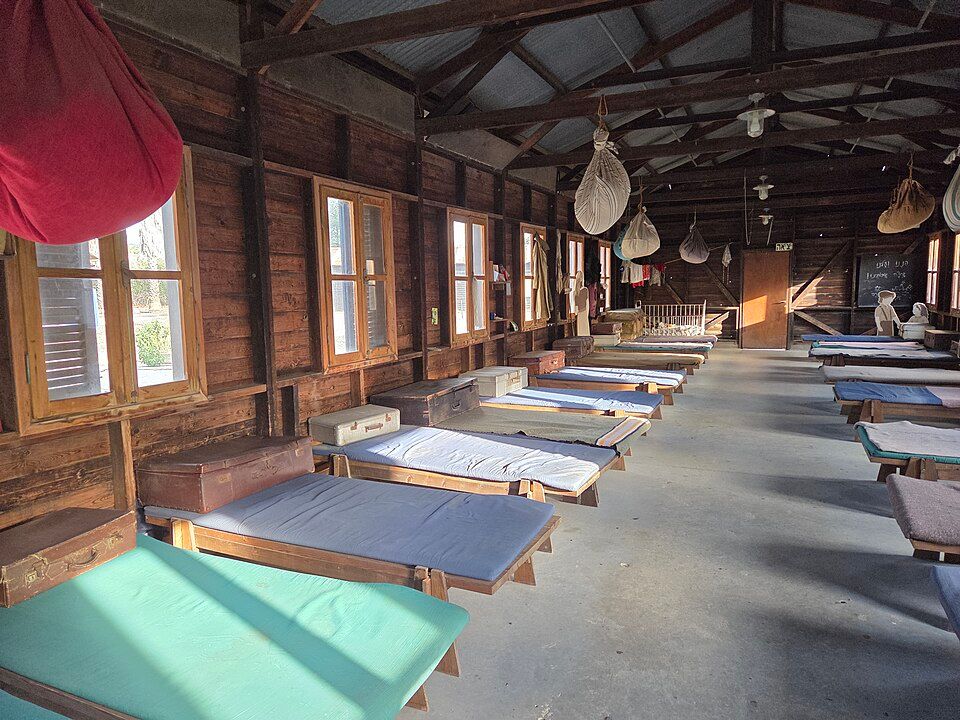 The detention camp consisted of rows of tin-roofed barracks surrounded by barbed wire fences and watchtowers. The conditions were harsh: overcrowded barracks, limited food and water, and the psychological torment of being imprisoned within sight of the promised land. For Holocaust survivors who had just escaped the camps of Europe, the experience of being behind barbed wire again, this time detained by the British rather than the Germans, was devastating. Detainees were stripped of their names and issued numbered identity tags, a practice that recalled the tattooed numbers of the Nazi camps. The camp could hold up to 1,500 detainees at a time, and the average detention lasted weeks to months, with no clear timeline for release.
The Disinfection Showers
One of the most disturbing aspects of the camp was the disinfection process that every arriving immigrant was required to undergo. Upon arrival, detainees were instructed to undress, surrender their personal belongings, and pass through a shower room where they were sprayed with disinfectant. For Holocaust survivors, many of whom had lost family members in the gas chambers of the Nazi death camps, being ordered to undress and walk into a shower room was a profound and terrifying echo of the worst trauma of their lives. The procedures were framed as a public health measure, but the effect on people carrying that particular memory was devastating. The museum preserves the disinfection building in its original form and guides visitors through the space, allowing the experience of the arriving immigrants to be understood not as an abstraction but as a visceral reality.
The Palmach Breakout
On the night of October 10, 1945, the Palmach carried out one of its most celebrated operations: a raid on the Atlit camp that freed 208 detainees. The operation was commanded by Nahum Sarig, with Yitzhak Rabin serving as his deputy, then a young Palmach officer in his early twenties. A unit cut through the perimeter wire while a diversionary assault drew the attention of the British guards; the freed immigrants were marched through the darkness to Kibbutz Beit Oren on the Carmel ridge and from there absorbed into the Jewish community before the British could respond. The breakout was one of the defining operations of the Palmach and became a symbol of the Jewish determination to bring immigrants home regardless of the restrictions placed on them.
The Exodus 1947
The most famous ship of the Ha’apala, the Exodus 1947, carried 4,515 Holocaust survivors from the port of Sète in southern France toward the Land of Israel in the summer of 1947. The British intercepted the vessel off the coast near Haifa, and in a violent boarding operation witnessed by international journalists and United Nations observers, three passengers were killed and dozens wounded. The passengers were not sent to Atlit; instead, in an internationally condemned decision, the British returned them to Europe on prison ships, ultimately forcing them ashore in Hamburg, Germany, the country that had attempted to murder them. The Exodus affair became an international scandal that dramatically shifted world opinion against British Mandate policy and helped galvanise support for the United Nations partition plan that led to the establishment of the State of Israel.
The Museum Today
The museum preserves the original barracks, watchtowers, barbed wire fences, and disinfection building, creating a physical encounter with the camp as it stood during the Mandate period. The centrepiece of the courtyard is an actual vessel from the period, the Af Al Pi Chen, which carried ma’apilim to the shores of Palestine and now stands as a monument to the crossings. Visitors can board the ship and experience firsthand the crushing conditions under which hundreds of people made the voyage. The museum also houses an extensive collection of photographs, documents, personal objects left behind by detainees, and audio and video testimonies recorded by survivors. The combination of the physical camp, the ship, the personal stories, and the knowledge that this happened to Holocaust survivors within sight of the shore they had come so far to reach makes Atlit one of the most emotionally intense museum experiences in Israel. The site is particularly meaningful for school groups, who often leave with a far deeper understanding of what the founding generation endured.
Visit with Hoshen Tours
A visit to Atlit Detention Camp pairs beautifully with nearby destinations along your route. Consider combining it with a stop at Haifa or Nahal Mearot, both just a short drive away. Many travelers also enjoy exploring Druze Villages on the Carmel and Stella Maris on the same day, while Ein Afek offers another worthwhile addition to your itinerary. Your Hoshen Tours guide will craft a seamless route that brings each destination to life with expert commentary and insider knowledge.
Explore Our Tour Collection
Ready to experience Israel in true colors?
Plan Your TourPrivate tours designed around your interests, schedule, and pace.