



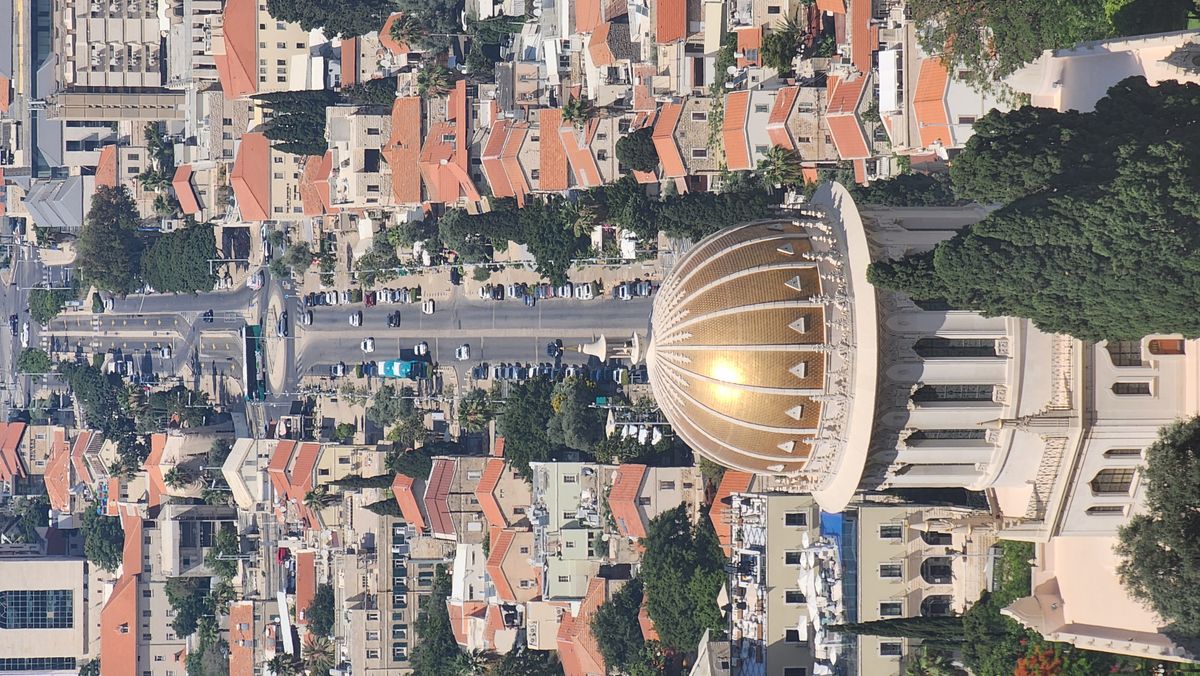
Tel Aviv gets the nightlife. Jerusalem gets the holiness. And Haifa? Haifa gets things done. Israel’s third-largest city sits at one of the most dramatic intersections in the country, the moment where Mount Carmel, one of the great ridges of the Levant, reaches the Mediterranean and stops. That collision of mountain and sea defines everything about Haifa: its topography, its neighborhoods, its history, and its character. It is a port city, an industrial city, a university city, and one of the most genuinely mixed communities in the Middle East, all at once, without apology.
Visitors arriving from Jerusalem or Tel Aviv often feel an immediate shift. Haifa is less intense than both, more comfortable with itself, and more interested in the practical business of living well than in proving any particular point. The locals have a saying that captures it perfectly: in Jerusalem they pray, in Tel Aviv they play, and in Haifa they work. That reputation is earned, and it goes deeper than the port cranes and the oil refineries visible from the bay. Haifa’s work ethic is also intellectual, technological, and cultural, a city of engineers, doctors, artists, and fishermen sharing the same slopes.
Geography: The Mountain and the Sea
Haifa’s geography is its personality. The city rises from the Mediterranean shore in three distinct tiers, each with its own atmosphere, its own pace, and its own identity. At sea level lies the port district and the old lower city, gritty, commercial, industrial, honest about what it is. Above it, clinging to the mid-slopes of the Carmel, is the Hadar neighborhood, once the commercial heart of the Jewish city during the British Mandate period, now a dense, slightly faded urban district full of small shops, markets, and institutions that have been doing business in the same locations for generations.
At the top of the mountain sit the Carmel neighborhoods, Merkaz Carmel, Ahuza, Neve Shaanan, where the air is cooler, the views are extraordinary, and the sense of elevation is both literal and social. From the Carmel ridge, on a clear day, the entire sweep of Haifa Bay is visible: the industrial port to the north, the gentle arc of the coastline south toward Caesarea, and the hills of the western Galilee to the north and east. It is one of the most dramatic urban panoramas in Israel. The Louis Promenade, a walking path along the crest of the ridge, makes the view accessible on foot, and on clear winter mornings, visitors have reported seeing as far as the peaks of Lebanon.
Between these tiers, the slopes of the Carmel are cut by wadis, seasonal stream beds, that become green corridors of garden and forest. The Carmel National Park, one of Israel’s oldest, begins almost at the city’s doorstep and extends south and east across the ridge, covering over 25,000 acres of Mediterranean woodland. The mountain is not backdrop. It is the city’s foundation, and Haifa has grown up along its contours rather than in spite of them.
Ancient and Medieval History
Haifa is ancient, though for most of its history it was a minor player in a region crowded with major ones. Egyptian sources from the New Kingdom period mention settlements on the slopes of the Carmel, and the coast below the mountain was known to Phoenician and Greek sailors who used the bay as a harbor long before the city took its current name. The name “Haifa” appears in rabbinic literature of the early centuries of the Common Era, associated with a Jewish settlement and a dyeing industry that made use of the murex snails common along this stretch of coast.
During the Crusader period, Haifa became a modest port town, always overshadowed by the vastly more important city of Akko just twelve kilometers to the north across the bay. Akko, with its deep harbor, its massive fortifications, and its status as the headquarters of the military orders, was the real prize of the eastern Mediterranean littoral. Haifa, by contrast, was a smaller settlement at the foot of a mountain, useful for access to the Carmel ridge and for coastal trade, but never a strategic city in its own right. The Crusaders held it, lost it, and held it again through the twelfth and thirteenth centuries, building modest fortifications that have since disappeared beneath later construction. When the Mamluk sultan Baybars swept through the region in 1265, Haifa was taken without great drama, a footnote to the larger story of the Crusader collapse.
The Ottoman centuries were quiet. Haifa remained a small town on a productive but unremarkable stretch of coast, its population perhaps a few thousand, its economy based on fishing, agriculture from the Carmel slopes, and modest coastal trade. That quietness was about to end.
Elijah and Mount Carmel
Mount Carmel, which rises directly above Haifa, is where tradition holds that Elijah called down fire from heaven in his contest against the 450 prophets of Baal, the dramatic episode recounted in 1 Kings 18. The Muhraka monastery on the southeastern spur of the ridge marks the traditional site of that confrontation. At the base of the Carmel near the port, Elijah’s Cave is venerated by Jews, Christians, Muslims, and Druze as the place where the prophet sheltered, one of the few genuinely shared holy sites in Israel.
German Protestant settlers founded the German Colony at the foot of the Carmel in 1868, introducing European construction and commercial energy that began Haifa’s transformation. When the Ottoman authorities built a branch line connecting Haifa to the Hejaz Railway network in 1905, connecting the city by rail to Damascus, Haifa became a regional hub overnight, and the British further expanded the port dramatically after 1918.
Kaiser Wilhelm II’s Visit
In October 1898, Kaiser Wilhelm II of Germany undertook a grand tour of the Holy Land, the first visit by a reigning German emperor to the region, and a journey designed to project German power and prestige in an Ottoman Empire over which the great European powers were competing for influence. The Kaiser arrived by sea at Haifa, disembarking with his empress Augusta Victoria and a large imperial entourage at the port and making his way to the German Templar colony, where he was received with celebrations that the community had been preparing for months.
For the Templar settlers, the Kaiser’s visit was a moment of extraordinary validation. These were German citizens living in the Ottoman Empire, loyal to their homeland, proud of what they had built, and eager to demonstrate to the world, and to their emperor, that the colony was a success. The reception they organized was elaborate: the boulevard was decorated, an address was delivered, and the Kaiser expressed his admiration for the colony’s order and industry. He then continued south through Jaffa to Jerusalem, where his formal entry through a specially cut opening in the walls of the Old City became one of the iconic images of late Ottoman political theater.
The visit had practical consequences. German interest in Haifa and the surrounding region intensified in its wake, and the episode illustrates the degree to which the Holy Land in the late nineteenth century was simultaneously a place of genuine religious significance and an arena for European imperial competition. The Templar colony itself survived the Kaiser’s visit by only a few decades; the British interned the German settlers during both World Wars, and the community was finally dispersed in 1948. Their beautifully built stone houses remain as the German Colony neighborhood, one of the most pleasant urban spaces in Israel.
Coexistence: Haifa Israel’s Most Distinctive Feature
Haifa has a reputation for Jewish-Arab coexistence that is real, earned, and worth understanding clearly, which means acknowledging both what it is and what it is not. It is not the absence of tension or a permanent state of harmony; the same national conflicts that affect the rest of Israel are present in Haifa. What Haifa has that other Israeli cities do not have to the same degree is a deep tradition of daily, practical, unremarkable coexistence at the neighborhood level, people sharing streets, markets, schools, and workplaces without treating that sharing as a political statement or a special achievement.
Wadi Nisnas, the predominantly Arab neighborhood at the heart of the lower city, is the most vivid expression of this coexistence, a working market neighborhood with some of the best food in Israel, where Jews and Arabs shop side by side without it being notable.
The Druze communities of the Carmel ridge, centered on the villages of Daliyat el-Karmel and Isfiya, a short drive south of the city, add another layer to Haifa’s mixed character. The Baha’i World Centre, with its extraordinary gardens descending the slopes of the Carmel to the German Colony below, makes Haifa an international center for the Baha’i faith, which counts millions of followers worldwide. The Baha’i regard Haifa and the adjacent city of Akko as the holiest places on earth, and their presence gives the city a quiet international dimension that is unlike anything in Jerusalem or Tel Aviv. Haifa’s coexistence is real because it is built into the city’s physical and economic structure. It was never the result of a program. It emerged from a port city’s practical need to have everyone working together.
The Port, Industry, and the Technion
Haifa Port, built to full modern capacity by the British in 1933, was Israel’s primary gateway to the world for decades and has recently been reinvented, with new terminals expanding capacity while the old port area redevelops into a cultural and commercial destination (read more). The industrial zone along the bay includes a refinery and chemical, steel, and pharmaceutical facilities, Haifa is not a city that has traded manufacturing for services; it does both.
The Technion, Israel Institute of Technology, was founded in 1912 and opened in 1924 on a hillside above Hadar, in premises that now form the historic campus. The main campus today occupies a large site in the Neve Sha’anan neighborhood, a sprawling complex of faculties, labs, and research centers that has produced some of the most significant scientific achievements in Israeli history. Technion graduates have won multiple Nobel Prizes in Chemistry, have led the development of Israel’s aerospace and defense industries, and have founded technology companies that operate globally. The University of Haifa, established in 1963 on the crest of the Carmel ridge, adds another dimension: it is one of Israel’s most ethnically diverse universities, with significant Arab and Druze enrollment alongside the Jewish majority. The Matam high-tech park on the southern bay hosts the Israeli R&D centers of major international technology companies. Haifa’s identity as a city of workers and engineers, practical, concrete, capable, has simply updated itself for the twenty-first century.
Culinary Haifa
Haifa’s food scene is one of its great pleasures and one of its best-kept secrets. The city does not have the international visibility of Tel Aviv’s restaurant culture, but for depth, authenticity, and value, it is hard to match. The starting point is Wadi Nisnas, where a cluster of Arab-owned restaurants and market stalls serves some of the finest traditional Arab cooking in Israel. Hummus here is fresh-ground and warm, served with olive oil and whole chickpeas, eaten with fresh flatbread from the bakery around the corner. Knafeh, the Levantine pastry of shredded dough, soft white cheese, and sweet syrup, comes in generous portions from shops that have been doing it the same way for decades.
The German Colony’s Ben Gurion Boulevard offers a different register: sit-down restaurants in stone buildings, cafes with outdoor tables on the tree-lined avenue, and a food culture that blends Israeli, Arab, and European influences in ways that feel natural rather than forced. The neighborhood’s Templar heritage shows up in the architecture and the occasional German-style bakery, though the cuisine has long since evolved beyond any single tradition. Masaryk Street, on the slopes between Hadar and the German Colony, has a concentration of cafes and casual restaurants that is a local favorite, less designed, more lived-in, with the kind of street energy that comes from a neighborhood where people actually live and work rather than visit. Druze cuisine from the Carmel villages, large round pita baked on a saj griddle, labaneh with za’atar and olive oil, slow-cooked lamb, can be found in the city as well, and the mix of Arab, Jewish, Druze, and international influences gives Haifa’s food scene a complexity that rewards exploration.
Visit with Hoshen Tours
A visit to Haifa pairs beautifully with nearby destinations along your route. Consider combining it with a stop at German Colony in Haifa or Stella Maris, both just a short drive away. Many travelers also enjoy exploring Wadi Nisnas and Bahai Gardens on the same day, while Haifa Port offers another worthwhile addition to your itinerary. Your Hoshen Tours guide will craft a seamless route that brings each destination to life with expert commentary and insider knowledge. Hoshen Tours often combines this site with Beit She’arim, Wadi Nisnas, and Elijahs Cave for a memorable day exploring the region.
Explore Our Tour Collection
Ready to experience Israel in true colors?
Plan Your TourPrivate tours designed around your interests, schedule, and pace.