



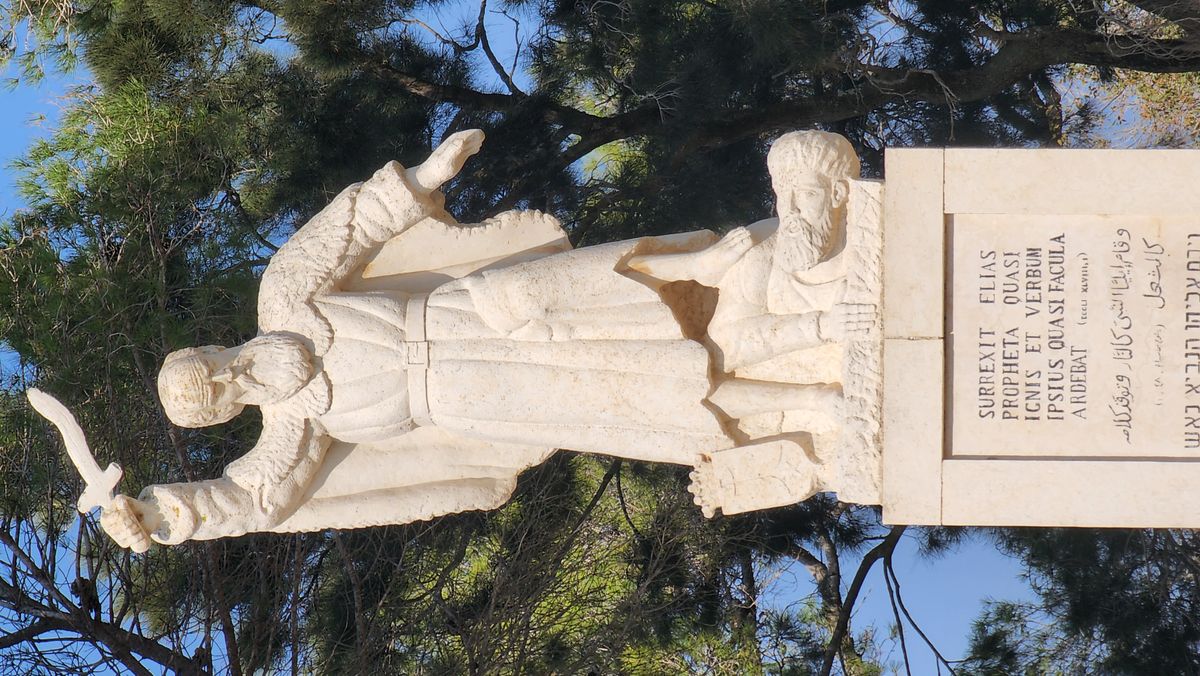
Mount Carmel is one of those places where the landscape does half the storytelling for you. Rising sharply from the Jezreel Valley on one side and sloping down to the Mediterranean on the other, this ridge of limestone and oak forest has been considered sacred for so long that nobody is entirely sure when it started. What everyone agrees on is what happened here, or at least what the Bible says happened here: one of the most dramatic showdowns in the entire Old Testament.
Elijah Against the World
The story is told in 1 Kings 18, and even if you have read it before, standing at Muhraka on Mount Carmel gives it a completely different weight.
Israel, under King Ahab and Queen Jezebel, had turned to the worship of Baal. The prophet Elijah, furious and outnumbered, challenged 450 prophets of Baal to a contest on Mount Carmel. The rules were simple: each side would prepare a sacrifice, and the god who answered with fire from heaven would be proven the true God.
The prophets of Baal went first. They prayed, danced, shouted, and cut themselves from morning until afternoon. Nothing happened. Elijah, who was not known for his diplomacy, began mocking them. “Shout louder,” he suggested. “Perhaps your god is deep in thought, or busy, or traveling. Maybe he is sleeping and must be awakened.” It is one of the earliest recorded instances of religious trash talk, and it is still funny three thousand years later.
Then Elijah took his turn. He rebuilt the altar of the Lord, arranged the wood and the sacrifice, and, just to make the point absolutely clear, ordered his servants to pour water over everything. Three times. The altar was drenched. The trench around it was filled. And then Elijah prayed, and fire fell from heaven and consumed everything, the sacrifice, the wood, the stones, the water, and the dust.
The crowd fell on their faces and declared: “The Lord, He is God.” The prophets of Baal did not survive the afternoon.
Muhraka: Where It Happened
Muhraka, the traditional site of Elijah’s contest, sits at the southeastern end of the Carmel ridge, where the mountain drops steeply toward the Jezreel Valley. The name itself comes from the Arabic word for “the burning,” a direct reference to the fire from heaven.
A small Carmelite monastery has stood here since the 19th century, built on what tradition identifies as the exact location of the altar. The Carmelite order traces its spiritual origins to Elijah and the community of hermits who lived on Mount Carmel in the centuries that followed. For the Carmelites, this is not just a historical site. It is home.
Inside the monastery chapel, a simple statue of Elijah stands with a sword raised, a reminder that the prophet was not a gentle figure. Outside, a rooftop terrace offers one of the most spectacular views in Israel: the entire Jezreel Valley spread out below, the hills of Nazareth and Mount Tabor to the east, and on a clear day, the Golan Heights in the distance.
It is easy to see why this spot was chosen for the story. The natural amphitheater of the valley below, the exposed ridge above, the sense of standing between earth and sky. This is a place built for a confrontation between the human and the divine.
A Mountain with Many Names
Mount Carmel’s sacred reputation goes far beyond the story of Elijah. The ridge has been revered since prehistoric times. Caves on the western slopes of Mount Carmel, including the famous Tabun and Skhul caves, have yielded some of the most important prehistoric discoveries in the world, including remains of both Neanderthals and early modern humans who lived here over 100,000 years ago. These caves are part of a UNESCO World Heritage Site recognized for their contribution to understanding human evolution.
The ancient Egyptians mentioned Mount Carmel as a “holy headland.” Greek and Roman writers described it as a sacred mountain where rituals were performed on an open-air altar. The prophet Elisha, Elijah’s successor, also spent time on the mountain. And the Crusaders, when they arrived, found the Carmelite hermits already living in caves on the slopes, carrying on a tradition of prayer and solitude that stretched back centuries.
Even the name reflects this layered holiness. “Carmel” comes from the Hebrew “Kerem El,” meaning “Vineyard of God.” A mountain named after God’s garden, covered in forest and wildflowers every spring, overlooking the most fertile valley in Israel. It is almost too perfect.
The Carmelite Connection
The Carmelite order, one of the great religious orders of the Catholic Church, was founded on Mount Carmel in the 12th century by Crusader-era hermits who gathered near Elijah’s cave. They saw themselves as spiritual descendants of the prophet, and their devotion to this mountain has never wavered.
The Stella Maris Monastery in Haifa, at the northern end of the Carmel ridge, is the international center of the Carmelite order and one of the most beautiful churches in Israel. But Muhraka, at the southern end, is where the story begins. The two sites together tell the story of a mountain that has been drawing people seeking God for over three thousand years.
For Christian visitors, Mount Carmel is a living connection to the Old Testament prophets. For Jewish visitors, Elijah is one of the most beloved figures in tradition, the prophet who is expected at every Passover Seder and who, according to tradition, will announce the coming of the Messiah. For everyone else, it is simply one of the most dramatic and beautiful places in the country.
Visit Mount Carmel with Hoshen Tours
Mount Carmel rewards visitors who come with context. The view from Muhraka is breathtaking on its own, but when you know the story behind it, when you can picture Elijah standing on that ridge with 450 prophets arrayed against him and a king watching from below, the landscape transforms into something unforgettable.
Hoshen Tours combines Mount Carmel with the nearby sites that complete the picture: Megiddo in the valley below, the port city of Caesarea along the coast, and the stunning Baha’i Gardens in Haifa on the Carmel’s northern slope. It is a day that moves from prehistory to prophecy to the present, all along one extraordinary mountain ridge.