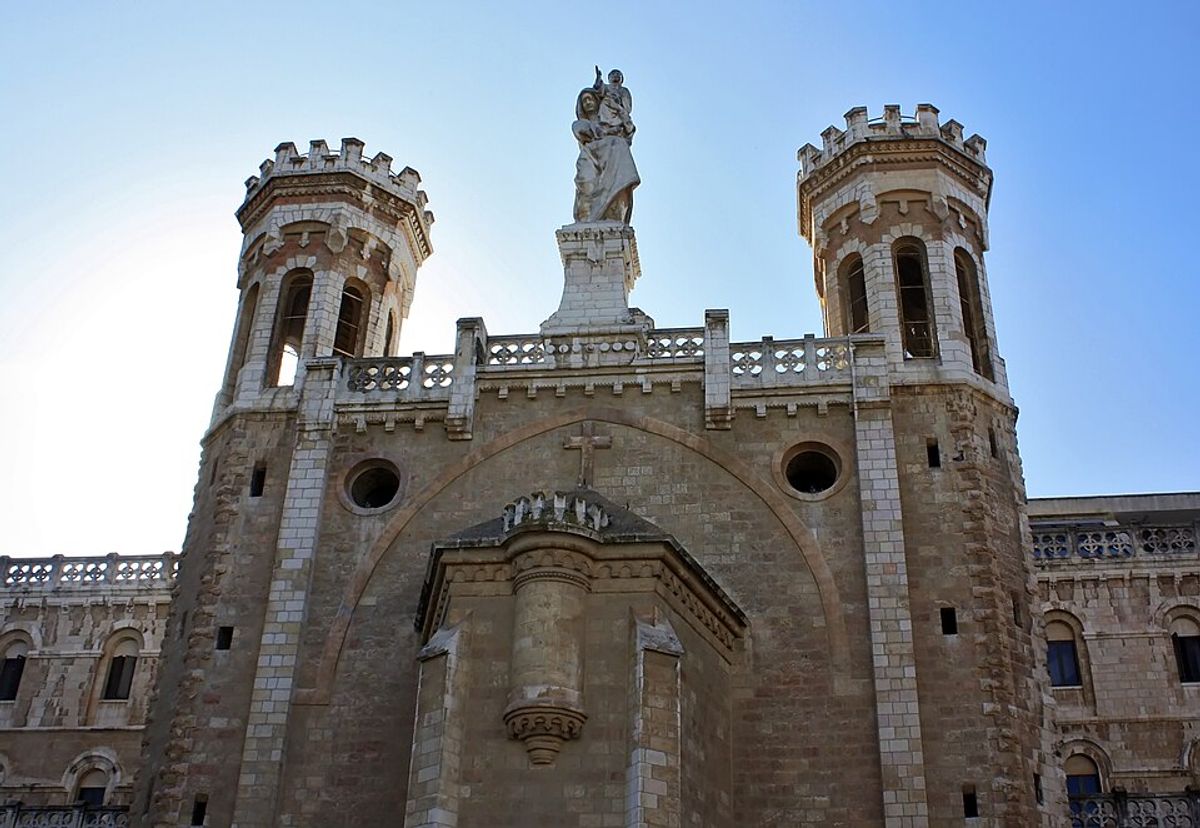
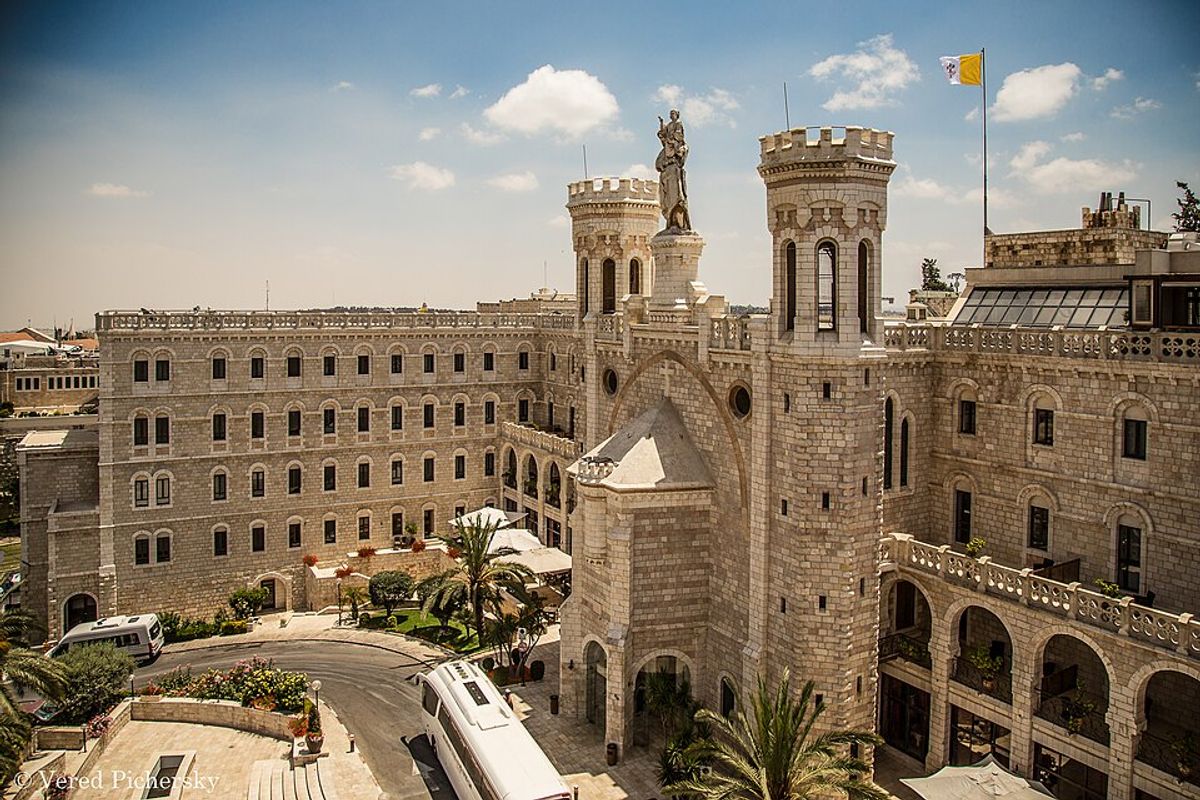
Notre Dame of Jerusalem is a massive French Catholic compound facing the Old City walls near the New Gate. Built in 1887 by the Assumptionist Fathers to accommodate French Catholic pilgrims, the building is one of the largest and most imposing structures in Jerusalem, a statement of French Catholic ambition that rivals anything built by the other European powers.
The Notre Dame de Jerusalem
Notre Dame was founded between 1882 and 1888 by the French Assumptionist Fathers, who envisioned a grand pilgrim guesthouse worthy of the Holy City. The cornerstone was laid in 1885, and the building was completed in 1904 with some 300 rooms and two chapels. The structure is enormous: a stone fortress of a building with vaulted corridors, stone staircases, and an atmosphere that recalls a provincial French seminary. Crowning the roofline is a statue of the Virgin Mary, a replica of Our Lady of Salvation from Paris, visible from across the city. The New Gate in the Old City wall was opened in 1889 specifically to give pilgrims staying at Notre Dame direct access to the Old City and the Church of the Holy Sepulchre, an extraordinary measure that shows how significant this compound was to the Christian pilgrimage landscape.
During the 1948 war, Notre Dame became a frontline position between Israeli and Arab forces. On May 18, 1948, during Operation Kilshon, Israeli forces captured the building. The last Mass was celebrated on May 19, before Notre Dame became a battlefield. On May 20, the Arab Legion launched a counterattack to recapture the compound but failed. The fighting left the building badly damaged: shells scarred the facade, stained glass windows were shattered, and the statue of the Virgin Mary was broken. Bullet and shell marks are still visible on the exterior walls today. The Israeli army held the building as a strategic position throughout the years of Jerusalem’s division.
In the 1970s, the compound was entrusted to the Vatican and the Holy See. It is now the Pontifical Institute Notre Dame of Jerusalem Center, administered by the Legionaries of Christ since 2004. The building operates as a hotel and pilgrim guesthouse, continuing its original mission of welcoming Christian pilgrims to Jerusalem.
The Rooftop
The rooftop restaurant, the Cheese and Wine Restaurant, offers what many consider the finest dining view in Jerusalem. The terrace looks directly across at the Old City walls, with the Jaffa Gate and the Tower of David in the foreground, and the Mount of Olives rising behind. At sunset, the walls glow gold, and the panoramic view across Jerusalem’s skyline is simply spectacular. A glass of wine on this rooftop, with the Old City spread before you, is one of those rare moments where the setting elevates everything.
The Shroud Exhibition
The permanent exhibition “Who Is the Man of the Shroud?” is housed in what was once the Sacred Heart of Jesus Chapel, partially destroyed during the 1948 war and now restored as an exhibition space. The display presents the Shroud of Turin, the ancient linen cloth bearing the faint image of a crucified man, venerated by many Christians as the burial cloth of Jesus, through a full-scale replica, scientific analysis, and multimedia presentations. Visitors see detailed reproductions of the crown of thorns, the Roman nails, and the instruments of the Passion, alongside a life-size bronze statue sculpted by Luigi Enzo Mattei based on the precise measurements taken from the Shroud’s image. The exhibition walks a careful line between faith and science, presenting the decades of research, carbon dating, pollen analysis, blood type studies, photographic negative discoveries, without claiming to settle the question. Whether the Shroud is the authentic burial cloth of Christ or a medieval masterpiece, the exhibition invites visitors to examine the evidence and draw their own conclusions. The exhibition is free and open to the public.
The Nun and the Dentures
One of Jerusalem’s most beloved stories from the years of division involves Notre Dame and a pair of false teeth. In the 1950s, a nun living in the building sneezed so violently that her dentures flew out of her mouth and landed in no-man’s land, the strip of minefields, barbed wire, and rubble that separated Israeli and Jordanian Jerusalem. Distraught and unable to eat, the nun approached the Israeli military and asked them to retrieve her teeth. The soldiers explained that anyone entering no-man’s land would be shot. The nun persisted. The military contacted the United Nations. The UN contacted the Jordanians. After negotiations that, by some accounts, involved more diplomatic effort than several actual border incidents, the dentures were retrieved and returned to their grateful owner. The story, a nun, a sneeze, a set of false teeth, and an international diplomatic operation, has become one of the signature anecdotes of divided Jerusalem, a reminder that even in the most tense and dangerous of circumstances, the city never lost its capacity for the absurd.
Visit with Hoshen Tours
Notre Dame combines French grandeur with a front-row view of the Old City. Located directly opposite the New Gate, the very gate that was opened specifically for the pilgrims staying here, it stands as a monument to 19th-century Christian pilgrimage and a witness to the battles that shaped modern Jerusalem. Hoshen Tours recommends the rooftop for sunset drinks and the Shroud exhibition for visitors interested in relics and sacred objects. Hoshen Tours often combines this site with Zedekiah’s Cave, Mea Shearim, and Nachlaot for a memorable day exploring the region.
Explore Our Tour Collection
Ready to experience Israel in true colors?
Plan Your TourPrivate tours designed around your interests, schedule, and pace.