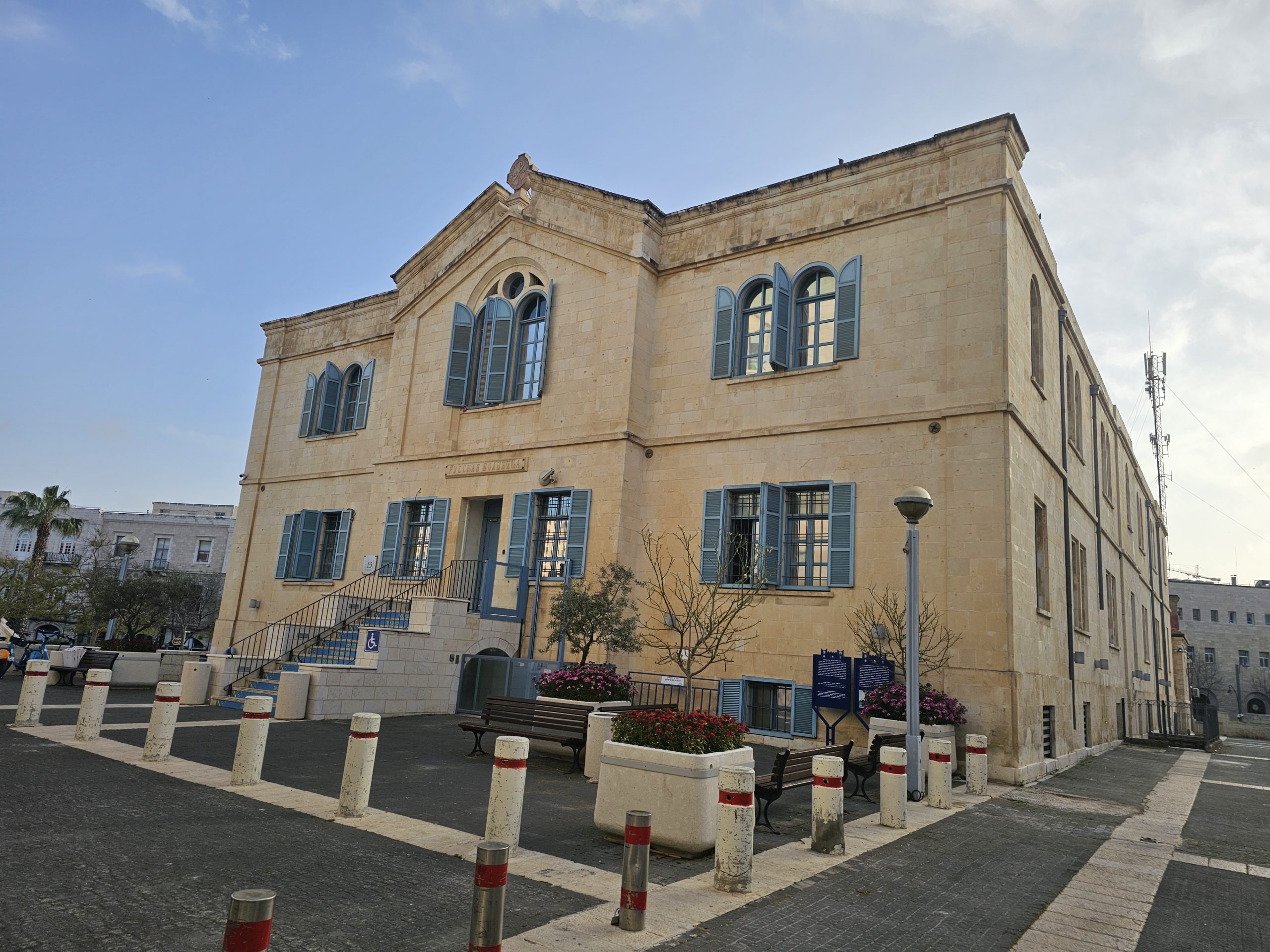
The Russian Compound is a massive 19th-century complex in the heart of downtown Jerusalem, built in the 1860s by Imperial Russia to house Russian Orthodox pilgrims who were arriving in the Holy Land in ever-growing numbers. The compound, covering several acres, included a consulate, hostels, a hospital, and a cathedral, and was the largest construction project in Jerusalem since the time of Herod. Its green-domed cathedral, sprawling hostels, and thick-walled buildings transformed the landscape of the city outside the walls and established Russia as a major presence in Jerusalem’s religious and political life.
The Russian Pilgrimage Compound
By the 1850s, thousands of Russian Orthodox pilgrims were arriving in Jerusalem each year, many of them peasants who had saved for decades to make the journey. They traveled by ship to Jaffa, walked barefoot to Jerusalem, and needed affordable housing near the holy sites. The Russian Imperial Orthodox Palestine Society built the compound to house, feed, and protect these pilgrims, and the hostels could accommodate up to 10,000 people at a time. After the 1917 Russian Revolution, the flow of pilgrims stopped abruptly, and the compound’s fate became complicated as the new Soviet government had little interest in maintaining religious properties abroad.
The Cathedral of the Holy Trinity, with its distinctive green domes, is the most prominent building in the compound. Consecrated in 1872, the cathedral is one of the finest Russian Orthodox churches outside of Russia. The interior features iconostasis, frescoes, and oil lamps that create the atmosphere of Russian Orthodoxy in the heart of Jerusalem.
The British Mandate Prison
During the British Mandate (1917-1948), the British took over much of the compound and used it as a prison and administrative center. Parts of the compound were converted into a central prison and a police station. Jewish underground fighters from the Irgun and Lehi were held here. Executions of Jewish fighters took place at Acre Prison, not in Jerusalem, but the Jerusalem prison saw its own act of defiance: in 1947, Meir Feinstein of the Irgun and Moshe Barazani of Lehi, held in the prison’s death row, took their own lives with a smuggled grenade on the eve of their scheduled execution rather than be hanged by the British. The Underground Prisoners Museum now occupies part of the former prison, telling the story of the Jewish resistance to British rule.
In the courtyard of the compound, a massive stone column lies on the ground where it has been since antiquity. The column, over 12 meters long, was quarried for Herod’s Temple but cracked during extraction and was abandoned. It is one of the largest single stones ever quarried in Jerusalem and provides a tangible connection to the scale of Herod’s building projects.
The Orange Deal and Sergei’s Courtyard
After the Russian Revolution, the Soviet Union inherited the compound but had little use for religious properties. For decades, the buildings sat in a diplomatic limbo. In 1964, in one of the Cold War’s most unusual real estate transactions, Israel purchased much of the compound from the Soviet Union in what became known as the “Orange Deal” (Eskat HaTapuzim). The price was paid not in cash but in Israeli oranges, shipments of Jaffa citrus valued at approximately $3.5 million, sent to the Soviet Union over several years. The deal was negotiated quietly, at a time when Israel and the USSR had no diplomatic relations, and it transferred some of the most valuable real estate in central Jerusalem to Israeli hands.
One building in the compound was not included in the Orange Deal: the Sergei Hostel (Sergei’s Courtyard), a grand pilgrim hostel named after Grand Duke Sergei Alexandrovich of Russia. The building has been the subject of ongoing negotiations and diplomatic disputes between Israel and Russia for decades. Russia has repeatedly demanded its return; Israel has used it for various government purposes. The fate of Sergei’s Courtyard remains one of the more delicate diplomatic issues between the two countries, a reminder that the ownership of the Russian Compound is still politically sensitive more than 150 years after it was built.
Visit with Hoshen Tours
The Russian Compound is one of the most surprising corners of Jerusalem, where massive 19th-century Russian Imperial buildings sit in the middle of the modern city center. Hoshen Tours explores the compound’s history from pilgrim hostel to British prison to Israeli courthouse, connecting it to the Underground Prisoners Museum within its walls. The compound sits near HaNeviim Street and Musrara, with Machane Yehuda market a short walk to the west.
Explore Our Tour Collection
Ready to experience Israel in true colors?
Plan Your TourPrivate tours designed around your interests, schedule, and pace.