



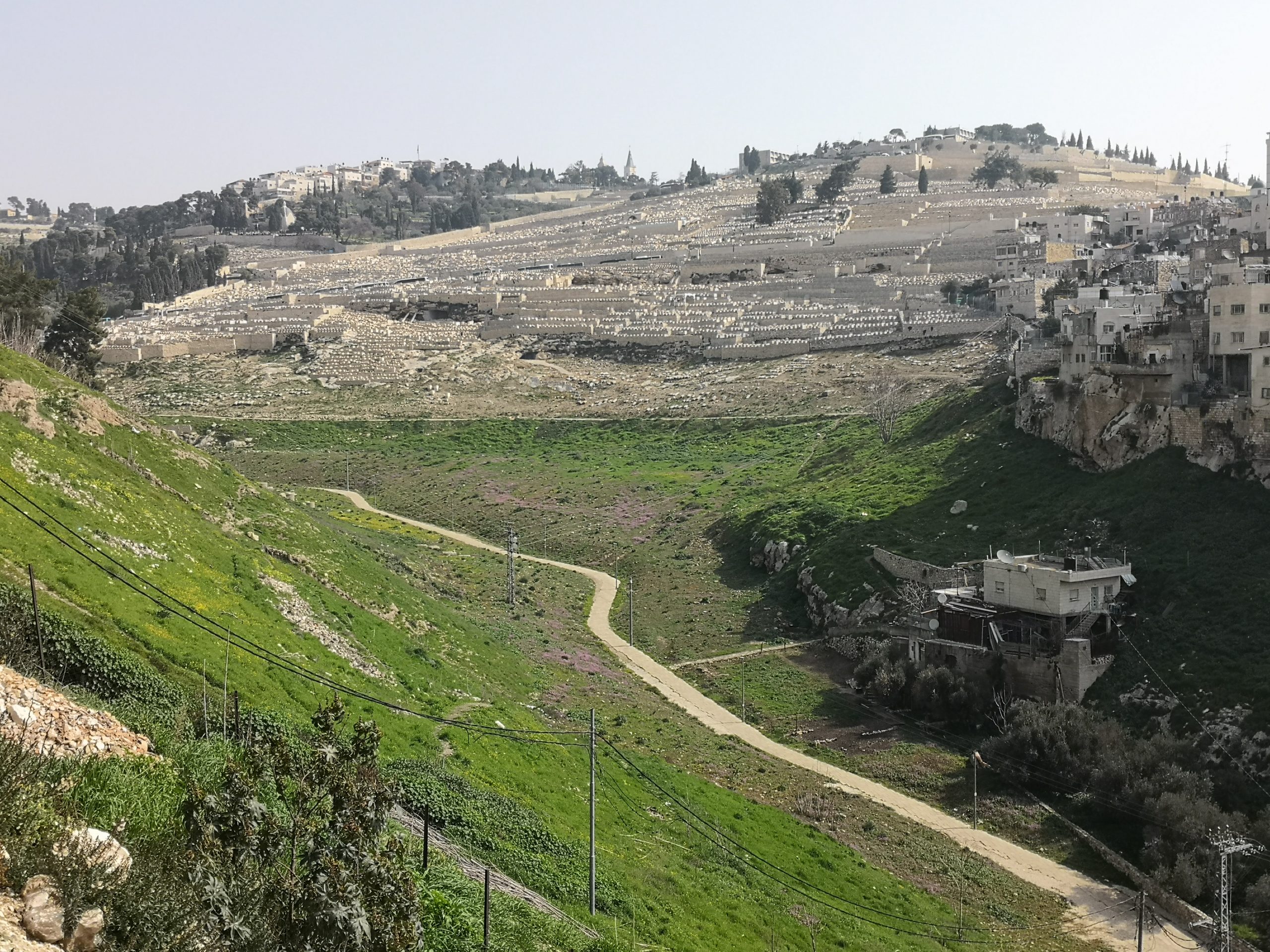
The Kidron Valley is the deep ravine that separates the Old City of Jerusalem and the Temple Mount from the Mount of Olives. It is one of the most layered landscapes in the world: a valley of kings and prophets, of tombs and judgment, of shadow and resurrection. For thousands of years, people have been buried here, prayed here, fled through here, and looked down into it from the walls above, seeing in its depths both death and the promise of life after death.
The valley runs north to south along the eastern wall of the Old City, passing between the Temple Mount and the ancient Jewish cemetery on the Mount of Olives, the largest and oldest Jewish cemetery in the world. In the Bible, King David crossed the Kidron while fleeing from his son Absalom (2 Samuel 15:23), and Jesus crossed it on the night of his arrest, walking from the Last Supper to the Garden of Gethsemane (John 18:1). The prophets Joel and Zechariah placed the final Day of Judgment here, in what Joel calls the Valley of Jehoshaphat: “I will gather all the nations and bring them down to the Valley of Jehoshaphat, and I will enter into judgment with them there” (Joel 3:2).
The Boundary Jerusalem
The Kidron Brook was the eastern boundary of Jerusalem. To cross it was to leave the city. When King Solomon placed Shimei ben Gera under house arrest in Jerusalem, he gave him a single warning: “The day you leave and cross the Kidron Valley, know for certain you will die” (1 Kings 2:37). Shimei agreed, lived in Jerusalem for three years, then crossed the Kidron to retrieve two runaway slaves. Solomon had him executed. The brook was a line you did not cross.
This gives new meaning to the movements of Jesus on his last night. The Last Supper took place inside the city. After the meal, tradition holds that Jesus walked east, through the city, past the Temple Mount, and descended into the Kidron Valley toward the Garden of Gethsemane on the Mount of Olives (John 18:1). On Passover eve, when Jewish law forbade leaving the city limits, tradition holds that Jesus walked to the farthest point he could, the Kidron, the ancient boundary, and crossed it. Whether this was a deliberate act of finality or simply the geography of the evening, it echoes the same boundary that David crossed in flight and Shimei crossed to his death.
The Monumental Tombs
The valley floor is lined with monumental rock-cut tombs from the Second Temple period, carved directly from the bedrock of the hillside. They are among the most iconic funerary monuments in Jerusalem, and they have stood in the shadow of the Temple Mount for over two thousand years.
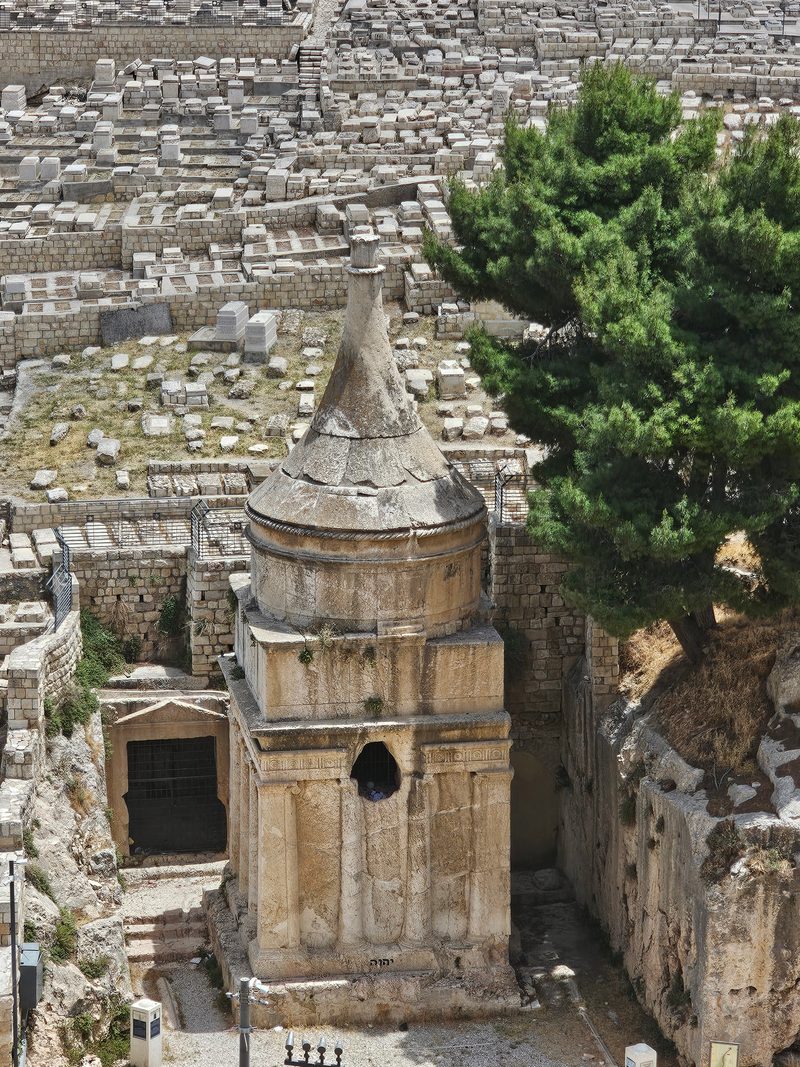
Absalom’s Pillar (Yad Avshalom) is the most striking, a cone-topped monument carved from a single piece of living rock in the 1st century CE. It stands over 20 meters high, its lower half cut from the bedrock and its upper section built of ashlar masonry topped with a concave conical roof. Despite its name, it has no connection to David’s son Absalom, who lived a thousand years earlier. The monument is a funerary memorial (nefesh) associated with an adjacent burial cave. For centuries, Jewish, Christian, and Muslim passersby threw stones at it, a tradition rooted in the belief that it marked the grave of the rebellious son, and that stoning it was a lesson against filial disobedience. The pile of stones at its base, cleared by archaeologists, was enormous.
Tombs and Burial Traditions
The Tomb of Zechariah next to Absalom’s Pillar, is a monolithic rock-cut monument topped with a pyramid that blends Egyptian, Ionic, and Doric architectural elements, a fusion of styles typical of Jerusalem’s Hellenistic period. The entire structure is carved from the bedrock, with no stones added, a single piece of mountain shaped into a monument. The craftsmanship required to carve a pyramid from living rock, leaving the surrounding cliff face intact, is extraordinary.
The Tomb of Bnei Hezir is the only monument in the Kidron Valley whose original owners are known. A Hebrew inscription above the columned entrance identifies the priestly family that commissioned it: the sons of Hezir, a family of Temple priests, in the 2nd century BCE. The inscription is one of the oldest Hebrew funerary inscriptions found in Jerusalem from the Second Temple period. The tomb features a Doric-columned porch carved into the cliff face, leading to burial chambers cut deep into the rock.
Together, these three monuments form a gallery of ancient funerary art unlike anything else in Israel. They stand at the base of the Mount of Olives, facing the Temple Mount across the narrow valley, positioned exactly where Jewish, Christian, and Muslim tradition places the final judgment.
The Valley of Judgment
Jewish, Christian, and Muslim traditions all identify the Kidron Valley as the Valley of Jehoshaphat, the place where the final judgment will take place at the end of days. The prophet Joel wrote: “I will gather all the nations and bring them down to the Valley of Jehoshaphat, and I will enter into judgment with them there” (Joel 3:2). The name Jehoshaphat itself means “God has judged.”
This belief explains the extraordinary density of graves on both sides of the valley. The Mount of Olives holds an estimated 120,000–150,000 Jewish graves, the oldest Jewish cemetery in continuous use in the world. The Muslim cemetery along the eastern wall of the Temple Mount is equally ancient. Everyone wants to be buried where the resurrection will begin. The Kidron Valley is, in the faith of three religions, the place where the dead will rise and face their maker, and the tombs crowd together on its slopes as if waiting in line.
The Monuments and Their Meaning
King David knew this valley intimately. His palace stood on the ridge above, overlooking the Kidron to the east. The valley below was steep, dark in the afternoon shadow of the Temple Mount, and lined with tombs even in his time. It is hard to stand on that ridge, looking down into the narrow gorge with its graves and its deep shade, and not hear the words of Psalm 23: “Even though I walk through the valley of the shadow of death, I will fear no evil, for You are with me” (Psalm 23:4). The Hebrew gei tzalmavet the valley of the shadow of death, may have been inspired by the view from David’s own doorstep. We cannot know this for certain, but the landscape fits the language so precisely that the connection has been made by scholars, pilgrims, and poets for centuries.
It was through this same valley that David fled when his son Absalom seized the throne. The Book of Samuel describes the king crossing the Kidron Brook on foot, weeping, barefoot, his head covered, climbing the Mount of Olives with his loyal followers while Jerusalem fell behind him (2 Samuel 15:23–30). A thousand years later, Jesus crossed the same valley on the night of his arrest, walking from the Last Supper on Mount Zion to the Garden of Gethsemane on the Mount of Olives (John 18:1). Both crossings, the king betrayed by his son, the teacher betrayed by his disciple, passed through the same dark ravine.
The Kidron Brook
The Kidron is a seasonal stream, dry most of the year, flowing only after heavy winter rains. It runs southward from the valley past the City of David through the Judean Desert, and empties into the Dead Sea. In antiquity, the brook carried the waste and ashes from the Temple sacrifices. When King Josiah and King Hezekiah destroyed idols and pagan altars as part of their religious reforms, they burned the objects and dumped the ashes into the Kidron Brook (2 Kings 23:4–6; 2 Chronicles 29:16), the valley was already associated with impurity, death, and the disposal of things that did not belong in the holy city above.
Visit with Hoshen Tours
The Kidron Valley is one of the most layered landscapes in Jerusalem. With Hoshen Tours, visitors explore the monumental tombs carved into the valley walls while tracing the ancient route between the Mount of Olives and the Old City. The walk often continues from the Mount of Olives Cemetery above, descending past the Tomb of the Virgin Mary and the Garden of Gethsemane toward the City of David to the south.
Ready to experience Israel in true colors?
Plan Your TourPrivate tours designed around your interests, schedule, and pace.