



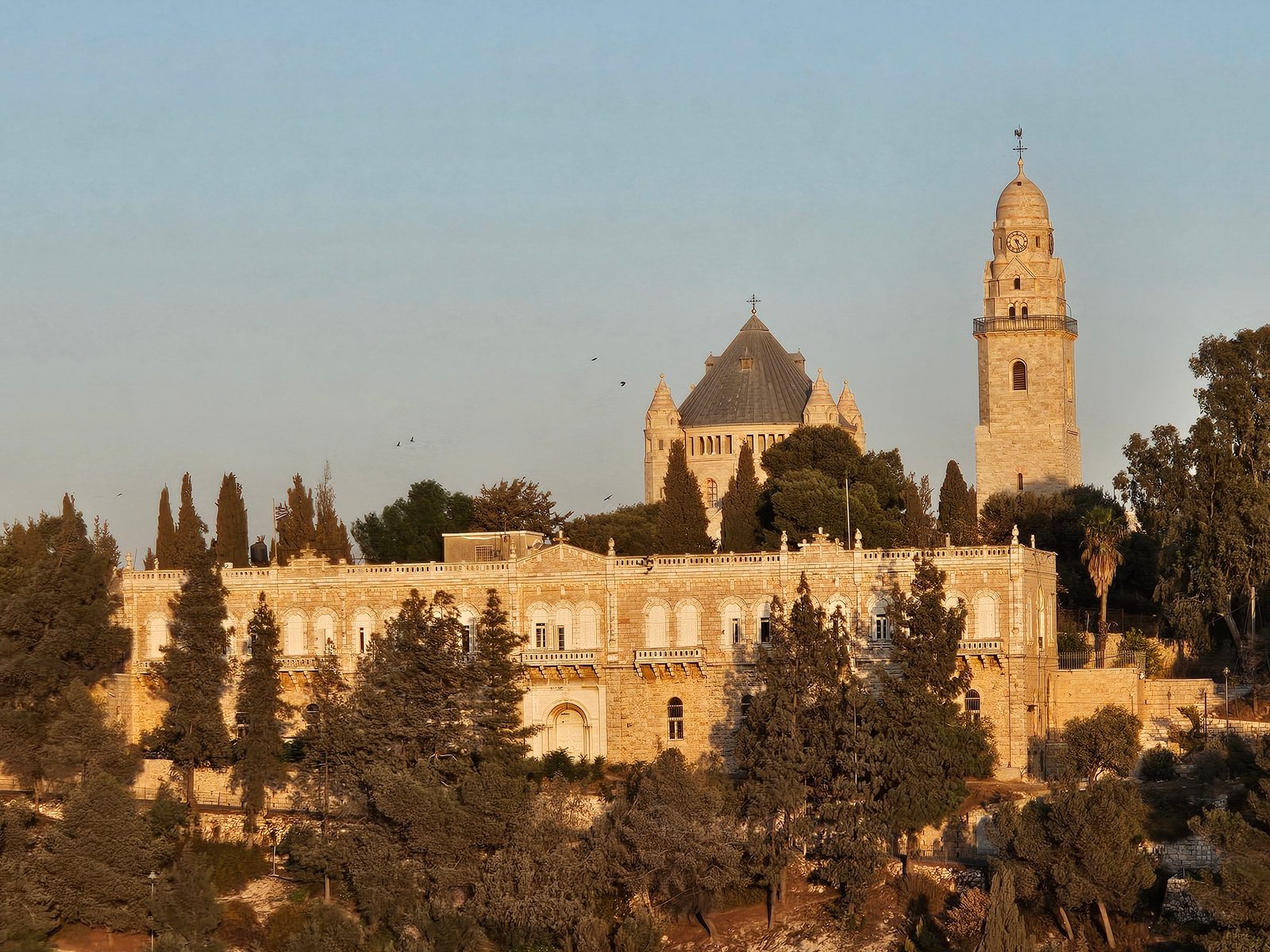
Mount Zion is the hill just south of the Old City walls, crowned by the Dormition Abbey and its iconic bell tower. It is a place where Jewish, Christian, and Muslim traditions converge on a single hilltop, and where the ancient, the medieval, and the modern history of Jerusalem all meet within a few hundred meters.
How the Name Traveled
The name “Zion” originally referred to a completely different place. In the Bible, “the stronghold of Zion” was the Jebusite fortress on the eastern ridge of Jerusalem, conquered by King David and renamed the City of David (2 Samuel 5:7). When Solomon built the Temple on the hilltop above, the name “Zion” migrated northward to the Temple Mount. After the destruction of the Temple, the name migrated again: this time to the larger, more prominent western hill. By the first century CE, the historian Josephus described this western hill as the “Upper City,” the wealthier and more elevated part of Jerusalem, and later Christian and Jewish tradition identified it as the true Mount Zion. The name has been here ever since, even though the original Zion was a kilometer to the east.
The Upper City
In the time of the Second Temple, Mount Zion, the western hill, was the neighborhood of Jerusalem’s elite. Josephus called it the Upper City and described it as the residence of the wealthy, the ruling class, and the high priestly families. Archaeological excavations on the hill and in the adjacent Jewish Quarter have uncovered palatial homes with mosaic floors, frescoed walls, private ritual baths, and even bathtubs: a luxury found elsewhere only in Herod’s palaces at Masada and Jericho. This was where power lived in ancient Jerusalem, looking across the valley at the Temple.
On the eastern slope of the hill, the Church of St. Peter in Gallicantu, built on the traditional site of the house of the high priest Caiaphas, offers a vivid glimpse of this world. Excavations beside the church have uncovered the remains of wealthy Herodian-period houses, complete with cisterns, storage rooms, and ritual baths, along with a stepped street that once descended from Mount Zion to the Kidron Valley. The steps, cut from bedrock, were certainly in use in the first century CE: a street that Jesus himself may have walked on the night of his arrest.
Jews and Christians on Mount Zion
After the Emperor Hadrian crushed the Bar Kokhba revolt in 135 CE and rebuilt Jerusalem as the pagan city Aelia Capitolina, Jews were banned from entering the city on pain of death. For centuries, the only exception was one day a year: Tisha B’Av, the fast day commemorating the destruction of the Temple, when Jews were permitted to enter Jerusalem to mourn. Early Christian pilgrims describe Jews coming to weep and rend their garments at the stones of the ruined Temple.
In 438 CE, the Empress Eudocia, wife of the Byzantine Emperor Theodosius II, visited Jerusalem on pilgrimage and took a remarkable step: she granted Jews permission to pray at the Temple Mount not only on Tisha B’Av but also on Jewish holidays. The news drew thousands of Jews back to the city, hoping for a restoration of Jewish life in Jerusalem. But the tolerance was short-lived. Christian monks attacked the Jewish worshippers, and the permissions were revoked. For almost two more centuries, until the Muslim conquest in 638, Jews remained largely barred from their holiest city. Mount Zion, the nearest hilltop to the Temple Mount that remained accessible at various points in history, became a place of Jewish longing: a connection to what had been lost.
The Sites
Mount Zion packs an extraordinary density of sacred and historical sites into a small area. The Cenacle (Upper Room) marks the traditional site of the Last Supper and the descent of the Holy Spirit at Pentecost. Directly below it, the Tomb of King David, almost certainly not his actual burial place, but venerated for centuries, is one of the most intense Jewish prayer spaces in the city. The Dormition Abbey, completed in 1910 by German Benedictines, marks where tradition holds the Virgin Mary fell into eternal sleep. The Holocaust Chamber, established in 1949 before Yad Vashem existed, was Israel’s first Holocaust memorial. And the Catholic cemetery on the hillside contains the grave of Oskar Schindler, who asked to be buried in Jerusalem.
Between the Wars: 1948–1967
When the Jewish Quarter fell to the Jordanian Arab Legion in May 1948, Mount Zion became the closest point in Israeli-held Jerusalem to the Old City walls. The hilltop remained in Israeli hands, but just barely. Zion Gate, riddled with bullets from the failed Palmach breakthrough on May 17–18, was sealed shut, and the armistice line ran along the foot of the hill.
For 19 years, Mount Zion was a frontier. The Tomb of King David, suddenly the closest accessible Jewish holy site to the lost Temple Mount, became a place of intense pilgrimage. Israel’s second president, Yitzhak Ben-Zvi, maintained a room on the rooftop of the David’s Tomb building where he would come to pray and gaze across at the Old City walls. The hilltop was dotted with military positions, and the proximity to the Jordanian-held Old City made it one of the most sensitive points along the divided city’s border.
Zion Gate
Zion Gate (Sha’ar Tzion) is the entrance to the Old City from Mount Zion, and the most battle-scarred of Jerusalem’s gates. On the night of May 17–18, 1948, a Palmach unit under David Elazar (later IDF Chief of Staff) broke through the gate and briefly reached the besieged Jewish Quarter. But the exhausted force could not hold the position, and within days the quarter fell. The hundreds of bullet holes that pockmark the stone on both sides of the gate have been deliberately preserved. In June 1967, Israeli paratroopers entered the Old City through Zion Gate and the Lions’ Gate, reuniting the city after 19 years of division.
Visit with Hoshen Tours
Mount Zion packs three faiths and two thousand years into a single hilltop. Hoshen Tours walks the hill from Zion Gate to the Cenacle, from King David’s Tomb to the Dormition Abbey, telling the story of a name that migrated across the city, a neighborhood that housed kings and priests, and a frontier that held for 19 years until the city was reunited.
Explore Our Tour Collection
Ready to experience Israel in true colors?
Plan Your TourPrivate tours designed around your interests, schedule, and pace.