



The ancient synagogue at Huqoq, a small village in the lower Galilee west of the Sea of Galilee, has produced some of the most extraordinary mosaics ever found in Israel. Since excavations began in 2012 under the direction of Jodi Magness of the University of North Carolina, the 5th-century synagogue has revealed mosaic floors depicting scenes never before seen in Jewish art, rewriting our understanding of what ancient Jews considered appropriate to depict in their sacred spaces.
Mosaics That Rewrote History
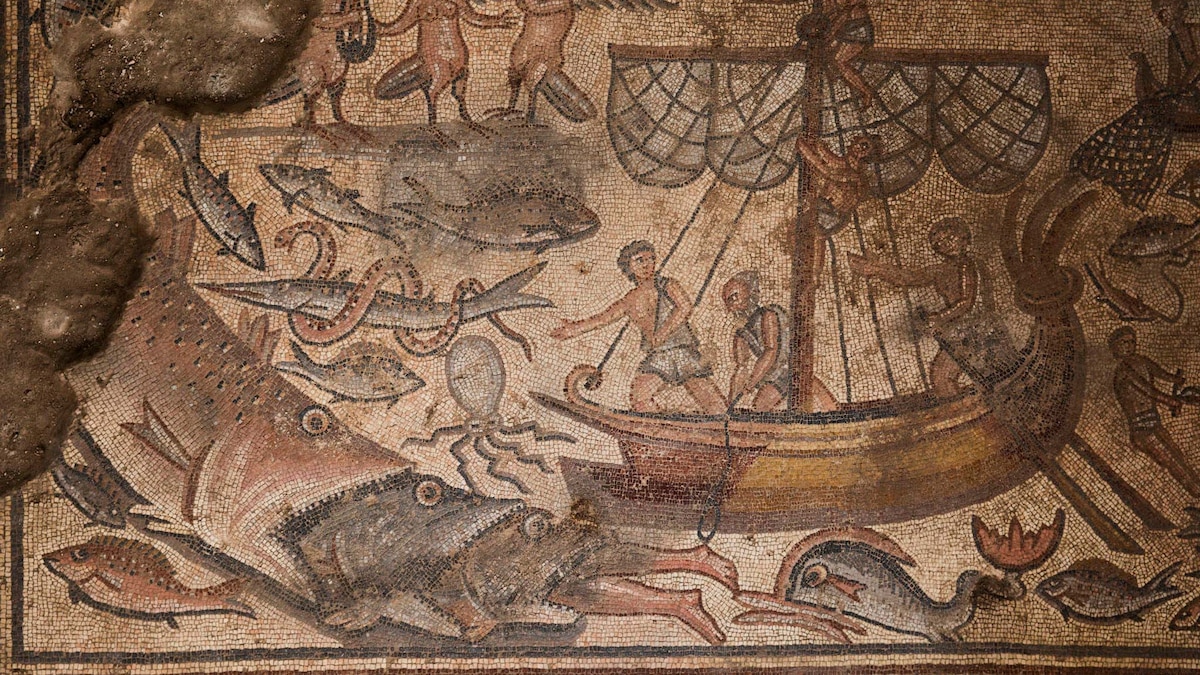
The Huqoq mosaics are remarkable for both their quality and their subject matter. Scenes include Samson carrying the gate of Gaza on his shoulders, Samson tying torches to the foxes’ tails, the meeting of two richly dressed figures (possibly Alexander the Great meeting the Jewish high priest), a scene with elephants that may depict a battle from the Maccabean period, and panels showing the building of a monumental structure (possibly the Tower of Babel or the construction of the Temple). The craftsmanship is among the finest of any ancient mosaic found in Israel, with vivid colors, detailed faces, and naturalistic rendering of animals.
Why It Matters
The Huqoq mosaics challenge the assumption that ancient Jews avoided figurative art. The synagogue contains images of human figures, animals, mythological scenes, and possibly pagan imagery, all in a building dedicated to Jewish worship. The mosaics at Beit Alpha had already shown that zodiac wheels and Helios were acceptable in synagogues, but Huqoq goes further: the scenes are narrative, dramatic, and draw on both Jewish and non-Jewish artistic traditions.
The Ongoing Excavation and Its Mosaics
The excavation at Huqoq is ongoing, and new panels are uncovered each season. The site is not yet open to the public as a permanent display, but the mosaics have been published in academic journals and featured in major media. The finds are expected to remain at the site when the excavation is complete, making Huqoq a future destination for visitors interested in ancient Jewish art.
The Village and the Synagogue
Huqoq was a Jewish agricultural village during the Roman and Byzantine periods, set on a hillside overlooking the Sea of Galilee. The village is mentioned in the Talmud as a boundary marker for the territory of the tribe of Naphtali, and ancient sources describe it as a prosperous farming community known for its mustard production. The synagogue, built in the late 4th or early 5th century CE, was a monumental structure — its walls constructed from carefully cut local limestone, its floor paved with some of the most elaborate mosaics ever found in a synagogue anywhere in Israel.
What makes the Huqoq mosaics so extraordinary is not just their artistic quality but their subject matter. Alongside expected biblical scenes, the artists depicted episodes rarely — or never — seen in other ancient synagogues. A scene showing Samson carrying the gate of Gaza on his shoulders. The building of the Tower of Babel with workers hauling stones. And most remarkably, a non-biblical scene that appears to depict a meeting between Alexander the Great and a Jewish high priest — an image found nowhere else in ancient Jewish art. The excavations, led by Professor Jodi Magness of the University of North Carolina since 2011, continue to yield new discoveries each season.
Visit with Hoshen Tours
Huqoq is an emerging site that will become a major attraction when fully excavated. Hoshen Tours follows the discoveries and includes Huqoq context in Galilee itineraries.
Visitors exploring the Galilee often combine Huqoq Synagogue with nearby destinations such as Capernaum, Sea of Galilee, and Mount Arbel, each offering its own distinctive perspective on the region’s layered history and landscape. A broader itinerary might also include Tabgha and Zippori, both within easy reach and rich in their own right.
Every Hoshen Tours itinerary is private and fully customizable. Contact us to begin planning your journey through the Galilee.
Ready to experience Israel in true colors?
Plan Your TourPrivate tours designed around your interests, schedule, and pace.