



Korazim (Chorazin) is a ruined town on the basalt hills above the Sea of Galilee, one of three towns cursed by Jesus for rejecting his message: “Woe to you, Chorazin! Woe to you, Bethsaida! For if the miracles that were performed in you had been performed in Tyre and Sidon, they would have repented long ago in sackcloth and ashes” (Matthew 11:21). The ruins, built entirely of black basalt, include one of the finest ancient synagogues in Israel.
The Synagogue and Its Treasures
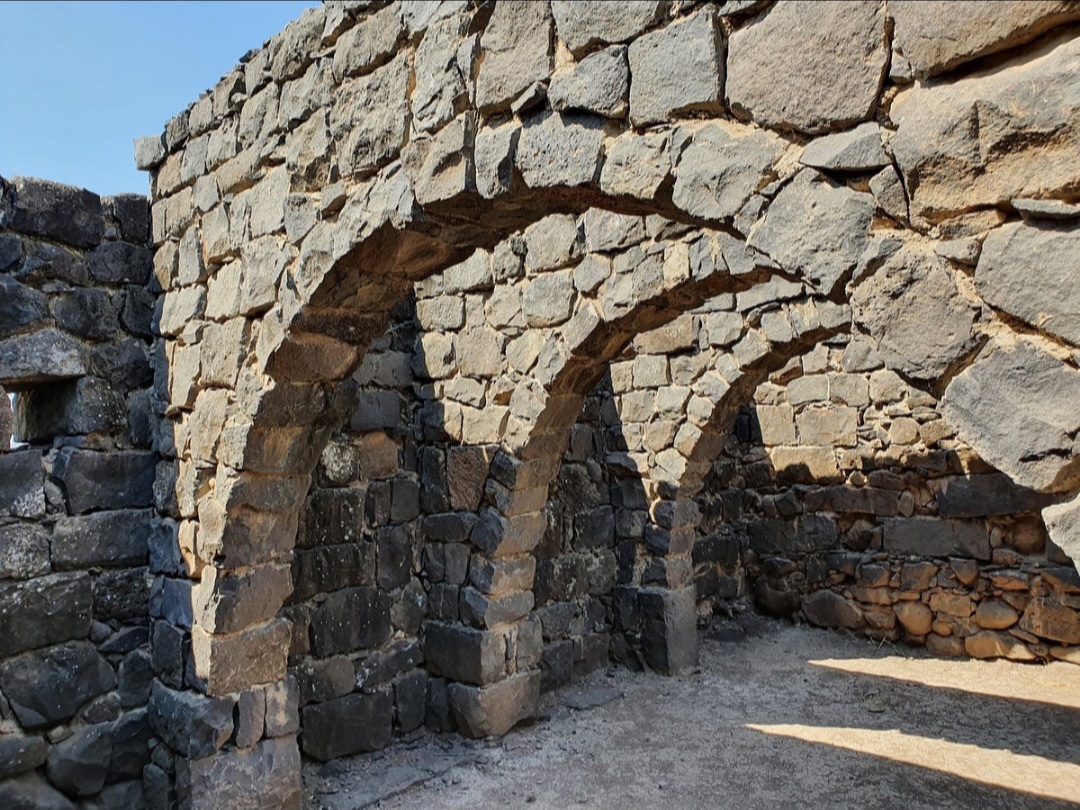
The Korazim synagogue dates to the 3rd, 4th century CE, built after the destruction of the earlier town that Jesus knew. The building is made of the dark basalt that defines the architecture of the Golan and upper Galilee, and its carved decorations are among the finest in any ancient synagogue. Medusa heads, lions, eagles, vine scrolls, and geometric patterns cover the basalt blocks with a level of craftsmanship that demonstrates the wealth and sophistication of the community that built it. The synagogue faced Jerusalem in the manner prescribed by Jewish tradition, and its interior would have held benches along three walls where the congregation sat during Torah readings and sermons.
The most significant find at Korazim is a carved basalt chair identified as a “Seat of Moses” (Cathedra of Moses), a ceremonial seat in the synagogue associated with the public reading and teaching of Torah. Jesus referenced this institution directly: “The teachers of the law and the Pharisees sit in Moses’ seat” (Matthew 23:2). The Korazim chair is one of the best-preserved examples of this type of object known from any ancient synagogue, and it provides striking physical evidence for a practice described in the Gospels centuries before the synagogue itself was built. The chair connects the New Testament text to the archaeological record in a way that few artifacts in Israel can match.
Jesus and Korazim
Despite the synagogue’s grandeur, Korazim is remembered in the Gospels not for what happened there but for what didn’t. Jesus pronounced judgment on the town alongside Capernaum and Bethsaida: “Woe to you, Chorazin! Woe to you, Bethsaida! For if the miracles that were performed in you had been performed in Tyre and Sidon, they would have repented long ago in sackcloth and ashes” (Matthew 11:21). The curse is chilling because it implies that great miracles were indeed performed here, miracles that the Gospels do not even record, and the town still refused to repent. Walking through the ruins of Korazim, knowing that Jesus cursed this place, gives the silent basalt stones a weight that other archaeological sites do not carry.
The synagogue and surrounding buildings are constructed entirely of the local dark basalt, and the quality of the stone carving is exceptional. The facades feature Medusa-like faces (unusual and debated in a Jewish context), lions, eagles, vine scrolls, geometric patterns, and grape clusters, an ornamental richness that reveals a prosperous and culturally sophisticated Jewish community in the late Roman and Byzantine periods. The contrast between the curse pronounced by Jesus in the 1st century and the thriving Jewish town that flourished here in the 4th, 5th century raises questions about continuity, destruction, and rebuilding that make Korazim more than a pile of old stones.
The Ancient Town and the National Park
The excavated town extends well beyond the synagogue. Residential buildings, ritual baths (mikva’ot), street paving, and domestic installations have all been uncovered, all constructed from the same distinctive dark basalt. Among the most important finds are large stone olive presses, heavy basalt crushing wheels and pressing platforms, that confirm olive oil production as the primary industry of ancient Korazim. The town sat in a landscape of olive groves, and the oil they pressed would have been traded throughout the region. The overall picture that emerges from the excavations is of a prosperous agricultural community sustained by olive oil, grain, and the regional trade that flowed through the Galilee in the Roman and Byzantine periods. The site’s hilltop location, about 300 meters above the Sea of Galilee, offers panoramic views of the lake below and the Golan Heights beyond.
Archaeological Discoveries
Among the most intriguing finds at the site are built-in wall niches in the residential buildings, discovered here for the first time and now known as “Korazim Windows.” These stone-framed openings, shaped like small cabinets or cupboards set into the basalt walls, have puzzled archaeologists since their discovery. No one knows for certain what they were used for. They may have served as room dividers within a house, replacing a full wall with a windowed partition. They may have been storage niches, display alcoves, or something else entirely. The mystery is part of what makes Korazim unique, a town that left behind architecture found nowhere else in the ancient world, and no instructions for how to read it.
Korazim is maintained as an Israeli national park with well-marked walking trails that wind through the ruins. The main trail loops past the synagogue, the Seat of Moses display, the residential quarters, the olive press installations, and a viewpoint overlooking the Sea of Galilee. The trail takes approximately one to one and a half hours at a comfortable pace. The basalt ruins absorb heat in summer, so early morning visits are recommended during July and August. The park has a parking area, visitor facilities, and entry signs with site maps. Because Korazim receives fewer visitors than Capernaum or the Mount of Beatitudes, the atmosphere at the site is typically quiet and unhurried, a contrast that makes it possible to stand among the ruins in something approaching the silence the place deserves.
Visit with Hoshen Tours
Korazim connects the Gospel narrative to the physical landscape of the Galilee in a way that few sites can. The combination of a Gospel curse, a magnificent synagogue, a physical Seat of Moses, and the mystery of the Korazim Windows makes it one of the most intellectually rich sites in the region. Hoshen Tours includes Korazim alongside Capernaum and the Mount of Beatitudes, building a complete picture of Jesus’ ministry around the northern shore of the Sea of Galilee and the towns that received his teaching, some with faith, and some, as the ruins of Korazim attest, without it. Hoshen Tours often combines this site with Nazareth, Hamat Tiberias, and Kafr Kanna for a memorable day exploring the region.
Explore Our Tour Collection
Ready to experience Israel in true colors?
Plan Your TourPrivate tours designed around your interests, schedule, and pace.