



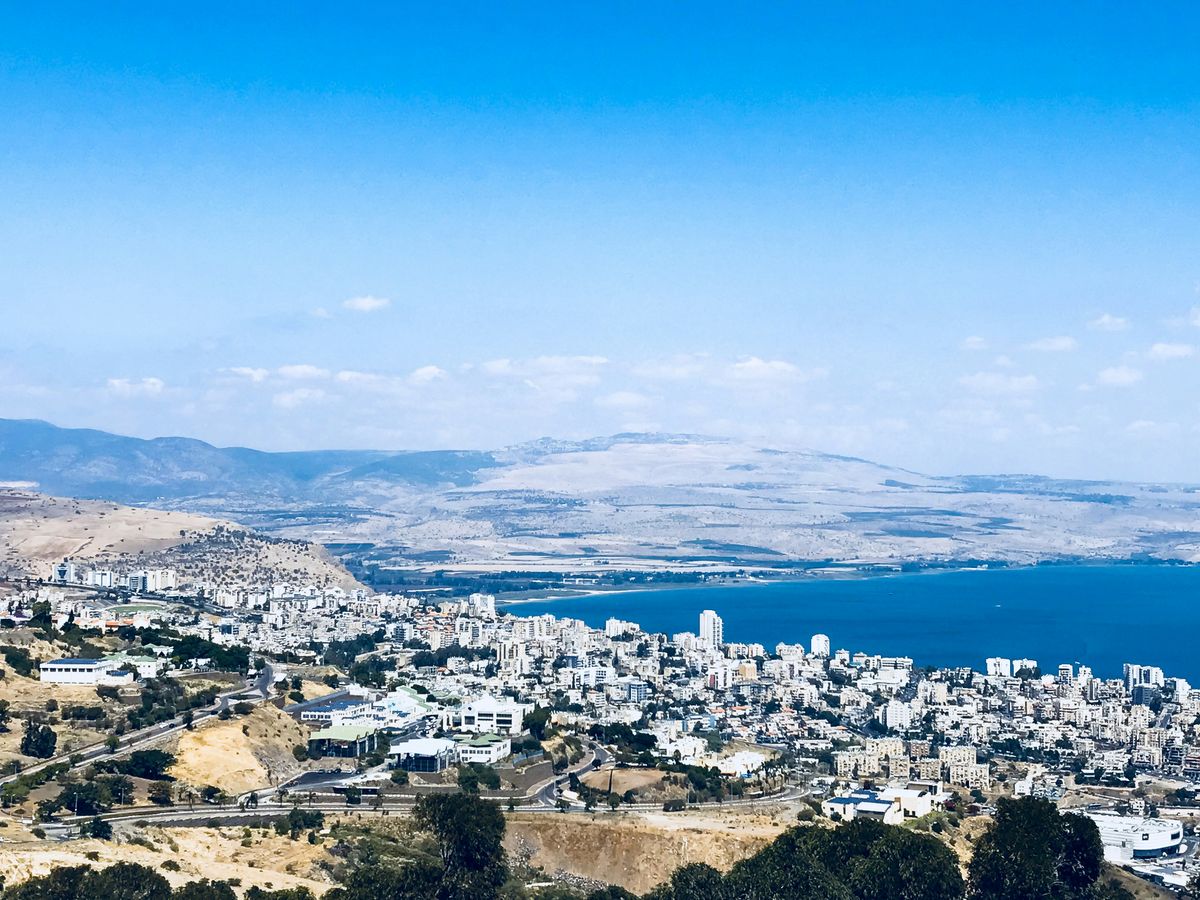
Tiberias Israel is one of Judaism’s four holy cities, alongside Jerusalem, Hebron, and Safed. Founded between 18 and 20 CE by Herod Antipas and named after the Roman Emperor Tiberius, the city sits on the western shore of the Sea of Galilee and has been a center of Jewish learning, burial, and pilgrimage for nearly two thousand years. The Sanhedrin settled here after the destruction of Jerusalem. The Jerusalem Talmud was compiled here. The Masoretes, the scholars who stabilized the text and pronunciation of the Hebrew Bible, did their defining work here. Maimonides is buried here, along with a concentration of the most revered sages in Jewish history. No other city outside Jerusalem holds so many layers of Jewish significance in so small a space.
Herod Antipas and a Cursed Founding Galilee
Herod Antipas, son of Herod the Great and tetrarch of Galilee and Perea, built Tiberias as his capital between 18 and 20 CE. He named the city after the reigning Roman Emperor Tiberius, a calculated act of flattery that reflected Antipas’s careful cultivation of Roman favor. But the site he chose created an immediate and serious problem: Tiberias was built directly on top of an ancient cemetery, which rendered the entire city ritually impure under Jewish law. Contact with the dead was among the gravest sources of impurity in Jewish tradition, and a city built over graves was effectively uninhabitable for observant Jews. Antipas solved the problem with a combination of incentives and compulsion. He offered free land, free houses, and exemption from taxes to anyone willing to settle in the new capital.
Some settlers came willingly. Others, tradition holds, were moved by force from surrounding towns. The result was a mixed population of Gentiles, Jewish settlers of varying observance, and freed slaves, a social composition quite different from the more homogeneous Jewish towns around the lake. The Gospels record that Jesus, who spent the central years of his ministry on the shores of the Sea of Galilee, apparently never entered Tiberias during his public ministry. Whether this reflects the city’s ritual impurity, its Herodian associations, or some other consideration, the pattern has been noted by scholars and pilgrims alike for many centuries.
One of Judaism’s Four Holy Cities
In Jewish religious tradition, four cities hold a special sanctity above all others: Jerusalem, Hebron, Safed, and Tiberias. Each of the four is associated in kabbalistic thought with one of the classical elements, Jerusalem with fire, Hebron with earth, Safed with air, and Tiberias with water, a fitting designation for a city that has drawn Jewish pilgrims to the edge of this lake for two thousand years. This designation as one of the arba kehillot kedoshot, the four holy congregations, reflects both biblical and rabbinic heritage and the continuous Jewish presence these cities maintained across centuries of conquest and change. While Jews were expelled or marginalized in many other places, these four cities retained functioning communities and remained centers of Jewish religious life. Tiberias earned its place through the extraordinary density of rabbinic learning, sanctified burial, and continuous devotion that accumulated here across the post-Temple centuries, a living tradition that outlasted empires and endures to the present day.
The Sanhedrin and the Jerusalem Talmud
After the destruction of the Second Temple in 70 CE and the failure of the Bar Kokhba revolt in 135 CE, the center of Jewish intellectual and religious life shifted northward into the Galilee. The Sanhedrin, the supreme rabbinic court that had once sat in Jerusalem, moved through several Galilean cities before eventually settling in Tiberias, where it remained until it was formally dissolved in the early 5th century CE. During these centuries, Tiberias was the de facto capital of Jewish civilization in the Land of Israel. It was here that the Jerusalem Talmud (Talmud Yerushalmi) was compiled and edited, a process completed around 400 CE. Despite its name, the Jerusalem Talmud was produced almost entirely in Tiberias, the name reflects its authority as the product of the academies of the Land of Israel, not its place of composition.
The Talmud Yerushalmi records the legal discussions and decisions of the Palestinian sages across several centuries, and it remains a foundational text of Jewish law and thought to this day. The Masoretes, the scholars who between the 6th and 10th centuries CE standardized the vowel markings and cantillation notes of the Hebrew Bible, also worked in Tiberias. The Tiberian vocalization system they developed became the standard for all subsequent Jewish reading of Scripture, and the text of the Hebrew Bible as read in synagogues around the world today bears the precise marks of their meticulous work on this lakeside city’s shores.
A City of Tombs: The Great Sages
Tiberias is one of the most important pilgrimage destinations in Israel because of the extraordinary concentration of rabbinic tombs in and around the city. Maimonides (the Rambam), the greatest Jewish philosopher, physician, and legal authority of the medieval period, is believed to be buried on the lakefront, where a white-and-black marble tomb has drawn pilgrims and scholars for centuries. Rabbi Meir Baal HaNes, the Talmudic sage whose name means “miracle worker,” is traditionally buried above the hot springs at Hamat Tiberias, and his tomb is one of the most visited pilgrimage sites in the entire country. Rabbi Akiva, the greatest of the Talmudic-era sages and a figure of towering importance in Jewish law, legend, and martyrology, is buried on the hillside above the city, his tomb marked by a distinctive cylindrical structure visible from the shore.
Rabbi Yochanan ben Zakkai, the sage credited with saving Judaism after the Temple’s destruction by negotiating with Vespasian and establishing the academy at Yavneh, is traditionally buried in Tiberias as well. The density of sacred burial here is unmatched outside Jerusalem. To walk through the older parts of the city is to move through a landscape saturated with Jewish memory, a place where the greatest minds of two millennia of Jewish thought chose, or were brought, to rest.
Crusader Tiberias and the Road to Hattin
When the Crusaders captured the Holy Land in 1099, they organized their conquests into feudal lordships. Tiberias became the capital of the Principality of Galilee, one of the most strategically valuable of the Crusader territories, given its position at the center of the fertile Galilee and beside the lake. The city was fortified, churches were built, and a Crusader court was established on the shores of the Sea of Galilee. But Tiberias is most fatefully remembered as the spark that ignited the decisive battle of the entire Crusader period. In the summer of 1187, Saladin, the Ayyubid sultan who had united the Muslim world against the Crusader states, launched a calculated provocation: he attacked Tiberias and besieged the citadel while the wife of Count Raymond III held out inside.
Raymond himself counseled patience, arguing that Tiberias was not worth the risk of marching an army through the scorched hills of the Galilee in high summer without a secure water supply. But King Guy of Lusignan overruled him and led the Crusader army away from the water sources of Sepphoris toward Tiberias, directly into Saladin’s prepared trap. At the twin volcanic peaks known as the Horns of Hattin, a ridge visible from much of the Galilee, the Crusader army was surrounded, cut off from water, and destroyed on July 4, 1187. Jerusalem fell three months later. The effective end of the Crusader kingdom in the Holy Land began at Tiberias.
Ottoman Tiberias and the Modern City
Under Ottoman rule, Tiberias was gradually rebuilt and resettled. In the 16th century, Suleiman the Magnificent granted the city and its surrounding region to Doña Gracia Nasi and her nephew Joseph Nasi, a remarkable Jewish family of Portuguese origin who had fled the Inquisition and risen to extraordinary influence at the Ottoman court. They embarked on a project to rebuild Tiberias as a flourishing Jewish city, encouraging immigration from Jewish communities across the Mediterranean. The effort was only partly realized, but it stands as one of the earliest organized attempts at Jewish settlement and renewal in the Land of Israel in the early modern period. The distinctive black basalt walls that still define parts of old Tiberias date to the Ottoman period of reconstruction, the volcanic stone of the Galilee giving the city a darker, more austere character than the white limestone of Jerusalem or Safed.
A catastrophic earthquake in 1837 killed much of the population and destroyed most of the existing structures. The city was rebuilt across the 19th century, and Jewish immigration accelerated through the early 20th century. Modern Tiberias is the largest city on the Sea of Galilee, with a lakefront promenade lined with hotels, restaurants, and fish markets, and a rough-edged urban vitality that contrasts with the quiet sanctity of the surrounding pilgrimage sites. On Friday afternoons, families make their way to the tombs for Shabbat prayers, and the sound of psalms drifts out across the water.
Just south of the city, Hamat Tiberias preserves a 4th-century synagogue with a remarkable ancient mosaic floor that is one of the most theologically surprising objects in Israel, full details on the Hamat Tiberias page.
Gateway to the Sea of Galilee
Tiberias is the only true city directly on the lake’s shore, and most Christian pilgrimage groups base themselves here, fanning out each morning to the circle of sacred sites within a short drive in every direction:
- Capernaum, ~15 min north
- Tabgha, ~15 min north
- Magdala, ~10 min north
- Mount of Beatitudes, ~20 min north
- Yardenit, ~15 min south
On the Tiberias waterfront itself stands the Franciscan Church of St. Peter, a modest stone church maintained by the Franciscan Custody of the Holy Land, built on the site tradition associates with the calling of Simon Peter and his brother Andrew, when tradition holds that Jesus walked along this very shore and said he would make them fishers of men. The church faces directly onto the lake, and for many pilgrims a quiet moment here, looking out at the same water the disciples worked, becomes one of the most affecting stops of the entire Galilee visit.
The waterfront promenade itself rewards unhurried time. In the early morning, fishing boats are still low on the glassy surface of the lake. By midday the restaurants along the shore are serving St. Peter’s fish, the tilapia that has been caught in these waters since antiquity, grilled and laid out with salads and fresh bread. In the evening, as the sun drops behind the Galilee hills to the west, the light turns the water gold, then deep orange, and the hills of the Golan on the far shore go dark and purple. It is the kind of sunset that makes it easy to understand why so many of the stories connected to this lake involve people stopping what they were doing and simply following.
Visit with Hoshen Tours
Tiberias is where Jewish history, Christian pilgrimage, and the extraordinary landscape of the Sea of Galilee converge in a single place. Hoshen Tours designs full days around the lake that move between the tombs of Maimonides and Rabbi Meir Baal HaNes, the Hamat Tiberias synagogue, the Gospel sites of the northern shore, and the lakefront itself, drawing the threads of Jewish and Christian history together against the backdrop of one of the most storied bodies of water in the world. Shuki Cohen brings deep knowledge of every layer of this landscape, from the Talmudic academies to the Crusader battlefield to the fishing boats on the morning lake, helping guests understand how a single city and a single lake have shaped so much of the history of faith.
Visitors exploring the Galilee often combine Tiberias with nearby destinations such as Sea of Galilee, Mount Arbel, and Yardenit Baptismal Site, each offering its own distinctive perspective on the region’s layered history and landscape. A broader itinerary might also include Rabbi Meir Baal HaNes and Kinneret Cemetery, both within easy reach and rich in their own right.
Every Hoshen Tours itinerary is private and fully customizable. Contact us to begin planning your journey through the Galilee. Hoshen Tours often combines this site with Nazareth, Hamat Tiberias, and Kafr Kanna for a memorable day exploring the region.
Explore Our Tour Collection
Ready to experience Israel in true colors?
Plan Your TourPrivate tours designed around your interests, schedule, and pace.