



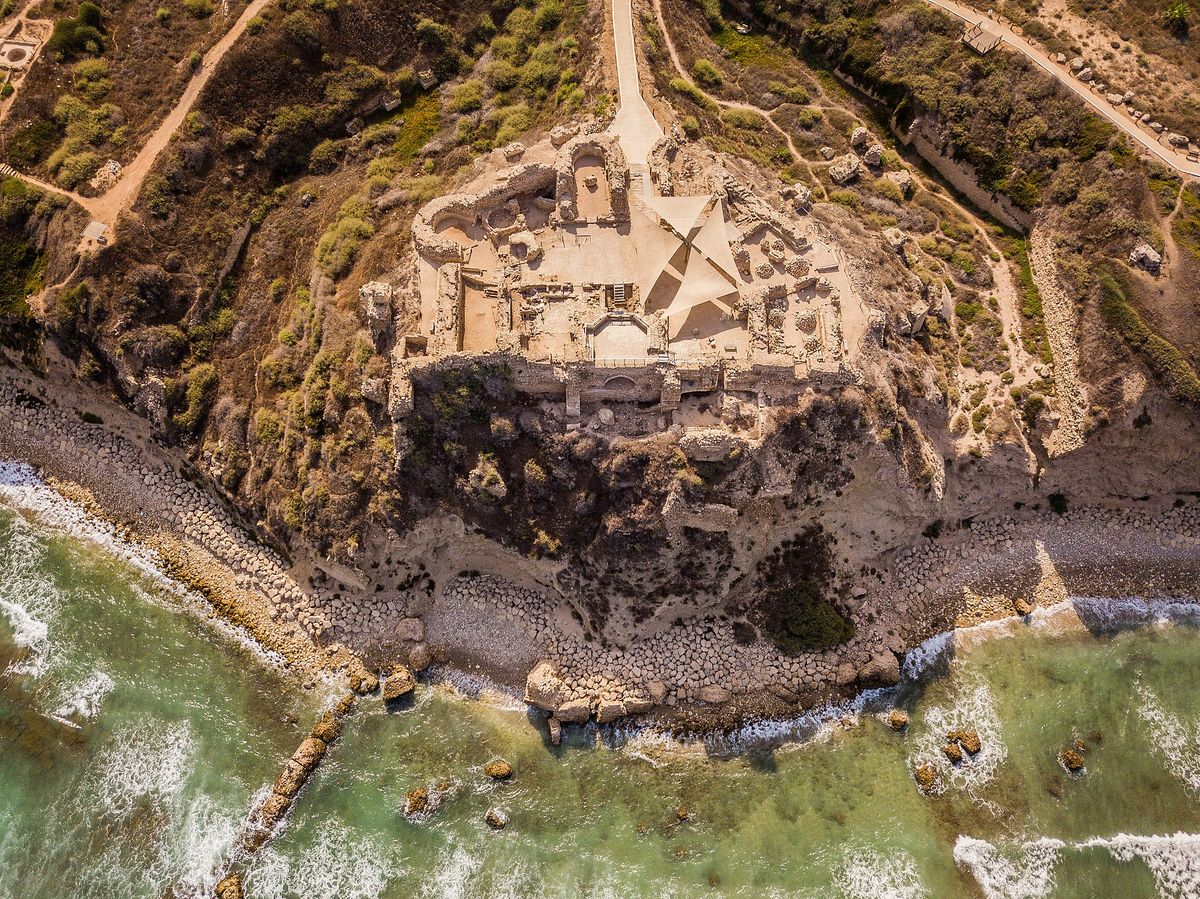
Apollonia (Arsuf) is a Crusader fortress on a sandstone cliff above the Mediterranean, north of Herzliya. Built in the 13th century on the ruins of an ancient port city, it was the site of a pivotal battle in 1191 when Richard the Lionheart defeated Saladin on the plain below, then destroyed by the Mamluks in 1265 after a siege that ended Crusader presence on this stretch of coast. Today it is one of Israel’s most striking archaeological parks, where medieval walls rise above a cliff edge with open sea on three sides.
Ancient Phoenician and Greek City
A Phoenician port flourished here from at least the 6th century BCE, valued for its position on the coastal road linking Egypt to the northern Levant. The city was later named Apollonia after the Greek god Apollo, reflecting its Hellenistic character following Alexander the Great’s campaigns.
One of Apollonia’s most notable industries was the production of purple dye from murex sea snails. Excavations have uncovered large quantities of crushed murex shells, the signature of a Tyrian purple workshop. This dye was among the most expensive commodities in the ancient world, and its production here connected Apollonia to the wider Phoenician trading network across the Mediterranean.
During the Roman period the city grew into a prosperous coastal town, with a villa, mosaic floors, and an active glass-making industry that took advantage of the high-quality local sand. By the Byzantine era it remained inhabited, before Arab conquest in 640 CE closed the classical chapter on this coast.
The Crusader Fortress
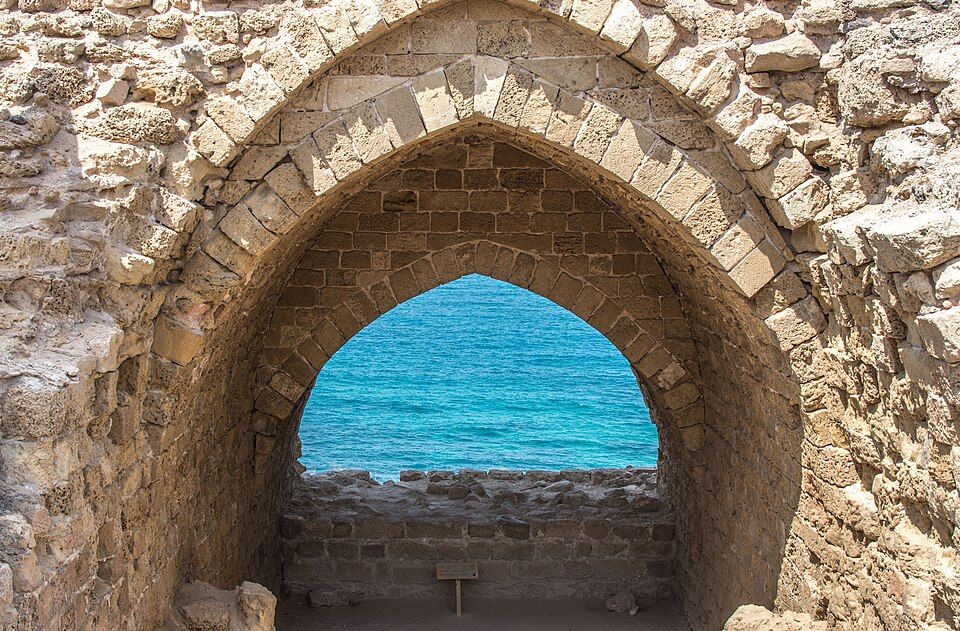
The Crusaders recognized the strategic value of the bluffs at Arsuf early on. The fortress here formed part of a chain of strongholds defending the coastal road, the lifeline connecting the ports of Acre and Jaffa.
The builders used the natural topography well. Three sides face the sea and the cliff, leaving only the eastern approach to defend. There the Crusaders cut a dry moat more than twenty meters wide directly into the kurkar (coastal sandstone), and beyond it raised a glacis — a sloped wall angled so that projectiles from above would skip off the face, denying attackers any shelter at the base. The main walls, towers, and gatehouse are well preserved and give a clear sense of how the fortress once looked. It passed from the Ibelin family, one of the great noble houses of the Kingdom of Jerusalem, to the Knights Hospitaller, who held it until Baybars arrived.
The Battle of Arsuf, 1191
On September 7, 1191, Richard I of England was leading his army south from Acre toward Jaffa during the Third Crusade, with his fleet sailing parallel to supply the column. Saladin, who had reconquered Jerusalem four years earlier at the Battle of Hattin, harassed the marching column with cavalry and archers, hoping to provoke a premature charge that would break the Crusader formation and leave the knights isolated.
Richard held his men in tight formation through hours of punishment. The Hospitallers, marching at the rear and taking the heaviest fire, were near their limit. When they finally broke ranks and charged without orders, Richard saw no choice but to call a general advance. The coordinated charge caught Saladin’s cavalry off balance and drove his army from the field.
The victory restored Crusader morale after the disaster at Hattin, secured the coastal road and its vital supply line, and opened the way to Jaffa — the essential base for any push toward Jerusalem. Saladin called it a heavy blow. The battle remains one of the finest examples of medieval battlefield discipline and command.
Destruction by Baybars, 1265
The end came at the hands of Mamluk Sultan Baybars, one of the most effective military commanders of the medieval period. After taking Caesarea in 1265, he turned on Arsuf. The Hospitaller garrison held out for forty days — one of the longer sieges Baybars faced in his systematic campaign to clear every Crusader stronghold from the coast. When the garrison finally surrendered, Baybars demolished the fortress rather than occupy it. By rendering Arsuf unusable, he ensured that even if a Crusader fleet arrived offshore, there would be no harbor to shelter in and no walls to defend. The site was left as rubble on the cliff edge and was never rebuilt.
The Archaeological Park Today
Tel Aviv University has been excavating Apollonia since 1994, and the site is now a national park operated by the Israel Nature and Parks Authority. The excavations have revealed Phoenician murex workshops, a Roman villa with mosaic floors, Byzantine remains, and the full extent of the Crusader fortress with its moat, glacis, towers, and gatehouse.
The clifftop setting is one of the best in Israel. The kurkar cliffs drop to the sea below, and the water stretches unbroken to the west. In the late afternoon the sandstone walls turn gold and the sea shifts through blue and green. Standing here, looking out to the same horizon the Crusader garrison watched, the history feels close.
Visit with Hoshen Tours
A visit to Apollonia pairs beautifully with nearby destinations along your route. Consider combining it with a stop at Ashkelon or Ashdod, both just a short drive away. Many travelers also enjoy exploring Caesarea and Tel Dor on the same day, while Park Alona offers another worthwhile addition to your itinerary. Your Hoshen Tours guide will craft a seamless route that brings each destination to life with expert commentary and insider knowledge.
Explore Our Tour Collection
Ready to experience Israel in true colors?
Plan Your TourPrivate tours designed around your interests, schedule, and pace.