



Ashdod was the largest of the five great Philistine cities, and the place where the Ark of the Covenant humiliated the god Dagon. Today it is Israel’s sixth-largest city and home to its busiest port, but the ancient tel south of the modern city preserves the remains of a civilization that arrived from across the sea and changed the history of the land.
Tel Ashdod and the Philistine Period
Tel Ashdod (Tell Isdud), about 6 kilometers south of the modern city, was excavated between 1962 and 1972. Among the five cities of the Philistine pentapolis, Gaza, Ashkelon, Ashdod, Gath, and Ekron, Ashdod was the largest and most prominent, its position on the coastal plain giving it both commercial and strategic dominance.
The most celebrated find from the excavations is the Ashdoda, a 12th-century BCE ceramic figurine of a seated female figure whose lower body merges with a throne, an abstract, stylized form unlike anything in the surrounding Canaanite tradition. Now in the Israel Museum in Jerusalem, it is considered one of the defining artifacts of Philistine culture. The excavations also turned up Philistine bichrome pottery with Aegean-style decoration and three fragments of a victory stele of the Assyrian king Sargon II.
Ark of the Covenant in Ashdod
The story of the Ark in Ashdod (1 Samuel 5) is one of the most vivid episodes in the Bible. After defeating the Israelites at the Battle of Ebenezer, the Philistines brought the Ark to Ashdod and placed it as a trophy in the Temple of Dagon beside their chief deity’s statue. The next morning the priests found Dagon fallen face down before the Ark. They set him upright. The following morning Dagon had fallen again, this time his head and both hands were severed on the threshold, only his trunk remaining (1 Samuel 5:4).
God then struck the people of Ashdod with a plague of tumors. Their leaders sent the Ark on to Gath, then to Ekron, but the plague followed wherever it went. After seven months, the Philistines returned the Ark on a new cart drawn by two milch cows, with a guilt offering of five golden tumors and five golden mice, one for each of their five cities. It is a foundational story of Philistine humiliation before the God of Israel, set at the heart of their greatest city.
Assyrian Conquest
In 711 BCE the Assyrian king Sargon II conquered Ashdod following a local revolt. Isaiah 20:1 names him directly, one of the rare instances in the Hebrew Bible where an Assyrian monarch is identified by name for a specific military event. Three stele fragments found at Tel Ashdod corroborate the account, confirming that Sargon left a victory monument at the city he subdued.
Philistine Museum
The Corinne Mamane Museum of Philistine Culture in modern Ashdod is the only museum in the world dedicated entirely to Philistine civilization. Opened in 1990, it traces the Philistines from their Aegean origins as part of the Sea Peoples migration around 1175 BCE through their centuries of dominance on the coastal plain. Exhibits include Philistine pottery with its distinctive bird-and-fish motifs, replicas of the Ashdoda figurine, displays on Philistine religion, and the two-pillared temple design that illuminates the Samson story.
Jonah and the Madaba Map
Tradition holds that the coast near Ashdod may have been where the great fish spat Jonah onto dry land (Jonah 2:10), a connection that likely draws on the city’s position between Joppa, where Jonah boarded his ill-fated ship, and points south. Ashdod also appears on the Madaba Map, the 6th-century Byzantine mosaic floor map in Jordan, depicted as “Azotus Paralos” (coastal Azotus) with a church and red-roofed buildings.
The Ad Halom Bridge and 1948
In May 1948, an Egyptian column advancing northward toward Tel Aviv was halted at the Lachish River crossing just south of Ashdod, at a bridge known afterward as Ad Halom, Hebrew for “up to here.” Israeli forces, including a newly arrived artillery piece, stopped the advance and prevented the column from reaching Jewish population centers to the north. The site is marked today as one of the defining moments of the war’s southern front.
Modern Ashdod
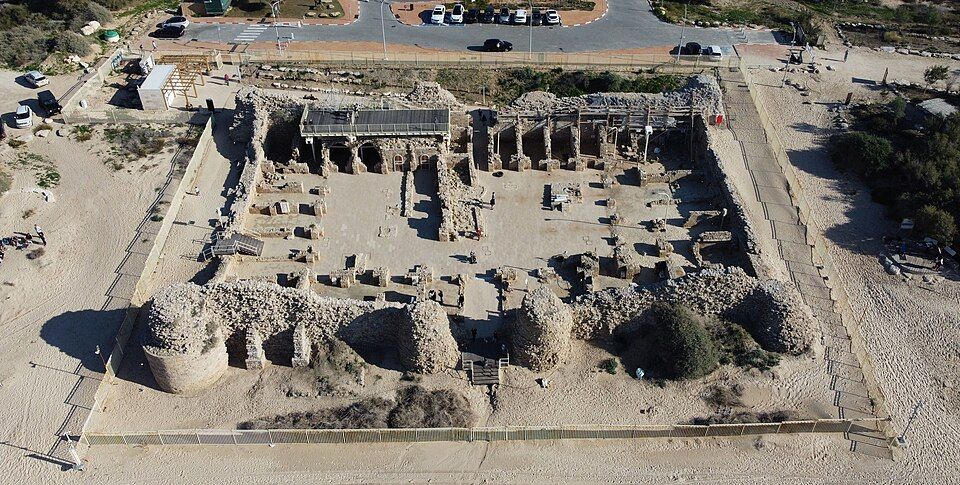 Modern Ashdod was founded in 1956 and has grown into Israel’s sixth-largest city, home to approximately 225,000 residents. Ashdod Port handles the majority of the country’s container traffic, making it the main gateway for imported goods. Communities from Morocco, Egypt, India, Ethiopia, and the former Soviet Union have all shaped the city’s character. The long Mediterranean beach, the Philistine Museum, and the ancient tel make it a place where deep history and contemporary life meet.
Visit with Hoshen Tours
A visit to Ashdod pairs beautifully with nearby destinations along your route. Consider combining it with a stop at Ashkelon or Apollonia, both just a short drive away. Many travelers also enjoy exploring Tel Dor and Caesarea on the same day, while Park Alona offers another worthwhile addition to your itinerary. Your Hoshen Tours guide will craft a seamless route that brings each destination to life with expert commentary and insider knowledge.
Explore Our Tour Collection
Ready to experience Israel in true colors?
Plan Your TourPrivate tours designed around your interests, schedule, and pace.