



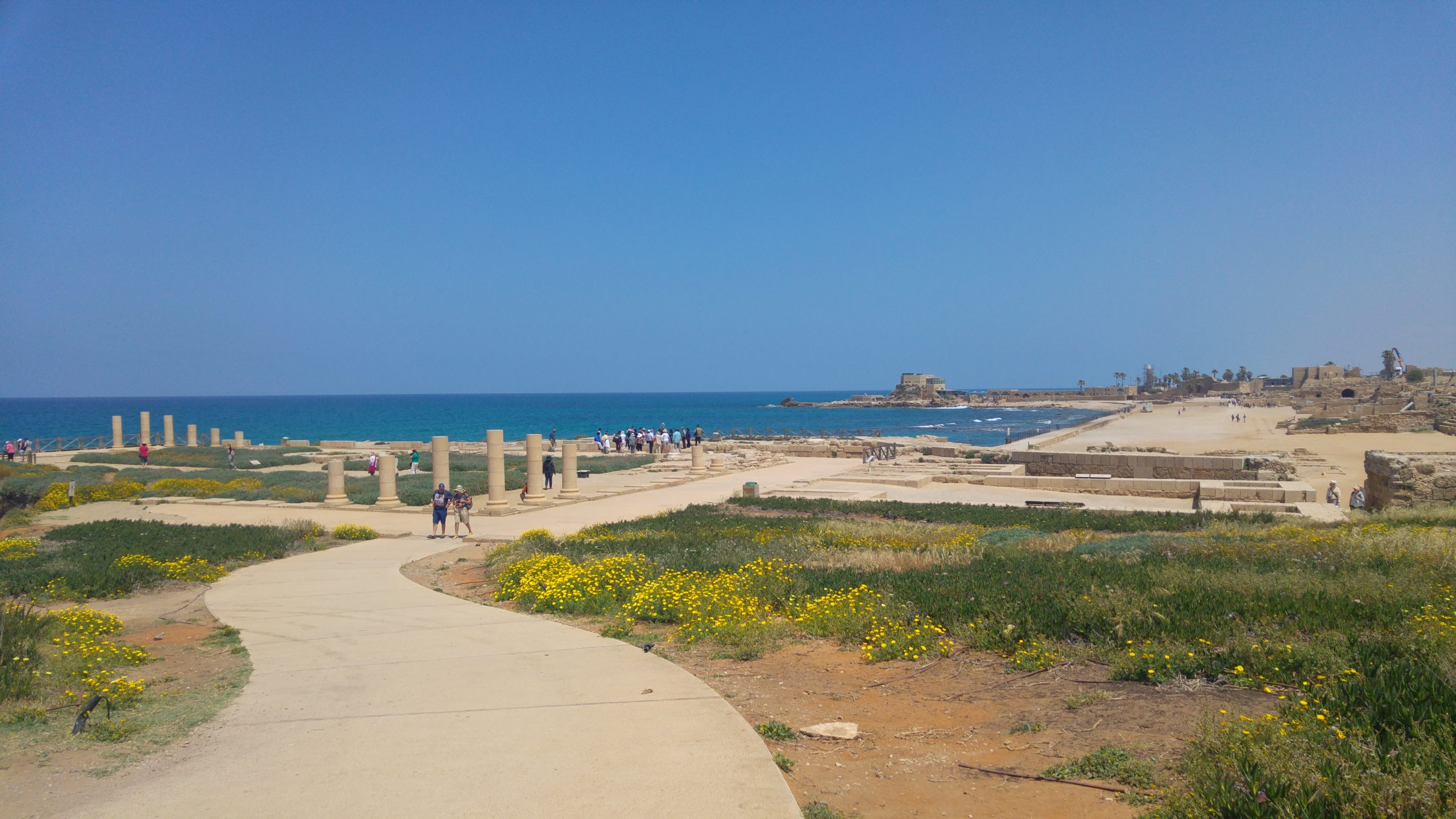
Caesarea Maritima is the most visited national park in Israel, and for good reason. No other place in the country packs so many layers of history into one stretch of Mediterranean coastline. Built by Herod the Great as a showcase of Roman engineering, it served as the capital of Roman Judea for over six centuries. According to Acts 10, the apostle Peter baptized the first Gentile here. tradition holds that Paul was imprisoned for two years in its palace. The massacre of its Jewish community helped ignite the Great Revolt against Rome. Rabbi Akiva was martyred within its walls. Crusaders fought and bled over it. And beneath the waves, the remains of Herod’s revolutionary harbor still lie on the sea floor. The story of Caesarea is, in many ways, the story of the Land of Israel itself.
Before Herod, the site was known as Strato’s Tower, a modest Phoenician anchorage founded in the 4th century BCE. It changed hands several times before Augustus Caesar granted it to Herod in 30 BCE. Herod saw what no one else had: an exposed, harborless stretch of coast on the Via Maris trade route, halfway between Egypt and Phoenicia, waiting for someone bold enough to build a world-class city from nothing.
Herod the Builder
Between roughly 22 and 10 BCE, Herod transformed Strato’s Tower into one of the grandest cities in the eastern Mediterranean. He named it Caesarea in honor of Augustus and threw everything he had at the project. The centerpiece was Sebastos, an artificial deep-water harbor built on a coastline with no natural shelter whatsoever. Josephus, writing a century later, compared it to the famous harbor of Piraeus in Athens. Two massive breakwaters enclosed roughly 25 acres of protected water. The engineering was revolutionary: Roman workers imported volcanic ash from near Naples and mixed it with lime and local stone to create hydraulic concrete that hardened underwater. Wooden forms were floated into position and sunk, forming the breakwater foundations. Individual blocks weighed up to 50 tons. A lighthouse marked the harbor entrance, and warehouses lined the quays. It was one of the most ambitious construction projects in the ancient world.
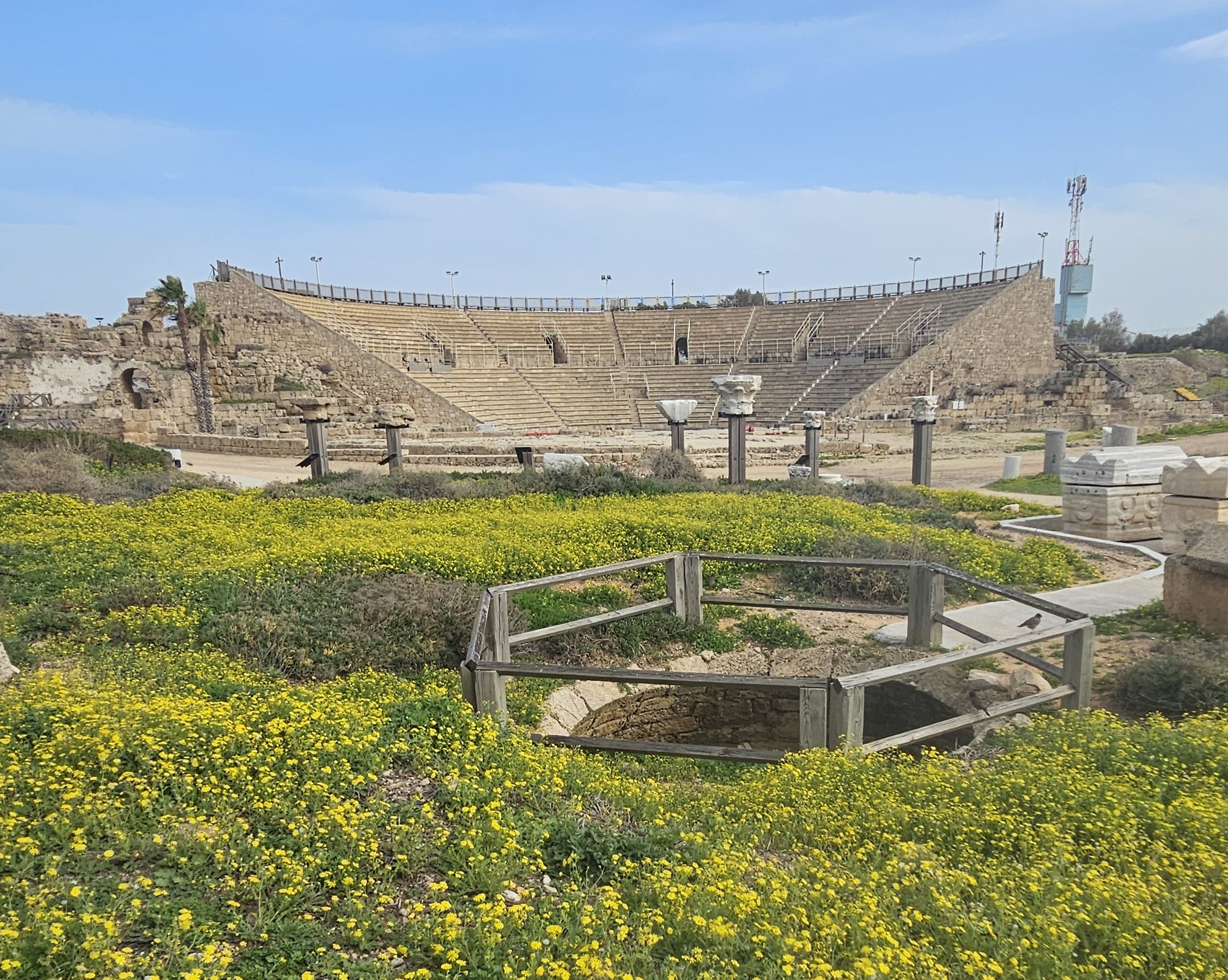
The city Herod built around the harbor was equally spectacular. A theater seating roughly 4,000 spectators was carved into the southern hillside, with the Mediterranean as its backdrop, and it still hosts concerts today. A hippodrome stretching 300 meters along the shore hosted chariot races for 10,000 fans. On a promontory jutting into the sea, Herod built his personal palace with a decorative swimming pool surrounded by columned porticoes, the waves crashing just below. A temple to Augustus stood on a raised podium overlooking the harbor, visible to every ship entering port. Streets followed a Roman grid, and an ingenious sewer system used the tides to flush waste into the sea. Josephus called the city “adorned with several splendid palaces,” and for once he was not exaggerating. Fresh water reached the city through multiple aqueduct systems stretching over 20 kilometers from springs in the Carmel foothills. The most visible remains stand on the Aqueduct Beach north of the city, where Roman arches rise directly from the sand.
Caesarea in the New Testament
For Christians, Caesarea holds a significance that goes far beyond archaeology. Acts 10 tells us that Peter received a vision here that would change the course of Christianity. A Roman centurion named Cornelius, stationed in Caesarea, was a God-fearing Gentile who worshipped the God of Israel. An angel appeared and told him to send for Peter in Joppa. Meanwhile, Peter had a vision of a sheet descending from heaven containing ritually unclean animals, and a voice saying, “Do not call anything impure that God has made clean.” Peter came to Caesarea, entered Cornelius’s home, a radical act for a Jew of that era, and preached. The Holy Spirit fell on everyone present. According to the account in Acts, Peter baptized them on the spot. This was the first baptism of non-Jews into the Christian faith, and it established that salvation was open to all peoples.
Herod and His Legacy
Caesarea also played a central role in Paul’s story. After his arrest in Jerusalem, Paul was transferred to Caesarea and held in Herod’s palace for two years by Governor Felix, who kept hoping for a bribe. When the next governor, Porcius Festus, suggested moving the trial to Jerusalem, Paul exercised his right as a Roman citizen and appealed directly to Caesar. Before his transfer to Rome, he appeared before King Herod Agrippa II and his sister Berenice. Agrippa reportedly said, “Do you think that in such a short time you can persuade me to be a Christian?” and concluded that Paul could have gone free had he not appealed to Caesar (Acts 26:28-32).
One of the most remarkable archaeological finds at Caesarea connects directly to the Gospel narrative. In 1961, excavators discovered a limestone block reused as a step in the theater’s staircase. The inscription bore the name Pontius Pilatus, Prefect of Judea. This Pilate Stone is the only physical evidence of the man who, the Gospels tell us, authorized the crucifixion of Jesus. The original is now in the Israel Museum in Jerusalem; a replica stands at Caesarea. Caesarea was also home to Philip the Evangelist, one of the seven deacons of the early Church, who settled here with his four prophesying daughters (Acts 21:8). When Paul arrived in Caesarea on his final journey to Jerusalem, it was at Philip’s house that he stayed.
The Spark That Ignited the Great Revolt
Caesarea’s history is not only one of building and belief. It is also one of violence. As the administrative capital of Roman Judea, the city’s Jewish community lived alongside a larger Greek and pagan population, and tensions ran deep. In 66 CE, a dispute over a synagogue escalated into open conflict. A Greek resident sacrificed birds at the synagogue entrance on Shabbat, a deliberate provocation. Governor Gessius Florus, who had already pocketed a bribe from the Jewish community without acting, did nothing. The violence that followed was devastating: Josephus reports some 20,000 Jews were killed by the non-Jewish residents of Caesarea. The scale of the violence is not in doubt, and this massacre was one of the direct triggers of the Great Jewish Revolt (66-73 CE), the war that ended with the destruction of the Second Temple. After the revolt was crushed, the Roman general Titus held victory games at Caesarea in which thousands of Jewish captives died in the arena.
Rabbi Akiva and the Ten Martyrs
Decades later, during the Bar Kokhba Revolt (132-136 CE), Caesarea became the site of one of the most revered martyrdom stories in Jewish tradition. Rabbi Akiva, the towering Talmudic sage who had defied the Roman ban on teaching Torah, was imprisoned in Caesarea and sentenced to death. The Talmud (Berakhot 61b) tells us the Romans tortured him with iron combs. As he was dying, his students asked how he could endure such agony. He replied that all his life he had recited the Shema, “You shall love the Lord your God with all your heart, with all your soul, and with all your might,” and had wondered when he would have the chance to fulfill “with all your soul,” meaning even at the cost of his life. “Now that the moment has come, shall I not fulfill it?” He died with the word Echad, “One,” on his lips.
Rabbi Akiva is counted among the Ten Martyrs, ten great sages executed by the Romans during the Hadrianic persecutions. The story of the Ten Martyrs, recited in synagogues on Yom Kippur and Tisha B’Av, is one of the most powerful texts in Jewish liturgy: of a Roman empire that could destroy bodies but not the faith those bodies carried. Tradition holds that several of these martyrdoms took place in Caesarea, giving this archaeological site a layer of sanctity that goes beyond the stones.
A Capital of Christian Learning
After centuries as a Roman administrative center, Caesarea became one of the most important cities in the early Christian world. In the 3rd century, the great Christian thinker Origen settled here around 232 CE and founded a school of higher learning along with the greatest Christian library of antiquity. It was in Caesarea that he produced the Hexapla, a monumental work presenting the Hebrew Bible in six parallel columns, including the original Hebrew and four Greek translations. The library was later expanded by his student Pamphilus to hold more than 30,000 manuscripts, drawing visitors like Jerome and Basil the Great.
The most famous figure connected to the library was Eusebius of Caesarea (c. 260-339 CE), who became bishop of the city around 314 CE and is known as the “Father of Church History.” His Onomasticon, a geographical dictionary cataloguing nearly a thousand biblical place names and identifying hundreds with known locations, is still consulted today as one of the key sources for understanding the Holy Land in the Roman period. Caesarea remained the metropolis of the province of Palaestina Prima from 390 CE onward, with authority over Jerusalem itself, until the Council of Chalcedon elevated Jerusalem to a patriarchate in 451 CE.
In 641 CE, Arab forces captured Caesarea after a prolonged siege, ending nearly seven centuries of Roman and Byzantine rule. The city shrank dramatically, and its great aqueducts fell silent.
The Crusader City and the Holy Grail
After centuries of decline under Arab rule, Caesarea returned to prominence during the Crusades. King Baldwin I of Jerusalem captured the city in May 1101 after a 15-day siege with Genoese support. During the sack, the Genoese discovered a hexagonal green glass vessel in what they believed was an ancient temple. They brought it to Genoa, where it became known as the Sacro Catino and was venerated as the Holy Grail, the dish used by Jesus at the Last Supper. Modern analysis has identified it as an Islamic artifact of the 9th-10th century, made of glass rather than emerald as once believed, but the legend endures.
The most visible Crusader remains today are the walls built by King Louis IX of France in 1251-1252, during the Seventh Crusade. Louis ordered massive fortifications with high walls, fifteen towers, and a deep moat. Parts of these walls still stand. But the Crusader presence was short-lived. In 1265, the Mamluk Sultan Baybars conquered Caesarea and systematically destroyed its fortifications to prevent any future Crusader return. The city was abandoned and remained uninhabited for centuries.
Beneath the Waves
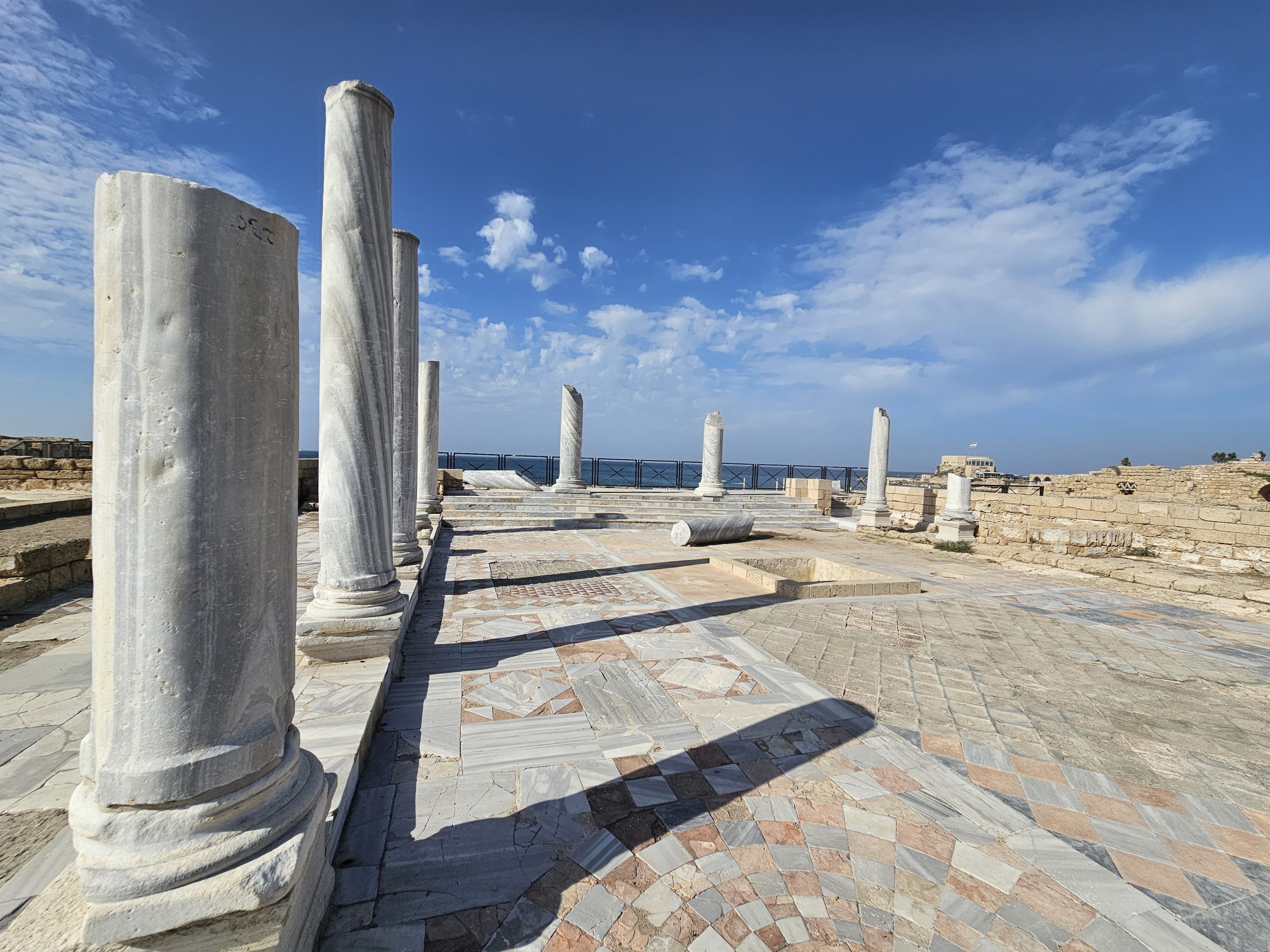
Today the remains of Herod’s harbor lie five meters or more beneath the surface, likely the result of earthquakes and a possible tsunami in the 1st or 2nd century CE. Israel’s first underwater archaeological park allows divers and snorkelers to explore the submerged ruins: massive breakwater blocks of Herod’s hydraulic concrete, ancient anchors, columns, and shipwrecks at depths of 5-8 meters. For those who prefer to stay dry, the national park includes the restored theater, the hippodrome, the Crusader city, the promontory palace ruins, a mosaic pavilion, a visitor center, and walking paths that wind through two thousand years of history along one of the most beautiful stretches of the Israeli coast.
Visit with Hoshen Tours
A visit to Caesarea pairs beautifully with nearby destinations along your route. Consider combining it with a stop at Caesarea Aqueduct or Ramat HaNadiv, both just a short drive away. Many travelers also enjoy exploring Nahal Taninim and Tel Dor on the same day, while Apollonia offers another worthwhile addition to your itinerary. Your Hoshen Tours guide will craft a seamless route that brings each destination to life with expert commentary and insider knowledge.
Ready to experience Israel in true colors?
Plan Your TourPrivate tours designed around your interests, schedule, and pace.