



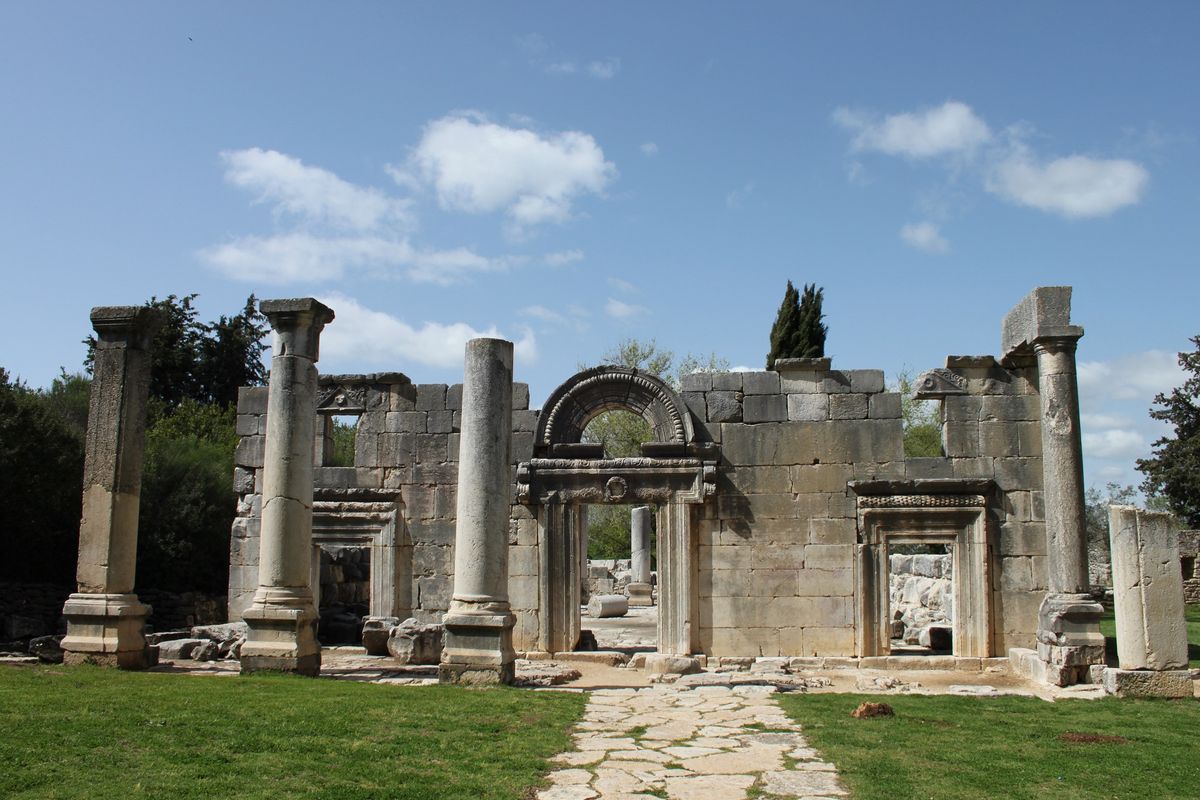
The ancient synagogue at Bar’am, near the Lebanese border in the upper Galilee, is one of the most impressive and best-preserved ancient synagogues in Israel. The building, dating to the late 3rd or 4th century CE, features a monumental stone facade with carved columns, lintels, and decorative elements that rival the finest Roman architecture of the period. Set in a forest of oaks and pines in the rolling hills of the Upper Galilee, the site is as beautiful as it is historically significant.
Two Synagogues at the Site – Ancient Synagogue at Bar’am
What many visitors do not realize is that Bar’am preserves the remains of two separate ancient synagogues. The larger synagogue, the one whose magnificent facade still stands, is the main attraction and one of the finest examples of late Roman Jewish architecture anywhere in the Land of Israel. A smaller synagogue also stood within the same settlement, its remains less intact but still visible. The fact that a single village in the Upper Galilee supported two synagogue buildings speaks to the size and prosperity of the Jewish community that once lived here during the Roman and Byzantine periods.
The Carved Stone Facade
The facade of the larger Bar’am synagogue is its most striking feature: a triple doorway entrance framed by Corinthian columns, with a magnificently carved stone lintel decorated with vine scrolls, garlands, and a central wreath, motifs drawn from the wider Greco-Roman decorative tradition and adapted by Jewish craftsmen for a sacred space. A second-story gallery once stood above the main entrance, supported by smaller columns. The quality and ambition of the stonework are exceptional, representing a community that was wealthy, confident, and willing to build in a style that drew on Roman architectural grandeur while serving a distinctly Jewish purpose.
The facade still stands to nearly its full original height, giving visitors a rare and vivid sense of the building’s original presence. Very few ancient synagogues in Israel survive in such complete form. Scholars classify Bar’am as a classic example of the Galilean-type synagogue, a basilical structure oriented toward Jerusalem, with elaborate exterior stone decoration, colonnaded interior halls, and a broadhouse or longitudinal plan. This architectural type flourished in the Galilee between the 3rd and 5th centuries CE and is known from sites including Capernaum, Chorazin, and Meiron, but Bar’am’s facade is among the finest of them all.
The Community and Its World
The synagogue at Bar’am served a Jewish community that lived in the upper Galilee during the Roman and Byzantine periods. After the destruction of Jerusalem in 70 CE and the suppression of the Bar Kokhba revolt in 135 CE, the center of Jewish life shifted northward into the Galilee, and towns and villages across this region became the heart of the Jewish world for several centuries. The Sanhedrin convened in various Galilean cities, the Mishnah was compiled at Beit She’arim, and the Jerusalem Talmud was edited in Tiberias. Bar’am was one of many Galilean villages that participated in this flourishing, supported by olive oil and wine production, and connected by trade routes through the hills.
The exact date when the Jewish community left Bar’am and what became of them is not recorded in detail. The site was eventually abandoned, and the synagogue fell into ruin over the centuries, though its facade proved durable enough to survive into the modern era largely intact.
The Forest Setting and the Maronite Connection
Bar’am sits within a forested landscape of Israeli oaks, carob, and pine in the hills of the Upper Galilee close to the Lebanese border. The natural setting, quiet, shaded, and green even in summer, makes the site feel remote and contemplative, very different from the dusty roadside ruins that characterize many archaeological sites in Israel.
Adjacent to the synagogue ruins stands a small Maronite church, built in the 19th century by the Christian community that had settled in the area. The presence of both buildings on the same small hilltop reflects the long layering of communities and faiths that has characterized the Upper Galilee across the centuries.
Visit with Hoshen Tours
The Bar’am synagogue is the most impressive ancient synagogue facade in the Galilee and one of the finest preserved examples of late Roman Jewish architecture in Israel. Hoshen Tours visits it as part of Upper Galilee itineraries alongside Safed, Meron, and the region’s other layers of Jewish history, giving the site the context it deserves as a monument to the vibrant Jewish Galilee of the Roman and Byzantine world.
Visitors exploring the upper Galilee often combine Baram Synagogue with nearby destinations such as Gush Halav, Mount Meron, and Safed, each offering its own distinctive perspective on the region’s layered history and landscape. A broader itinerary might also include Ikrit and Biram and Montfort Castle, both within easy reach and rich in their own right.
Every Hoshen Tours itinerary is private and fully customizable. Contact us to begin planning your journey through the upper Galilee.
Explore Our Tour Collection
Ready to experience Israel in true colors?
Plan Your TourPrivate tours designed around your interests, schedule, and pace.