



Kabbalah is one of those words that everyone has heard and almost nobody can explain. Madonna practices it, Hollywood celebrities wear red string bracelets because of it, and in the narrow alleys of Safed, scholars have been studying it for over 500 years, quietly amused by what the rest of the world thinks it means.
The real Kabbalah is Jewish mysticism, a tradition of seeking the hidden dimensions of the Torah and the nature of God. It is dense, complex, and not for beginners, but its influence on Judaism, from the prayers recited every Friday night to the way synagogues are designed, is enormous. And yet, at its heart, Kabbalah asks a question that anyone can understand: if God is infinite and perfect, why does the world exist, and why is it so broken?
Where Kabbalah Israel Comes From
The roots of Jewish mysticism stretch back to the earliest layers of Jewish tradition. The Bible itself contains mystical moments: Ezekiel’s vision of the divine chariot (the Merkavah), Isaiah’s vision of God’s throne, Jacob’s ladder reaching into heaven. In the Talmudic period, a tradition known as Ma’aseh Merkavah (the Work of the Chariot) and Ma’aseh Bereshit (the Work of Creation) explored the hidden meaning behind these texts. These were considered dangerous subjects, the Talmud warns that only the most mature and spiritually prepared scholars should engage with them, and tells stories of sages who entered the “Pardes” (the mystical garden) and emerged damaged or lost.
The word “Kabbalah” itself means “receiving” or “that which has been received”, it refers to a tradition passed down from teacher to student, mouth to ear, in an unbroken chain. For centuries, Kabbalistic knowledge was transmitted only in small circles of initiated scholars. It was not meant for the masses. It was not meant for beginners. And it was certainly not meant for red string bracelets.
The Sefer Yetzirah and Early Mysticism
One of the earliest Kabbalistic texts is the Sefer Yetzirah (Book of Formation), a short and enigmatic work dating to somewhere between the 2nd and 6th centuries CE. The Sefer Yetzirah describes how God created the universe using the 22 letters of the Hebrew alphabet and ten primordial numbers, which it calls sefirot. The idea is radical: language is not just a tool for describing reality. Language is the fabric of reality. God spoke the world into existence, and the Hebrew letters are the building blocks of creation itself.
This concept, that the Hebrew language has creative power, that each letter carries divine energy, runs through all of Kabbalah and explains practices like gematria, the system that assigns numerical values to Hebrew letters and finds hidden connections between words that share the same numerical total.
Ein Sof: The Infinite
Kabbalah begins with a problem. If God is infinite, unlimited, and beyond all comprehension, how can a finite world exist? How can there be anything that is not God? The Kabbalists’ answer is Ein Sof, literally “without end”, the unknowable, infinite essence of God before creation. Ein Sof is not a being, not a personality, not a king on a throne. It is pure, limitless existence, so total and complete that nothing else could exist within it.
To make room for creation, something had to happen. And this is where the Kabbalah of the Ari begins.
The Tree of Life and the Ten Sefirot
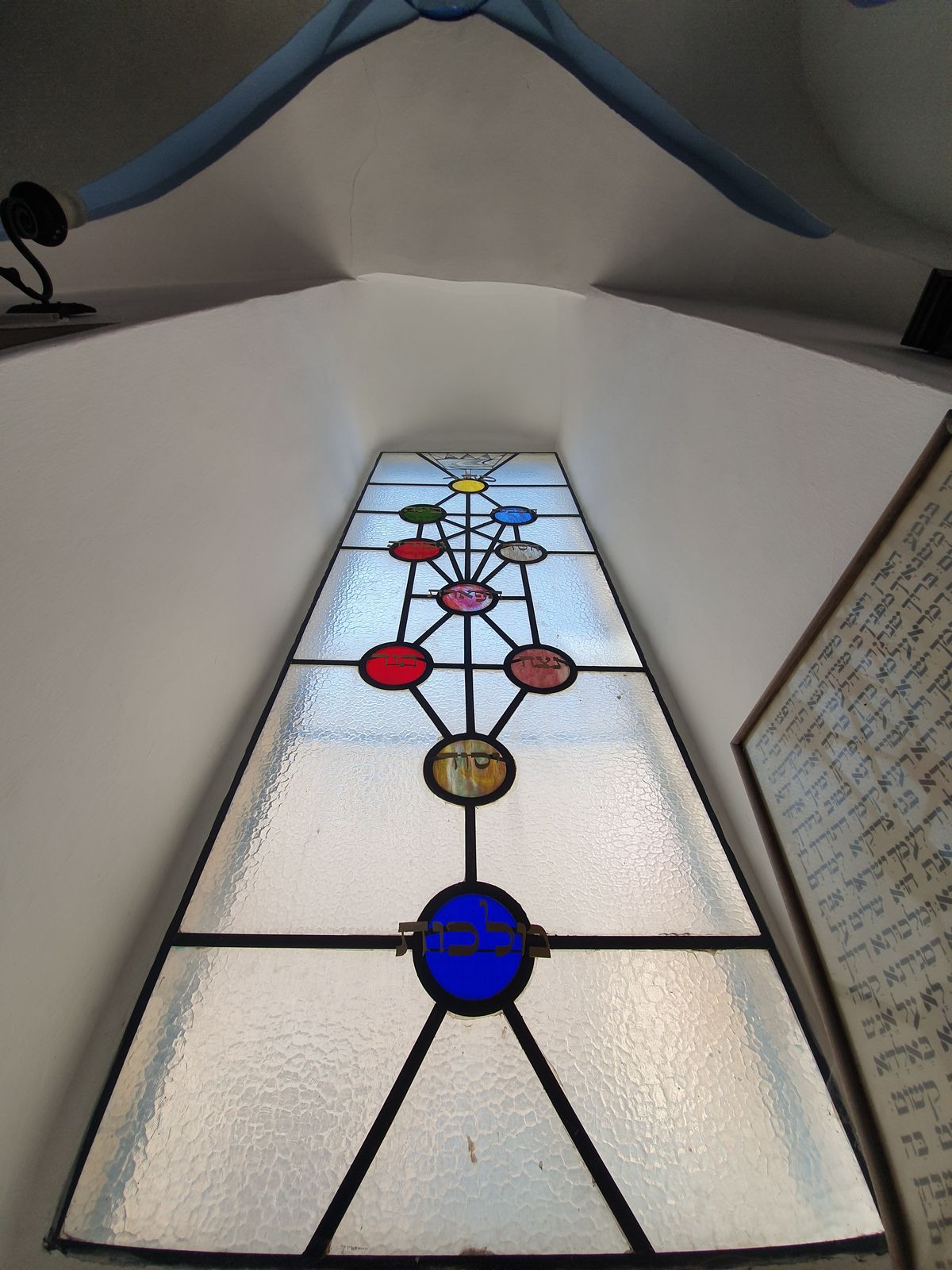
The most recognizable image in Kabbalah is the Etz Chaim, the Tree of Life, a diagram of ten sefirot (divine attributes) connected by 22 paths. The sefirot are not God. They are the channels through which God’s infinite light flows into the world, each one representing a different quality of the divine as it manifests in creation.
The ten sefirot, from the highest to the lowest, are: Keter (Crown), the divine will, the point where the infinite first begins to take shape; Chokhmah (Wisdom), the flash of insight, the first spark of an idea; Binah (Understanding), the development of that idea into structure and detail; Chesed (Loving-kindness), boundless giving, generosity without limit; Gevurah (Strength/Judgment), restraint, discipline, the setting of boundaries; Tiferet (Beauty), the balance between giving and restraint, harmony at the center of the tree; Netzach (Eternity/Victory), endurance, the drive to overcome; Hod (Splendor), humility, surrender, the acceptance of a larger plan; Yesod (Foundation), the channel through which all the upper sefirot flow into the final one; and Malkhut (Sovereignty/Kingdom), the physical world, the place where the divine light arrives and is experienced by human beings.
The genius of the sefirot system is that it maps the inner life of God onto the inner life of the human being. Every person contains all ten sefirot. Every human emotion, love, fear, compassion, endurance, is a reflection of a divine attribute. When you feel love, you are experiencing Chesed. When you feel discipline, you are experiencing Gevurah. The Tree of Life is not just a diagram of heaven. It is a diagram of you.
The Zohar
The Zohar (the Book of Radiance) is the foundational text of Kabbalah. It is written in Aramaic, structured as a mystical commentary on the Torah, and attributed to the 2nd-century sage Rabbi Shimon bar Yochai, who according to tradition composed it while hiding in a cave from the Romans for thirteen years. Modern scholars believe it was largely compiled in 13th-century Spain by Rabbi Moshe de Leon, though it likely draws on older mystical traditions.
The Zohar reads the Torah as a coded text, with every story, every name, and every number concealing a deeper spiritual meaning. The creation story in Genesis is not just an account of how the world was made, it is a description of how the sefirot unfolded from Ein Sof. The story of the Exodus is not just a historical narrative, it is a map of the soul’s journey from slavery to freedom, from the material world to divine consciousness. For the Kabbalist, the Torah has four levels of meaning: peshat (the plain meaning), remez (the hinted meaning), derash (the interpreted meaning), and sod (the secret meaning). Kabbalah lives in sod.
The Ari’s Revolution in Safed
In 1492, the Jews were expelled from Spain, and the exiles carried the Zohar with them to new communities across the Ottoman Empire. Many settled in Safed, a small hilltop town in the Upper Galilee that became, in the 16th century, the undisputed capital of Kabbalistic thought.
Rabbi Isaac Luria, known as the Ari (the Lion), arrived in Safed in 1570 and spent only two years there before his death at age 38. Yet in those two years he transformed Kabbalah from an elite intellectual pursuit into a lived spiritual practice that reshaped Judaism itself.
The Ari introduced three revolutionary concepts that changed how Jews understood God, evil, and their own role in the universe:
The Mystical Tradition in Practice
Tzimtzum (Contraction): God, who was everything, contracted to create an empty space in which the universe could exist. Creation is not an act of expansion but an act of withdrawal, God made room for us by pulling back. This explains how a finite world can exist within an infinite God.
Shevirat HaKelim (the Breaking of the Vessels): When God’s light poured into the newly created space, it was too powerful for the vessels meant to contain it. The vessels shattered, and sparks of divine light scattered throughout creation, becoming trapped in the material world. This explains the existence of evil and imperfection, the world is broken because the vessels broke, and fragments of holiness are trapped in the lowest places.
Tikkun (Repair): Every human being has the power, and the responsibility, to gather the scattered sparks and return them to their source. Every prayer, every good deed, every act of kindness releases a trapped spark and moves the world closer to its repair. When all the sparks are gathered, the world will be whole again. This is Tikkun Olam, the repair of the world, a concept that has entered mainstream culture far beyond its Kabbalistic origins.
The Ari taught that every action has cosmic significance. Eating a meal with the right intention can release divine sparks. Saying a prayer with proper focus (kavanah) can repair a broken vessel. The most ordinary moments of human life are, in the Kabbalistic view, opportunities for cosmic healing.
Kabbalah’s Impact on Daily Judaism
Many aspects of Jewish practice that observant Jews perform every week have Kabbalistic origins or Kabbalistic layers of meaning. The Kabbalat Shabbat service, recited every Friday evening in synagogues worldwide, was composed by the Ari and his circle in Safed. The custom of wearing white on Shabbat comes from the mystics. The practice of singing Lecha Dodi, the hymn welcoming the Sabbath bride, was written by Rabbi Shlomo Alkabetz while walking through the fields of Safed on a Friday afternoon.
The structure of the Passover Seder, the counting of the Omer (the 49-day period between Passover and Shavuot, with each day corresponding to a combination of two sefirot), and many elements of the High Holiday liturgy all carry Kabbalistic fingerprints. For centuries, Kabbalah has been quietly shaping Jewish life, even for Jews who have never studied a page of the Zohar.
The Four Worlds
Kabbalah describes reality as consisting of four worlds, or levels of existence, each one progressively further from the divine source: Atzilut (Emanation), the world closest to God, where the sefirot exist in their purest form; Beriah (Creation), the world of the divine throne and the highest angels; Yetzirah (Formation), the world of angels and spiritual beings; and Assiyah (Action), the physical world in which we live. Every soul descends through these worlds to reach the body it inhabits, and every prayer ascends through them to reach the divine. The Kabbalist’s goal is to be aware of all four worlds simultaneously, to live in the physical world while remaining conscious of the spiritual realities that underlie it.
Kabbalah and the Modern World
In the 20th and 21st centuries, Kabbalah has experienced a remarkable revival. Academic scholars like Gershom Scholem brought it into the university; the Hasidic movement, founded in the 18th century by the Baal Shem Tov, democratized many Kabbalistic ideas and made them accessible to ordinary Jews; and popular culture discovered it through the Kabbalah Centre and celebrity endorsements.
The tension between the scholarly tradition and the popular version is real. Traditional Kabbalists maintain that serious study requires years of preparation, fluency in Hebrew and Aramaic, and a grounding in Talmud and Halakha. The popularizers argue that the basic ideas of Kabbalah, the interconnectedness of all things, the power of intention, the responsibility to repair the world, are too important to keep locked away from those who could benefit from them. Both sides have a point.
Visit with Hoshen Tours
Safed remains the living heart of Kabbalah. The synagogues where the Ari prayed still stand, the study halls where the Zohar was debated are still in use, and the cemetery where the great mystics are buried draws pilgrims from around the world. Walking through Safed’s narrow alleys, past blue-painted doorways and ancient stone walls, you can feel the weight of five centuries of mystical tradition in the air.
Visitors exploring the upper Galilee often combine Kabbalah in Safed with nearby destinations such as Safed, The Ari – Rabbi Isaac Luria, and Rabbi Joseph Caro, each offering its own distinctive perspective on the region’s layered history and landscape. A broader itinerary might also include Abuhav Synagogue and Mount Meron, both within easy reach and rich in their own right.
Hoshen Tours brings visitors into the world of the Kabbalists, not the red-string version, but the real one. The synagogues, the study halls, the cemetery, and the stories of the men who believed they could repair the universe, one prayer at a time. No red string required.
Explore Our Tour Collection
Ready to experience Israel in true colors?
Plan Your TourPrivate tours designed around your interests, schedule, and pace.