



Tel Dan Israel has everything. A lush nature reserve with streams running through ancient trees. One of the most important archaeological discoveries of the 20th century. A mud-brick gate that is roughly 4,000 years old and still standing. A basalt inscription that proved the existence of King David’s dynasty beyond the pages of the Bible. And a biblical story about a golden calf that split a kingdom in two. If you could visit only one site in northern Israel, a strong case could be made for Tel Dan.
The City Called Dan
In the Bible, the phrase “from Dan to Beersheba” is used again and again to describe the entire length of the Land of Israel, north to south. Dan was the northernmost city in the Israelite kingdom, and its location at the foot of Mount Hermon, near the largest source of the Jordan River, made it both strategically vital and impossibly beautiful. The phrase appears in Judges, Samuel, Kings, and Chronicles, functioning as a shorthand for “the whole country”, the way an American might say “from Maine to Florida.” It is a phrase that fixes Dan permanently in the biblical imagination as the far northern boundary of the Promised Land, and standing there today, with the snowcapped peak of Hermon rising to the north and cold streams rushing through the undergrowth at your feet, it is easy to understand why this place became a landmark of the entire world.
Dan appears in the Bible as early as Abraham himself. When his nephew Lot was captured by the coalition of four kings who had raided Sodom and the cities of the plain, Abraham mustered 318 trained men from his own household and set out in pursuit. The text records the dramatic outcome: he recovered all the goods and brought back his relative Lot and his possessions, together with the women and the other people, and he pursued the raiders “as far as Dan” (Genesis 14:14-16). The pursuit to Dan marks the northern limit of Abraham’s military campaign and is the very first appearance of the name “Dan” in the entire biblical text.
It is a remarkable detail, because at the time of Abraham the city was still known as Laish, the name “Dan” would not come into use for centuries, when the tribe of Dan conquered it. The use of “Dan” in the Genesis narrative is widely understood as an updating by a later editor writing at a time when the city was already well known by its tribal name. What it preserves, however, is the ancient memory that this northern point marked the extreme reach of Abraham’s world, and that “from Dan to Beersheba” was the span of the land his descendants would inherit.
The Danite Migration
The tribe of Dan was originally allotted territory on the Mediterranean coast, in the area between Joppa and what is now Tel Aviv. But the tribe found itself unable to hold that coastal lowland against the peoples already settled there. Judges 18 tells the story of their relocation in vivid and morally complex detail. The Danites sent five scouts north, who discovered the city of Laish: “a people living in safety, like the Sidonians, unsuspecting and secure. And since their land lacked nothing, they were prosperous.” The scouts brought back an enthusiastic report, and the tribe sent 600 armed men north. Along the way they stopped at the house of a man named Micah in the hill country of Ephraim and took his silver idol, his ephod, and his household gods, along with his hired Levite priest.
They marched on Laish, destroyed the city by fire, rebuilt it, and renamed it Dan after their ancestor. Then they set up the idol and established a priesthood. The text identifies the founding priest as Jonathan son of Gershom, a grandson of Moses himself, and notes that his descendants served as priests at Dan until the time of the captivity of the land. It is an uncomfortable story: the idol was stolen, the city was taken by surprise, and the priesthood traced back to Moses is established in service of a shrine the biblical narrator views with deep ambivalence.
The Kingdom Divided
After the death of King Solomon, the united kingdom of Israel split in two. Jeroboam, the first king of the northern kingdom of Israel, inherited a political crisis: his subjects were still making pilgrimages to the Temple in Jerusalem, which was in the rival southern kingdom of Judah. Every trip south was a potential defection. Jeroboam’s solution was politically clever and, in the biblical narrator’s view, catastrophic. He cast two golden calves and announced to the people: “It is too much for you to go up to Jerusalem. Here are your gods, O Israel, who brought you up out of Egypt” (1 Kings 12:28-29). He installed one calf at Bethel in the south of his kingdom and one at Dan in the north, placing them at the two extremities of his territory, “from Dan to Beersheba” in reverse.
The parallel to the golden calf of Exodus was unmistakable, and the biblical authors use it as a deliberate indictment. At Tel Dan, archaeologists have uncovered the remains of the sacred precinct where the northern calf tradition holds was installed: a large raised platform (bamah), the foundations of a monumental altar, and an elaborate gate complex that formed the ceremonial entrance to the high place. The Bible’s condemnation of Jeroboam echoes through the books of Kings like a refrain, “the sin of Jeroboam” becomes the standard measure by which every subsequent king of the northern kingdom is judged.
The House of David Inscription
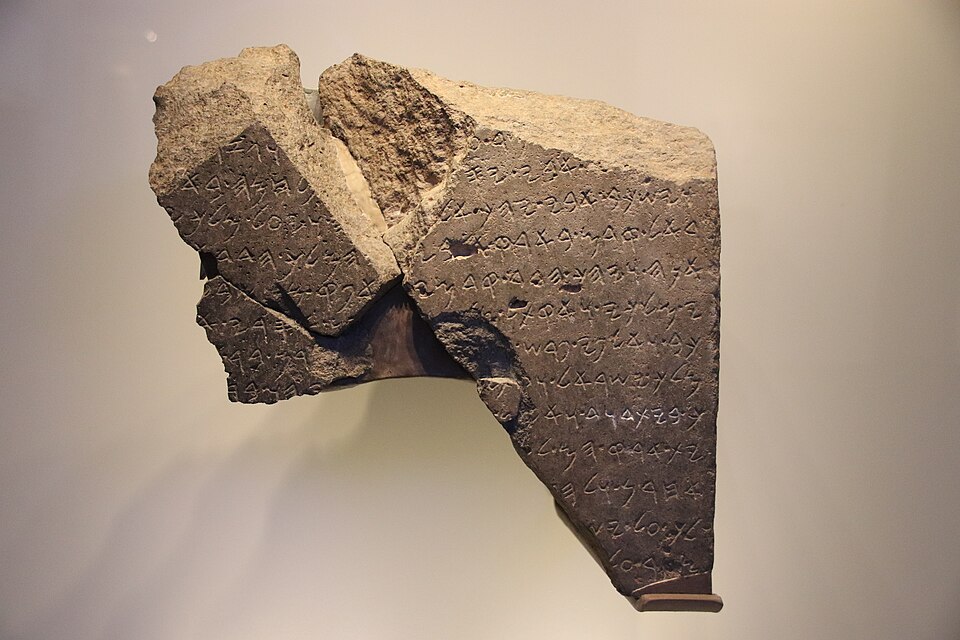
In the summer of 1993, during excavations led by Avraham Biran of Hebrew Union College, a site architect named Gila Cook noticed something unusual in a section of a wall being dismantled at the site: a fragment of black basalt with an Aramaic inscription. The fragment was examined, and what the scholars read changed everything. Among the surviving letters was the sequence bytdwd, which scholars read as “House of David” (Beit David). A second fragment was found in 1994. Together, the two pieces preserve a royal inscription from the 9th century BCE, most likely erected by Hazael king of Aram-Damascus, boasting of his military victories over the king of Israel and the king of the “House of David”, that is, the kingdom of Judah. This was, and remains, the first extra-biblical reference to King David or his dynasty ever found in any ancient inscription.
Before 1993, some scholars had argued that David was a legendary figure, a literary creation of later Jerusalem scribes. The Tel Dan Stele provided physical, epigraphic evidence that by the 9th century BCE, the ruling dynasty of Judah was known to its enemies as “the House of David”, making David’s dynasty a historical fact recognized in the inscriptions of enemy kings. The original stele is displayed in the Israel Museum in Jerusalem. A replica stands at the site itself, near where it was found, and pausing beside it, understanding that this fractured piece of basalt is the oldest written mention of Israel’s most famous king, is one of the most powerful moments any visitor to Israel can have.
The Gates and the Excavations
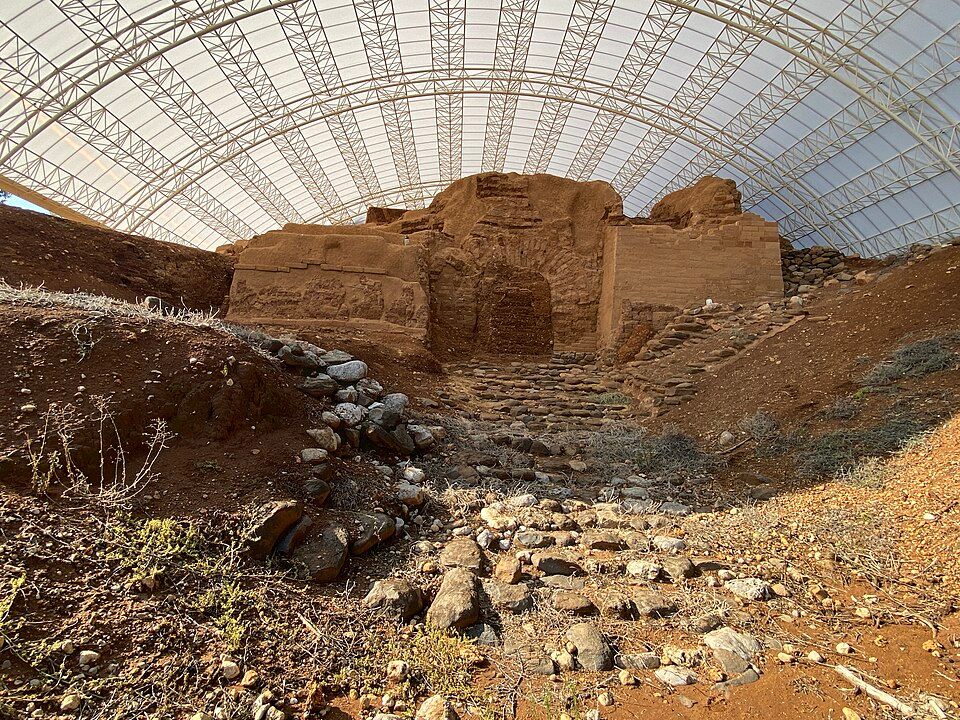
In 1979, excavators at Tel Dan uncovered a mud-brick arched gate dating to approximately 1750 BCE, the Middle Bronze Age. It is widely recognized as one of the oldest arched gates in the world, and its preservation is extraordinary. The arch stands over 7 meters high, built entirely of sun-dried mud bricks, and it has been restored to its estimated original height after nearly 4,000 years. It was part of the city’s fortification system, and at some point in antiquity it was deliberately buried, probably to reinforce or heighten the city walls, and this burial is what saved it. Sealed from air, moisture, and human disturbance for millennia, the mud bricks survived essentially undamaged. Because this gate dates to the general period when biblical tradition places Abraham’s journeys through Canaan, it was given the popular name “Abraham’s Gate.” Visitors today can walk directly up to the gate, examine the individual bricks, and see the curved arch profile still holding its shape after four millennia. The steps that once led up into the gateway have also been preserved. It is one of the most visceral encounters with the ancient world available anywhere in Israel.
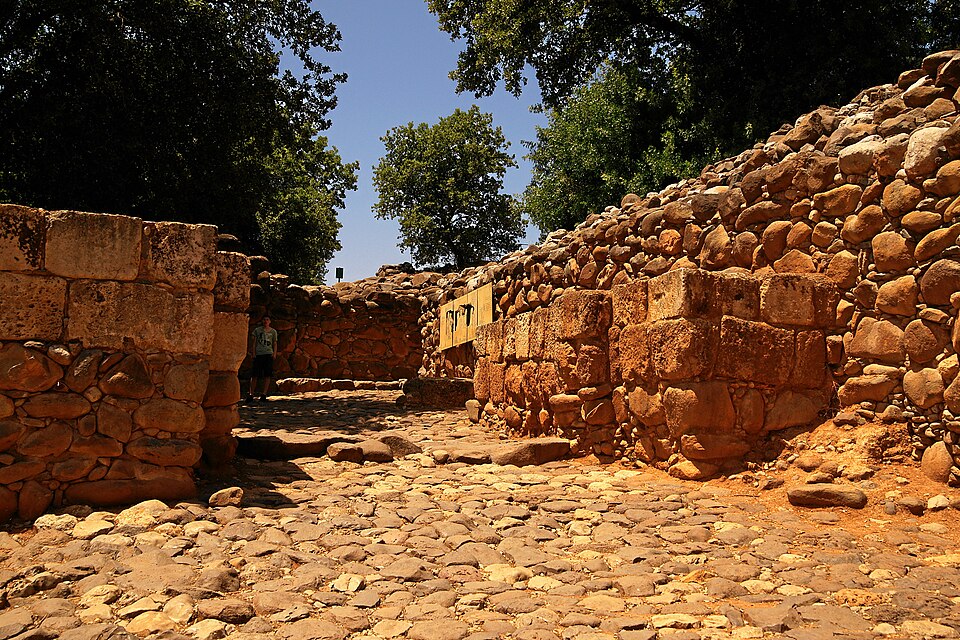
From the Iron Age, Tel Dan preserves one of the best-maintained gate complexes in the country. Dating to the period of the Israelite kings, roughly the 10th to 8th centuries BCE, the outer and inner gates formed an elaborate entrance system typical of major Israelite cities. A four-chambered inner gate, with guard rooms flanking the passageway on both sides, is matched by an outer gate that formed a second line of defense. What makes Tel Dan’s gate particularly significant is the discovery at the outer gate of a large stone platform that scholars believe served as a throne or judgment seat, the place where the king or his representatives would sit to hear legal cases and conduct official business. The Bible repeatedly describes the city gate as the center of civic life, the place where business was transacted, disputes were settled, and justice was administered. In the book of Ruth, Boaz goes to “the gate” to conduct the legal proceedings that allow him to marry Ruth. At Tel Dan, that description comes to life in stone.
Tel Dan was excavated by Avraham Biran from 1966 to 1999, 33 years at one site. Under his direction, every major discovery emerged: the Abraham Gate, the Israelite gate, the high place, and the stele. The work continues under subsequent directors, and each season adds to the picture.
The Springs of Dan
Tel Dan is also a nature reserve of exceptional beauty, and the two experiences reinforce each other in a way that is unusual even by Israel’s standards. The Dan Spring is the largest of the three main headwaters of the Jordan River, the others being the Banias and the Hasbani, and together these streams converge in the Hula Valley below and form the Jordan proper. The Dan Spring alone produces an estimated 240 million cubic meters of water per year, emerging cold and clear from the base of Mount Hermon, which functions as a vast underground reservoir collecting the snowmelt from the mountain above. The water gushing from the Dan Spring fell as snow on Mount Hermon months or years earlier, percolated down through the limestone, and emerges here ice-cold even in midsummer.
The result is a microclimate entirely unlike the rest of Israel: dense forest canopy of laurel, bay, and oak trees, mossy banks, pools of still water, and the constant sound of rushing streams. Walking the trails at Tel Dan in the heat of July is one of the most refreshing experiences in the country. The combination of shaded paths, cool water underfoot, bird life in the canopy, and ancient ruins appearing around each bend makes Tel Dan unlike any other site in Israel.
Visit with Hoshen Tours
Tel Dan is a cornerstone of any upper Galilee and Golan Heights itinerary. Hoshen Tours combines it with Banias, the Hula Valley, and Mount Hermon, creating a day that balances archaeology, nature, and the stories that shaped the biblical world. From Abraham’s pursuit of the four kings to the stele that proved David’s dynasty existed, from the world’s oldest arch to the springs that birth the Jordan River, Tel Dan delivers more per acre than almost anywhere else in the Land of Israel. Because Tel Dan is where history and beauty meet under the trees. And some discoveries are best made on foot.
Ready to experience Israel in true colors?
Plan Your TourPrivate tours designed around your interests, schedule, and pace.