


Call us today!
+1-917-9055850

Magazine
The Desert Kingdom That Was Never Desolate: Israel and Egypt Through the Ages
Egypt is often imagined as an endless expanse of sand, camels, and silence. In reality, it was one of the wealthiest, most fertile, and most powerful civilizations the ancient world ever produced. A kingdom built along the Nile that had more grain than it knew what to do with, more gold than most empires could dream of, and an army that made its neighbors very, very nervous.
And no neighbor felt Egypt’s gravitational pull quite like the small, hilly land just to the northeast: the Land of Israel.
The relationship between these two lands is one of the longest-running stories in human history. It is not the neat, textbook version of wars and treaties. It is messier, more fascinating, and far more personal. A story of hunger and refuge, bondage and liberation, artistic obsession and political scheming. And the remarkable thing is: you can still see it today, walking through mosaic floors and ancient ruins across Israel. Explore our Jerusalem and Negev destination pages to plan your visit.
There is a pattern buried deep in the biblical narrative that repeats itself almost stubbornly across the centuries: when things go wrong in the Land of Canaan, people pack up and head to Egypt.
Abraham did it when famine struck. Jacob and his entire family did it a few generations later, lured south by the promise of Egyptian grain and by a particularly well-connected son who had worked his way up from prison to Pharaoh’s right-hand man (it is, admittedly, an unusual career path). And centuries after that, when King Herod’s paranoia spiraled into the Massacre of the Innocents, Joseph and Mary took the infant Jesus and fled. Where else? To Egypt.
This was the great duality of Egypt in the eyes of Israel. Egypt saved you from starvation, but it could also enslave you. It was a place of refuge and a place of bondage. The Exodus, the foundational story of the Jewish people, is the story of breaking free from Egyptian servitude. And yet, every time disaster struck, the road south beckoned again. Old habits, it seems, die hard, even when they come with a risk of forced labor.
Egypt’s geography created a unique kind of superpower. Surrounded by desert yet fed by the Nile, it was both isolated and enormously rich. A combination that tends to produce rulers with large armies and even larger ambitions.
The earliest recorded battle in world history is a perfect illustration. In the 15th century BCE, Pharaoh Thutmose III led his forces through the narrow Aruna Pass and surprised a coalition of Canaanite kings at Megiddo. Yes, that Megiddo, the one that would later lend its name to Armageddon. The Egyptian victory was decisive and established Pharaoh’s control over Canaan for generations.
How deep was that control? The Tel Amarna Letters, discovered in Egypt, give us a surprisingly intimate look. These are actual letters from local Canaanite rulers writing to Pharaoh, and they read less like diplomatic correspondence and more like anxious middle managers emailing the CEO. “Please send troops.” “My neighbor is attacking me.” “I am your loyal servant, I swear.” It is 3,400-year-old bureaucracy, and it is oddly relatable.
And then there is the Merneptah Stele, a victory inscription from around 1208 BCE that contains the earliest known mention of “Israel” outside the Bible. Israel appears almost as an afterthought, tucked into a list of peoples Pharaoh claims to have defeated. The very first time Israel shows up in the historical record, it is through Egyptian eyes. Egypt, as usual, got there first.
Perhaps the most surprising evidence of this deep connection does not come from texts or battlefields. It comes from floors.
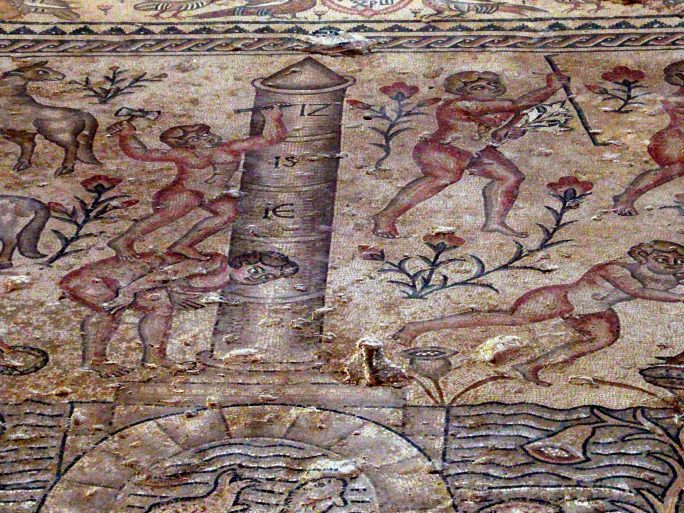
Across Israel, Byzantine-era mosaic floors feature unmistakably Egyptian imagery. Nile River scenes, complete with a Nilometer measuring the river’s sacred floods. Lotus flowers. Crocodiles. Hippopotami. These are animals that have never roamed the hills of the Galilee, and yet there they are, rendered in thousands of tiny mosaic stones by artists who clearly knew exactly what they were depicting.
The most spectacular example is the Nile House in Zippori (Sepphoris), a stunning mosaic floor that shows the Nile in full flood, teeming with exotic wildlife. A Nilometer tower stands at the center of the scene, with a man climbing up to mark the water level at seventeen cubits, the point of “plenitude” when the irrigation ditches were opened and the Nile festival began.
But Zippori is not alone. At the Church of the Multiplication of the Loaves and Fishes on the shores of the Sea of Galilee, a mosaic floor dating to the end of the 5th century features the same fascination: lotus blossoms, water birds, and another Nilometer, all rendered in careful detail in a church commemorating one of Jesus’ most famous miracles by the Sea of Galilee.
Why would artists in the Galilee, hundreds of miles from Egypt, keep returning to images of the Nile? Because the Nile was never just a river. It was a symbol of abundance, fertility, and the mysterious power of the south. Long after the political ties between the two lands had shifted, the cultural fascination refused to fade.
Egypt’s wealth did not only attract hungry refugees. It attracted conquerors. Cambyses the Persian seized it. Alexander the Great claimed it and founded Alexandria, which became the intellectual capital of the ancient world. Augustus’s Rome eventually absorbed it. The Ptolemaic dynasty ruled it for centuries, blending Greek and Egyptian culture into something entirely new. Each wave of conquest reshaped the entire region, and each time, the land of Israel caught the aftershock.
But the connection between the two lands goes far deeper than politics and armies. In medieval Cairo, a synagogue storeroom preserved what would become one of the most important documentary finds in history: the Cairo Geniza. Hundreds of thousands of fragments. Letters, contracts, poems, shopping lists. A thriving Jewish community with deep ties to the Land of Israel. A thousand years of daily life, preserved by accident in the Egyptian heat.
And it was in Egypt that Maimonides, rabbi, philosopher, physician, and arguably the most influential Jewish thinker of the past millennium, served as doctor to the Sultan’s court and wrote the works that would shape Jewish thought for centuries. He chose to live in Cairo. Not bad for a city that started as a place people fled to during famines.
The ancient Via Maris, the Way of the Sea, was the highway that connected Egypt to the Land of Israel and beyond. It carried armies, merchants, refugees, and pilgrims for thousands of years. Thutmose III marched north along it. The Holy Family fled south on it. Napoleon followed it from Egypt to the walls of Acre in 1799, where he failed spectacularly, proving that not everyone who takes this road gets what they came for.
And in 1978, when Anwar Sadat and Menachem Begin signed the Camp David Accords, they were not simply ending a modern conflict. They were writing the latest chapter in a relationship that stretches back over thirty-five centuries. Two lands, bound by geography, shaped by each other’s history, and connected by a road that has never truly closed.
For travelers visiting Israel today, the Egyptian connection is not something you need to imagine. It is something you can touch. Stand at Megiddo and look across the valley where Thutmose fought the battle that gave us the word Armageddon. Walk through the mosaic halls of Zippori and see the Nile rendered in stone a thousand miles from its banks. Follow the ancient coastal road that carried empires north and south for millennia.
Egypt may be across the border, but in Israel, it has never felt far away, and it still doesn’t.
Hoshen Tours can weave these ancient connections into your itinerary, from the mosaics of the Galilee to the battlefields of Megiddo to the ports of the Mediterranean coast. Because some stories are best understood not from a textbook, but from the ground they happened on.
Contact Us
Related articles
Tours and Activities
Water Desalination in Israel: How a Desert Nation Became a Global Water Superpower
From Water Crisis to Water SecurityIsrael is one of the driest countries on earth. Over 60% of its territory is…
Israel's Missile Defense Systems: How a Small Country Built the World's Most Advanced Air Defense
Born from WarIn the summer of 2006, the Second Lebanon War exposed a critical vulnerability in Israel's defences. Over 34…

What to Pack for Your Israeli Trip
What to Pack for Your Israeli TripPacking for Israel can feel tricky. The country spans deserts, mountains, coastline, and ancient…