



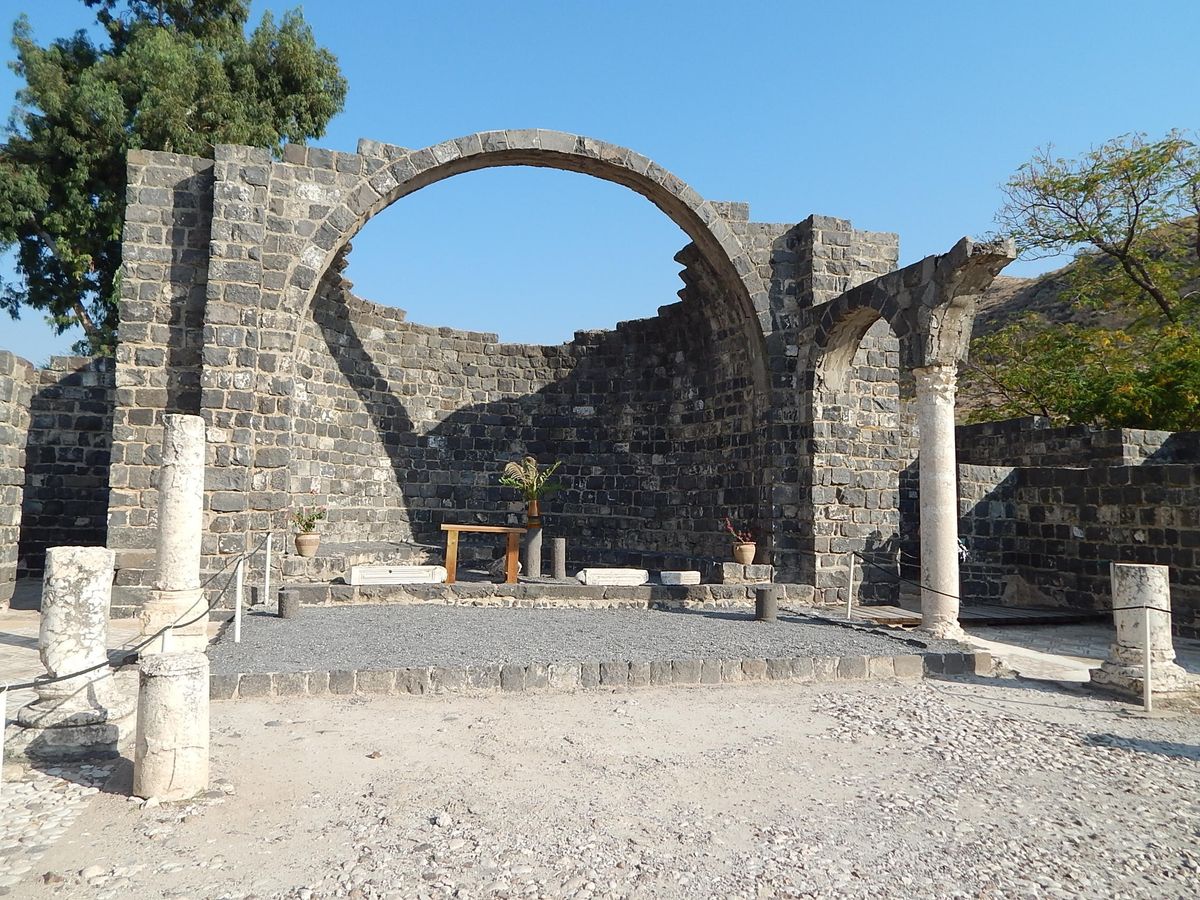
Kursi sits on the eastern shore of the Sea of Galilee, at the foot of a steep hillside that drops sharply to the water. This is the site traditionally identified with one of the most dramatic miracles in the Gospels: the exorcism of a man possessed by a legion of demons, whom Jesus cast into a herd of pigs that then stampeded down the slope and drowned in the lake. The Golan cliffs rising immediately behind the shore give the landscape an almost theatrical quality, rugged, shadowed, and unmistakably the “other side” of the lake.
The Gospel Story
The account appears in all three Synoptic Gospels (Matthew 8:28–34, Mark 5:1–20, Luke 8:26–39), with Mark offering the most detailed version. Jesus and his disciples cross the Sea of Galilee by boat to the eastern shore, Gentile territory, outside the Jewish heartland. There they encounter a man in desperate condition: possessed by demons so violent that he lived among the tombs, broke every chain used to restrain him, and cried out day and night, cutting himself with stones. No one had the strength to subdue him.
When Jesus confronts the man, the possessing spirit speaks: “My name is Legion, for we are many” (Mark 5:9), a word that carried unmistakable connotations of Roman military power in the 1st century. The demons beg not to be sent out of the region, asking instead to be cast into a large herd of pigs grazing on the hillside. Jesus gives the command. The pigs, some two thousand in Mark’s account, rush down the steep bank and are drowned in the lake. The man is found sitting quietly, clothed and in his right mind.
What follows is equally significant. The townspeople, frightened, ask Jesus to leave. But the healed man begs to go with him. Jesus refuses and gives him an extraordinary commission: “Go home to your own people and tell them how much the Lord has done for you” (Mark 5:19). Tradition holds that this man became the first evangelist to the Gentile Decapolis, a region of ten Greek cities east of the Jordan, proclaiming the miracle before Jesus himself had set foot there.
The Landscape and the Gospel
The geography at Kursi corresponds closely to the details the Gospel writers record. Standing at the top of the slope and looking down to the water, the drop is sudden and real. You can picture exactly how the scene unfolded: the cliffs at your back, the steep grade beneath your feet, and the lake waiting below. The steep Golan hillside drops directly to the water, precisely the “steep bank” of Mark 5:13, making the stampede entirely plausible in physical terms. The eastern shore was Gentile territory in the 1st century, which explains the presence of a large pig herd, an animal forbidden in Jewish law. Rock-cut tombs are visible in the hillside above the site, matching the description of the man’s dwelling place. Scholars continue to debate the exact identification of the location, ancient manuscripts offer variant place names including Gadarenes, Gerasenes, and Gergesenes, but the landscape at Kursi fits the narrative better than any other candidate on the lake’s shore.
The Byzantine Monastery
Byzantine pilgrims were drawn to Kursi at least as early as the 5th century, and a large monastery complex was built here to mark the site of the miracle. The complex was discovered in 1970 during road construction and has since been excavated as one of the largest Byzantine-period monasteries found anywhere on the shores of the Sea of Galilee. The remains include a broad basilica church with beautifully preserved mosaic floors, a small hillside chapel believed to have been built directly over the traditional spot of the exorcism, an oil press, a bathhouse, and extensive living quarters for the monastic community. A boundary wall enclosed the entire compound.
The monastery flourished for roughly two centuries before being violently destroyed, most likely during the Sasanian Persian invasion of 614 CE or in the upheaval of the Arab conquest in the 630s. Fire damage visible in the ruins and a coin hoard suggest a sudden abandonment. The site lay buried and largely forgotten until the twentieth century.
Visiting Kursi Today
Kursi is managed as a national park and is one of the more evocative stops on the eastern shore. The reconstructed monastery walls, mosaic floors, and the small hillside chapel all survive in good condition. Standing at the edge of the site, visitors look directly down the same slope toward the water that the Gospel describes, with the Golan heights rising behind them. Hoshen Tours visits the monastery and reads the Gospel text on location, placing the story in the landscape that shaped it, the steep cliffs, the lake below, the Gentile shore that Jesus chose deliberately as the setting for a miracle addressed not just to Israel but to the wider world.
Explore Our Tour Collection
Ready to experience Israel in true colors?
Plan Your TourPrivate tours designed around your interests, schedule, and pace.