



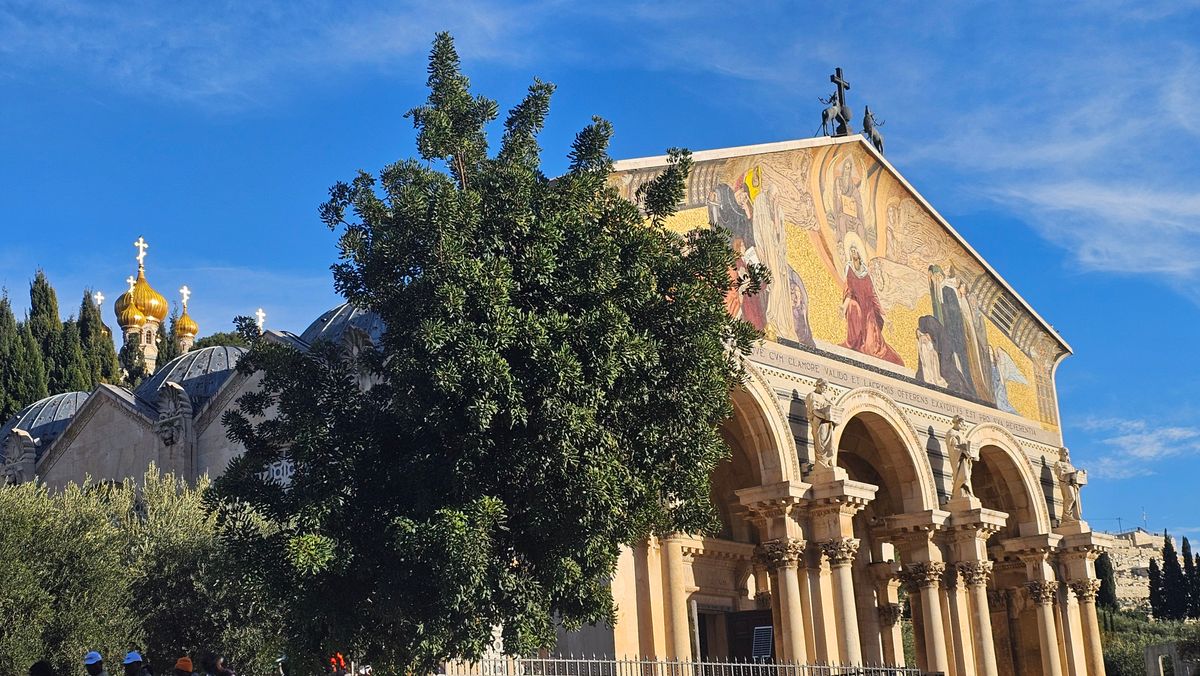
The Church of All Nations (Basilica of the Agony) stands at the foot of the Mount of Olives in the Garden of Gethsemane, over the rock where tradition holds that Jesus prayed on the night before his arrest and crucifixion. The name Gethsemane comes from the Aramaic Gat Shmanim, meaning “oil press,” and the garden was likely an olive grove with a press for producing olive oil. It was here, among the olive trees, that Jesus experienced his most human moment: the agony of knowing what was coming and asking his Father to take it away.
The Darkest Night
The Gospel accounts describe Jesus bringing Peter, James, and John to Gethsemane after the Last Supper, asking them to stay awake and watch while he went ahead to pray. “My soul is overwhelmed with sorrow to the point of death,” he told them (Matthew 26:38). Then he fell to the ground and prayed: “My Father, if it is possible, let this cup pass from me; yet not as I will, but as you will” (Matthew 26:39). He returned to find the disciples sleeping, went back to pray again, and returned again to find them sleeping. The third time, he said: “Are you still sleeping and resting? Look, the hour has come” (Matthew 26:45). Judas arrived with a crowd carrying swords and clubs, identified Jesus with a kiss, and the arrest began.
Oil Press and the Blood
The phenomenon of sweating blood is a real, documented medical condition called hematidrosis. It occurs under extreme psychological stress, when the tiny capillaries that feed the sweat glands rupture, mixing blood with sweat. The condition is rare but recognized in medical literature, and the fact that Luke, traditionally identified as a physician, is the only Gospel writer to record this detail has not been lost on scholars. In a garden named after the crushing of olives, Jesus was crushed until he bled.
Twelve Legions of Angels
When Judas arrived with the armed crowd and Peter drew his sword to fight, Jesus stopped him: “Do you think I cannot call on my Father, and he will at once put at my disposal more than twelve legions of angels?” (Matthew 26:53). A Roman legion consisted of approximately 6,000 soldiers, which means Jesus was speaking of over 72,000 angels. The scale of the claim is staggering, but what makes it even more powerful is what we know from elsewhere in the Bible about what a single angel can do.
When the Assyrian king Sennacherib besieged Jerusalem in 701 BCE with an overwhelming army, the Bible records: “That night the angel of the Lord went out and put to death a hundred and eighty-five thousand in the Assyrian camp” (2 Kings 19:35). One angel, 185,000 soldiers, in a single night. Jesus said he could summon twelve legions of such beings. He chose not to. The olive press continued its work, and the oil, or the blood, flowed.
The Church of All Nations at Gethsemane Jerusalem
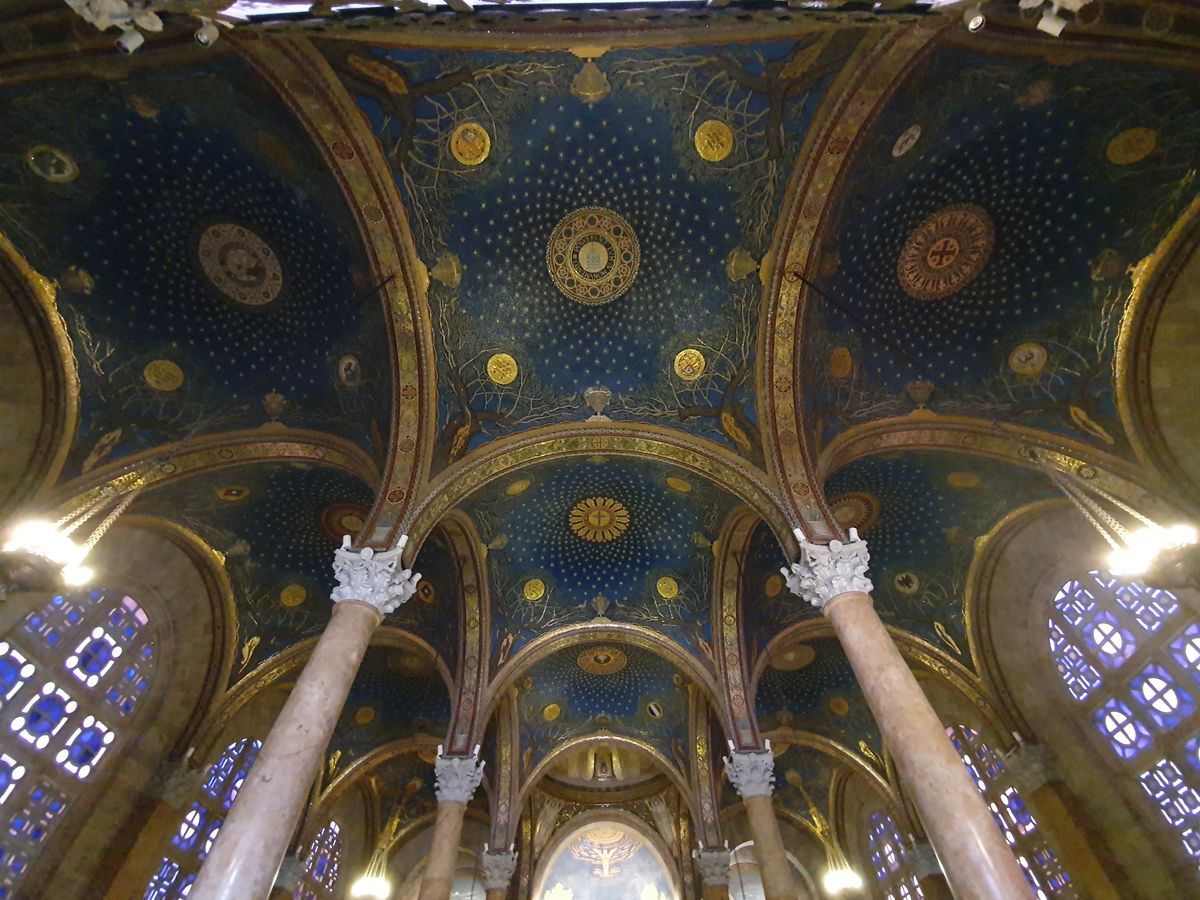
The Church of All Nations, designed by Antonio Barluzzi and completed in 1924, was with twelve ceiling domes, each bearing the coat of arms of one of the contributing nations decorated with its national coat of arms. Barluzzi’s design is a masterpiece of architectural theology. The interior is deliberately dark, with purple-tinted windows that create the atmosphere of a night vigil. The mosaics on the ceiling depict a sky full of stars. The bare rock of the agony protrudes from the floor before the altar, surrounded by a wrought-iron crown of thorns. Everything in the building, the darkness, the stone, the thorns, draws the visitor into the emotional reality of that last night.
Olive Trees
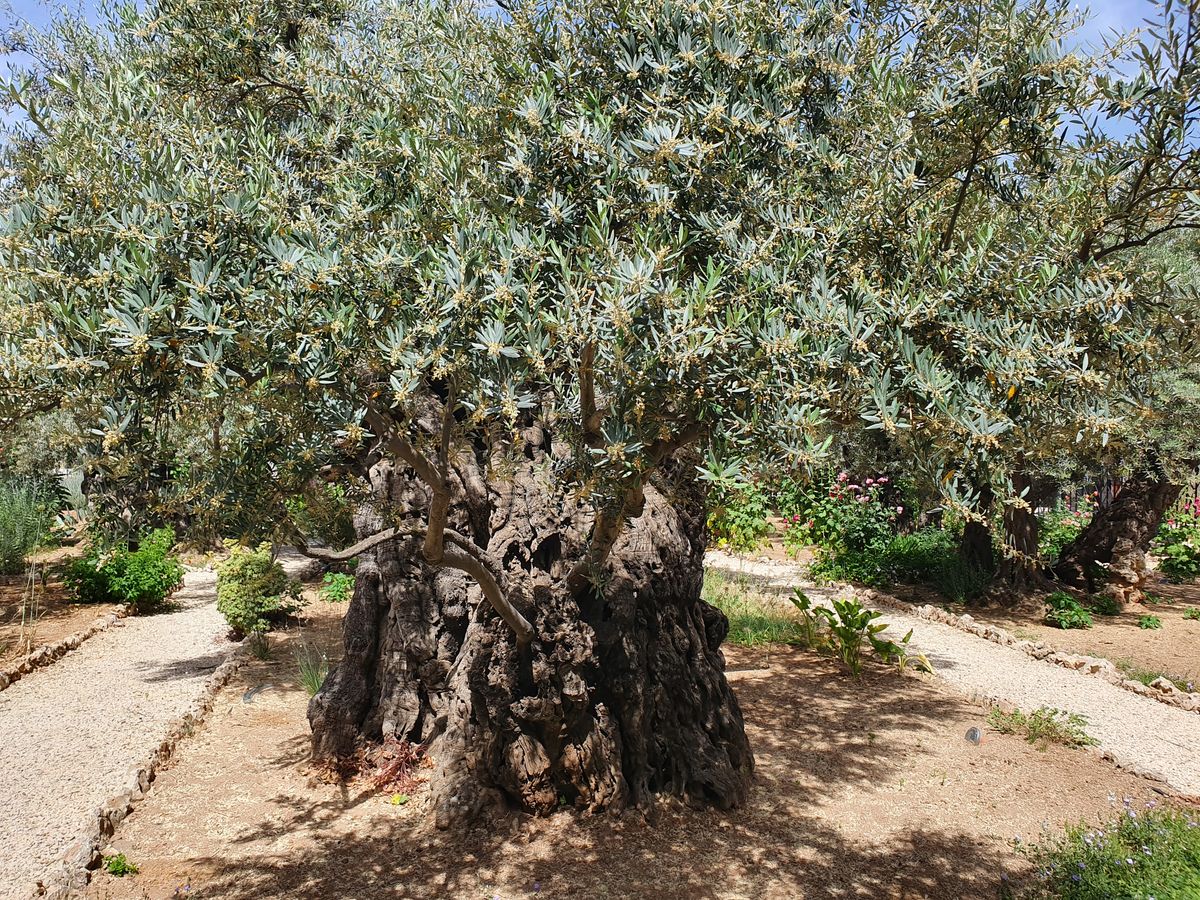
The ancient olive trees in the garden outside the church are among the oldest living trees in Jerusalem. Scientific testing conducted by Italian researchers in 2012 dated the trunks of some trees to approximately 900 years old. However, olive trees can regenerate from their roots, and it is possible that the root systems are far older than the trunks. Whether these specific trees witnessed the events of that night is unknowable, but olive trees have grown on this hillside for millennia, and the gnarled, twisted trunks create an atmosphere that needs no explanation.
Cave of Gethsemane
Adjacent to the Church of All Nations, a natural cave known as the Grotto of Gethsemane is one of the lesser-known but most evocative sites on the Mount of Olives. The cave is believed by tradition to be the place where the disciples slept while Jesus withdrew to pray on the night of his arrest, the place where he returned three times to find them sleeping, and where he said: “Could you not watch with me one hour?” (Matthew 26:40).
Some scholars believe this cave was the actual olive press (gat shemanim in Hebrew/Aramaic means “oil press”) that gave Gethsemane its name. The cave is large enough to have housed an ancient pressing operation, and the cool, enclosed space would have been ideal for storing olives and oil. If this identification is correct, then the name Gethsemane refers not to the garden above but to the working cave below.
The grotto, managed by the Franciscan Custody of the Holy Land, has been arranged as a chapel with three altars. The ceiling preserves traces of Byzantine-era paintings, and the rough stone walls give the space an intimate, underground atmosphere very different from the ornate church outside. For many pilgrims, the cave feels closer to the original experience than the church, a dark, enclosed space where the weight of that night still seems to press against the walls.
Visit with Hoshen Tours
Gethsemane is one of the most emotionally powerful Christian sites in Jerusalem, and Hoshen Tours gives visitors time to absorb the atmosphere of this ancient garden rather than rushing through. The visit includes the Church of All Nations, the ancient olive trees, and the reading of the Gospel account on the spot where tradition holds that Jesus prayed on the night of his arrest. Hoshen Tours connects it to the full Mount of Olives descent, including Dominus Flevit above, the Kidron Valley below, and the Church of Mary Magdalene.
Ready to experience Israel in true colors?
Plan Your TourPrivate tours designed around your interests, schedule, and pace.