



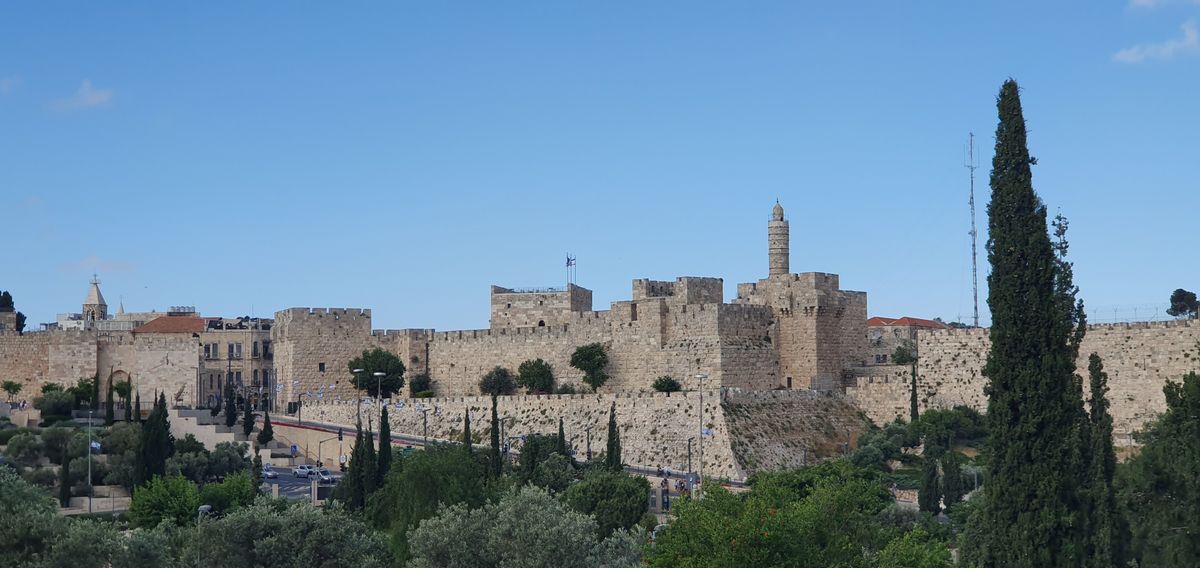
The Tower of David is not David’s tower. It has nothing to do with King David. The name is a Byzantine-era misidentification that stuck, and it is one of the most enduring misnomers in Jerusalem. What stands beside the Jaffa Gate is a citadel built and rebuilt by virtually every power that has ruled Jerusalem over the past 2,500 years, from the Hasmoneans to the Ottomans. The massive stone base visible at the northeast corner dates to Herod the Great, the archaeological garden in the courtyard reveals layers from at least eight distinct periods, and the view from the top is the finest orientation point in the city. It is Jerusalem’s history compressed into a single compound.
Herod’s Three Towers
The fortifications on this hilltop, the highest point on the western ridge of the Old City, date back to the Hasmonean dynasty in the 2nd century BCE. But the citadel as we know it was shaped by Herod the Great, who built three massive towers at the northwest corner of his royal palace complex in the final decades of the 1st century BCE. He named them after the people he loved and lost: Hippicus, after a friend who fell in battle; Phasael, after his brother who took his own life in Parthian captivity to avoid mutilation; and Mariamne, after his Hasmonean wife, whom he later had executed. Josephus describes Phasael as resembling the great lighthouse of Alexandria. The enormous stone base visible today, roughly 20 by 20 meters of perfectly fitted Herodian ashlars without mortar, is traditionally identified as the base of Phasael’s tower. Herod’s palace, which extended south from the towers, was described by Josephus as lavishly decorated with porticoes, gardens, canals, and banquet halls.
From Rome to the Crusaders
When the Romans under Titus destroyed Jerusalem in 70 CE, they deliberately left Herod’s three towers standing as testimony to the might of the fortifications their army had overcome. The site became the base of the Tenth Roman Legion (Legio X Fretensis), which garrisoned Jerusalem for roughly two centuries. Roof tiles stamped with the legion’s insignia, a boar and a ship, have been found in the area. During the Byzantine period, monks settled here and the misidentification with King David took root. After the Muslim conquest in 638 CE, the citadel continued as a fortified point. When the Crusaders captured Jerusalem in 1099, the citadel became a key fortress of the Crusader Kingdom, and Crusader kings resided here at various times. They built the great hall, expanded the moat, and added towers. When Saladin captured Jerusalem in 1187, the citadel was among the last points surrendered.
Mamluks, Ottomans, and the British
The Mamluks rebuilt the citadel after the Ayyubids had dismantled its fortifications in 1239 to deny them to the Crusaders. Much of the upper structure visible today on the Herodian base dates from Mamluk reconstruction in the 14th century. Sultan Suleiman the Magnificent renovated the citadel when he rebuilt Jerusalem’s walls in the 16th century. The minaret, the slender tower that defines the citadel’s silhouette against the Jerusalem skyline, was added during the Ottoman period and is associated with a small mosque built inside the compound. On December 11, 1917, General Allenby entered Jerusalem on foot at the Jaffa Gate, directly beneath the citadel walls, a deliberate gesture of humility. During the 1948 war, the citadel saw fierce fighting and came under Jordanian control until Israel captured the Old City in 1967.
The Museum and the Night Show
The Tower of David Museum, established in 1989 inside the citadel, tells the story of Jerusalem from the Canaanite period through to modern times. The museum has undergone a major renovation with state-of-the-art multimedia installations that bring Jerusalem’s history to life through projections, holograms, and immersive rooms. The physical layers of the citadel itself serve as exhibits: visitors walk through Hasmonean walls, past Herodian stones, under Crusader arches, and alongside Mamluk and Ottoman additions. The inner courtyard functions as an archaeological garden where excavations have revealed remains from at least eight distinct historical periods, all visible in one concentrated area. In the evenings, the citadel hosts a famous sound and light show projected onto its ancient walls, transforming the stone surfaces into screens that tell the story of Jerusalem through animation and surround sound.
The View from the Citadel Ramparts
The view from the citadel’s ramparts is widely considered the best orientation point in Jerusalem. Looking east, the Old City rooftops spread out toward the Temple Mount with the golden Dome of the Rock, and beyond it the Mount of Olives. To the south, Mount Zion and the Hinnom Valley. To the west, the modern city center and the Mamilla pedestrian mall. To the north, the domes of the Church of the Holy Sepulchre. All four quarters of the Old City can be surveyed from this single vantage point, making it an ideal first stop for visitors trying to understand the geography of a city that can otherwise feel like a maze.
Visit with Hoshen Tours
The Tower of David stands as a landmark at Jaffa Gate, greeting visitors as they enter the Old City from the west. With your Hoshen Tours guide, you’ll explore the citadel’s museum tracing Jerusalem’s history from its earliest days to the modern era. From here, it’s a short walk into the Armenian Quarter or along the Ramparts Walk for panoramic views of both the Old City and the new. Nearby Christ Church adds another layer to the area’s diverse heritage.
Explore Our Tour Collection
Ready to experience Israel in true colors?
Plan Your TourPrivate tours designed around your interests, schedule, and pace.