



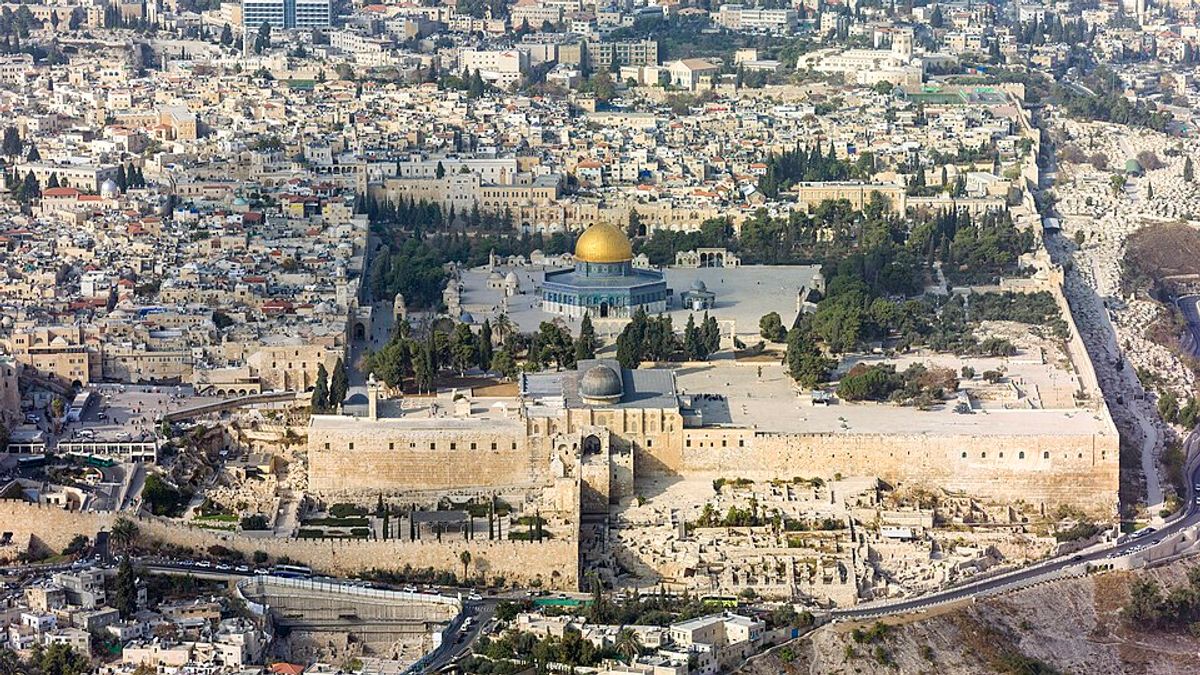
The Temple Mount (Har HaBayit in Hebrew, Haram al-Sharif in Arabic) is a 36-acre elevated platform in the heart of Jerusalem’s Old City that is sacred to Judaism, Christianity, and Islam. According to Jewish tradition, it is the place where Abraham bound Isaac for sacrifice (Genesis 22), where tradition holds Solomon built the First Temple, where tradition holds that Jesus taught and challenged, and where Muslims believe Muhammad ascended to heaven. The golden Dome of the Rock, visible from every direction, is the most recognizable symbol of Jerusalem, and the platform it stands on is the most significant piece of ground in the history of monotheism.
Foundation Stone Jerusalem
Beneath the golden dome, at the center of the octagonal building, a large outcropping of natural bedrock protrudes from the floor. This is the Even HaShtiya (the Foundation Stone), which Jewish tradition identifies as the point from which God created the world and the place where Abraham bound Isaac for sacrifice. In the Temple period, the Foundation Stone was in the Holy of Holies, the innermost sanctum of the Temple, where only the High Priest entered, once a year, on Yom Kippur. Islamic tradition holds that this is the rock from which the Prophet Muhammad ascended to heaven on his Night Journey (Isra and Mi’raj). A small cave beneath the rock, accessible by stairs, is known as the Well of Souls, where tradition says the voices of the dead can sometimes be heard. The stone, the cave, and the dome above them make this single piece of bedrock the most spiritually contested rock on the face of the earth.
First and Second Temples
According to the Bible, King Solomon built the First Temple on this spot in the 10th century BCE, fulfilling the vision of his father David, who had purchased the threshing floor of Araunah the Jebusite on Mount Moriah (2 Samuel 24:18-25). The Temple stood for nearly four centuries until Nebuchadnezzar and the Babylonians destroyed it in 586 BCE. The returning exiles built the Second Temple on the same site, completing it around 516 BCE, a more modest structure that served for five centuries.
Herod’s Mountain
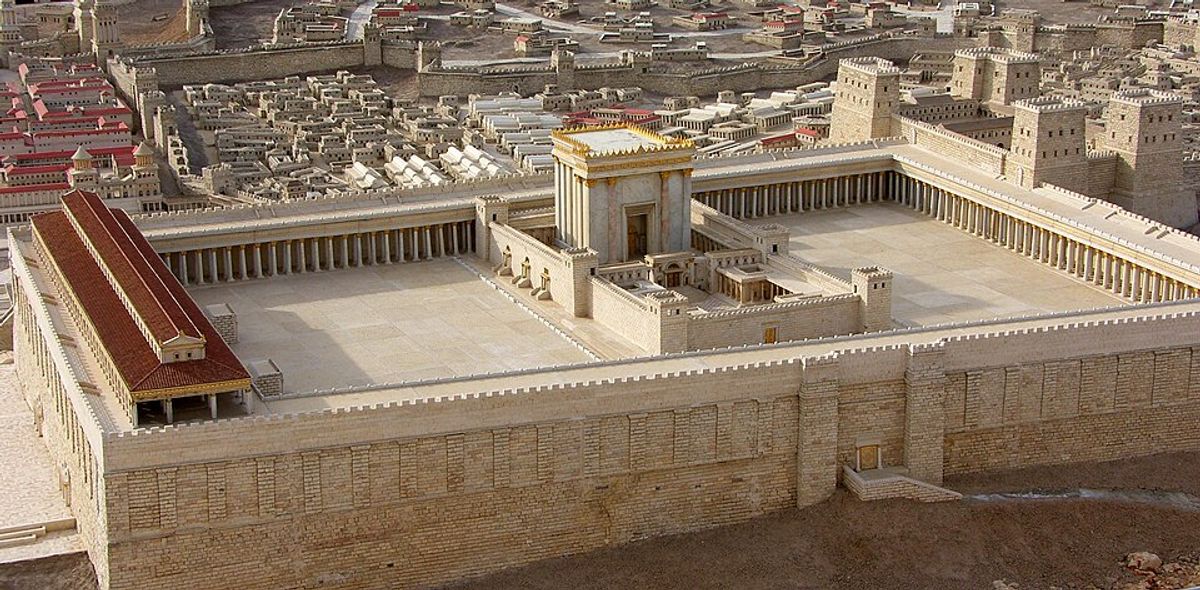
Around 19 BCE, Herod the Great announced his intention to transform the Temple Mount into the largest religious complex in the ancient world. According to the Talmud (Bava Batra 3b), Herod consulted the Jewish elders before beginning. Their condition was uncompromising: do not tear down the old Temple until the new one is ready. The Temple service must never be interrupted. Herod reportedly assembled 1,000 wagons for transporting stone, trained 1,000 priests as masons (since only priests could enter the sacred areas), and gathered 10,000 skilled laborers before dismantling a single wall.
The engineering was staggering. Herod built massive retaining walls on all four sides of Mount Moriah, then filled the spaces between the bedrock and the walls with earth, rubble, and vaulted substructures, creating a level platform of approximately 144,000 square meters (36 acres), the largest artificial platform in the Roman world. The stones were cut from local quarries with extraordinary precision, fitted together without mortar, their surfaces dressed with the distinctive flat-bordered margins that are the hallmark of Herodian masonry. The largest stones in the Western Wall weigh hundreds of tons. Along the southern edge, Herod built the Royal Stoa, a colossal basilica with 162 columns that Josephus described as surpassing anything under the sun. Robinson’s Arch, whose spring stones are still visible near the southern end of the Western Wall, once supported a monumental staircase rising from the street below. Wilson’s Arch, still intact, carried a bridge from the Upper City to the Temple compound.
The Temple sanctuary itself was completed in just 18 months by the specially trained priests. But work on the surrounding courts, colonnades, and fortifications continued for decades. In the Gospel of John, people told Jesus: “This temple has been under construction for forty-six years” (John 2:20). The entire complex was finally completed in 64 CE, just six years before the Romans destroyed it. Josephus notes that when construction ended, 18,000 workers were suddenly unemployed, creating an economic crisis in the city.
The Destruction of the Temple
In the summer of 70 CE, after a five-month siege, Roman legions under Titus breached the walls of Jerusalem and fought their way to the Temple Mount. Josephus, who witnessed the destruction from the Roman camp, describes how Titus initially ordered the Temple to be spared, but in the chaos of battle a soldier threw a torch through a window of one of the Temple chambers and the fire spread beyond control. The Temple burned on the 9th of Av (Tisha B’Av), the same date on which, according to tradition, the Babylonians had destroyed the First Temple nearly 660 years earlier.
The destruction was total. The gold that covered the Temple’s interior melted into the cracks between the stones, and the Romans pried the stones apart to retrieve it, fulfilling Jesus’ prophecy that not one stone would be left standing on another. Thousands were killed, thousands more enslaved and marched to Rome, where they were paraded through the streets in a triumph that is depicted on the Arch of Titus near the Roman Forum. The Temple’s sacred objects, including the golden menorah and the Table of Showbread, were carried off as spoils. The Temple has never been rebuilt. The 9th of Av remains the most solemn day of mourning in the Jewish calendar, observed with fasting and the reading of the Book of Lamentations.
Jesus at the Temple
The Temple was central to the life and ministry of Jesus. He was presented at the Temple as an infant (Luke 2:22). At age twelve, his parents found him in the Temple courts, “sitting among the teachers, listening to them and asking them questions. Everyone who heard him was amazed at his understanding” (Luke 2:46-47). As an adult, tradition holds that Jesus visited the Temple during the major Jewish festivals, and some of the most dramatic moments of the Gospels took place on this platform.
The Cleansing of the Temple: Jesus entered the Temple courts and overturned the tables of the money changers and the benches of those selling doves: “It is written, ‘My house will be called a house of prayer,’ but you are making it ‘a den of robbers’” (Matthew 21:13). The money changers provided the Temple currency needed to purchase sacrificial animals, and their tables filled the Court of the Gentiles, the only area where non-Jews could worship. Jesus’ anger was directed at those who turned a place of prayer into a marketplace.
The Woman Caught in Adultery: While teaching at the Temple, Jesus was confronted by teachers of the law who brought a woman caught in adultery and demanded he pronounce judgment. Jesus bent down and wrote on the ground with his finger. Then he straightened up and said: “Let any one of you who is without sin be the first to throw a stone at her.” One by one, her accusers left, and Jesus said to the woman: “Neither do I condemn you. Go now and leave your life of sin” (John 8:7-11). The scene took place in the Temple courts, where the stone pavement would have been the surface on which Jesus wrote his mysterious, unrecorded words.
The Gospel Connection
The Widow’s Offering: Sitting opposite the Temple treasury, Jesus watched people putting their money into the offering boxes. Many rich people threw in large amounts. Then a poor widow came and put in two small copper coins (lepta), worth only a few cents. Jesus called his disciples and said: “Truly I tell you, this poor widow has put more into the treasury than all the others. They all gave out of their wealth; but she, out of her poverty, put in everything, all she had to live on” (Mark 12:41-44). The treasury was located in the Court of the Women, and the scene is a window into the daily Temple life that Jesus observed.
The Prediction of Destruction: As Jesus left the Temple for the last time, his disciples called his attention to the magnificent buildings. Jesus responded with a prophecy that was fulfilled 40 years later: “Do you see all these great buildings? Not one stone here will be left on another; every one will be thrown down” (Mark 13:2). The fallen stones at the Davidson Center, lying on the street where the Romans threw them in 70 CE, are the physical evidence of this prophecy.
Al-Aqsa Mosque
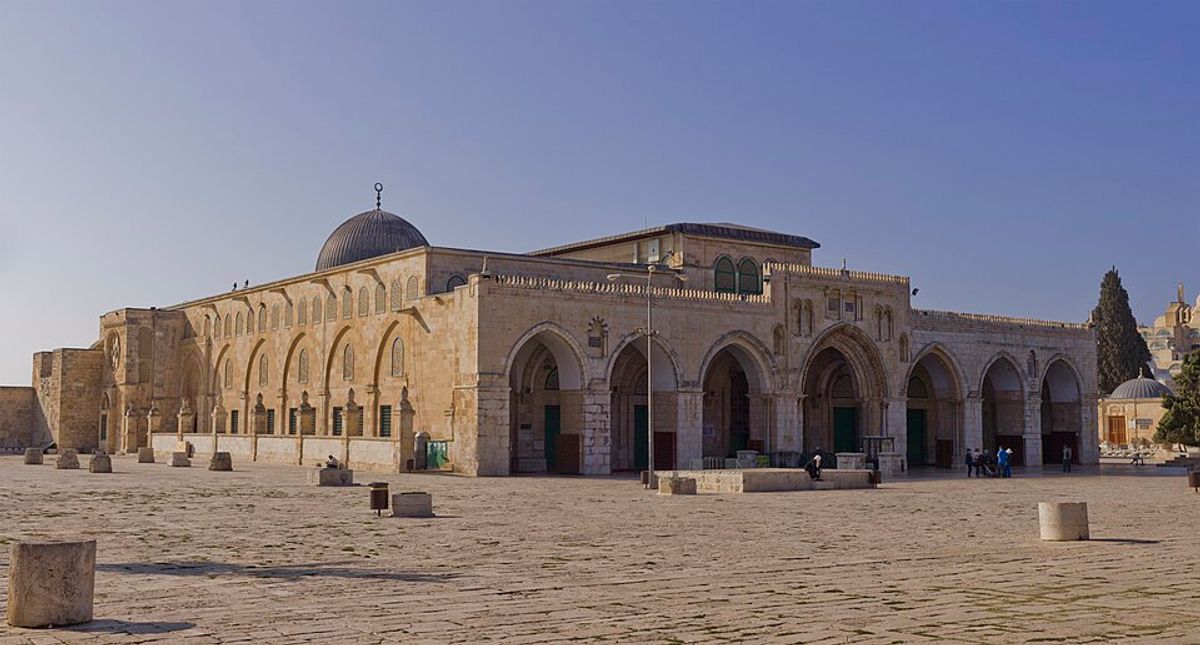
Al-Aqsa (“the Farthest”) takes its name from the Quran (17:1), which describes Muhammad’s Night Journey (al-Isra) from “the Sacred Mosque” in Mecca to “the Farthest Mosque,” identified by Islamic tradition as this site in Jerusalem. From here, tradition holds, Muhammad ascended through the seven heavens (the Mi’raj). The first prayer house on the site was built by Caliph Umar after the Muslim conquest of Jerusalem in 638 CE. The substantial mosque was constructed by the Umayyad Caliph al-Walid I in the early 8th century, destroyed by earthquakes, and rebuilt several times. The current structure is largely based on the Fatimid reconstruction of 1034-1036 CE, with later Crusader, Ayyubid, Mamluk, and Ottoman modifications.
After the Crusaders captured Jerusalem in 1099, they converted the mosque into a royal palace, and in 1119-1120 King Baldwin II gave the building to the newly founded Knights Templar, who used it as their headquarters. The Templars got their name from this building, which the Crusaders called Templum Solomonis, the Temple of Solomon. The vaulted substructures beneath the southeast corner, which the Templars used as stables, became known as Solomon’s Stables. After Saladin recaptured Jerusalem in 1187, the mosque was restored to Islamic worship. Today the silver-domed mosque accommodates approximately 5,000 worshippers inside, while during Ramadan, tens of thousands pray across the entire platform. The term “Al-Aqsa” is increasingly used to refer not just to the mosque building but to the entire 36-acre compound, a usage that carries significant political weight.
Dome of the Rock
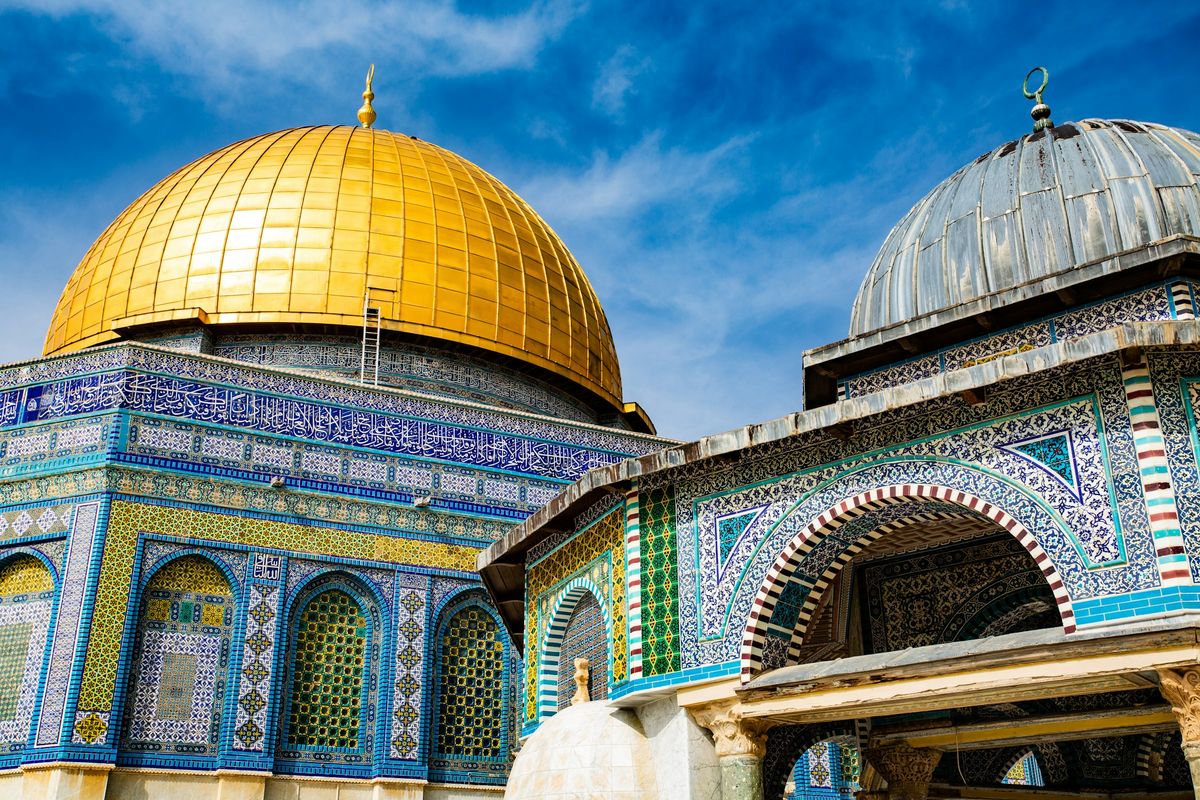
The golden dome that dominates the Jerusalem skyline was completed in 691-692 CE by the Umayyad Caliph Abd al-Malik ibn Marwan, making it one of the oldest surviving works of Islamic architecture in the world. The octagonal building, with walls approximately 18 meters per side and a dome approximately 20 meters in diameter rising to a total height of roughly 30 meters, was almost certainly designed to rival the great Byzantine churches of Jerusalem, particularly the rotunda of the Church of the Holy Sepulchre. The interior is covered with elaborate mosaics featuring vegetal motifs, jewels, and crowns, but no human or animal figures, consistent with Islamic aniconism. The mosaic inscriptions running around the interior arcades include some of the earliest known Quranic inscriptions, directly addressing Christian theology: “God is one, He has no companion, He does not beget and is not begotten.”
The dome was originally covered in lead. In the 1960s it was replaced with an aluminum-bronze alloy, and in 1993 King Hussein of Jordan funded the current gold-leaf covering at a reported cost of over $8 million. The contrast between the golden Dome of the Rock and the silver dome of Al-Aqsa is one of the most recognizable features of the Jerusalem skyline.
The 36-Acre Platform
The 36-acre platform that visitors walk on today was largely the creation of Herod the Great, who doubled the size of the original Temple Mount by building massive retaining walls and filling in the space behind them. The engineering was extraordinary: some of the stones in the retaining walls weigh over 500 tons, and the platform they support is one of the largest religious precincts in the ancient world. The open esplanade is dotted with smaller structures: fountains for ablution, arcaded galleries, staircases, and the scales (mawazin), a row of arches that tradition associates with the scales of judgment on the Last Day.
Cypress trees, olive trees, and gardens cover parts of the platform, and the overall atmosphere, especially on a quiet morning, is surprisingly peaceful. The contrast between the serenity of the platform and the intensity of the emotions it generates is one of the defining paradoxes of Jerusalem.
Sacred to Three Faiths
The Temple Mount is sacred to half the world’s population. For Jews, it is the place where God chose to dwell and where the Temple will one day be rebuilt. For Christians, it is believed to be where Jesus taught, healed, and prophesied. For Muslims, it is the third holiest site in Islam, after Mecca and Medina. The convergence of three faiths on a single platform, each with deep and legitimate claims, makes the Temple Mount the most spiritually dense place on earth. Its future is one of the great unresolved questions of our time.
Non-Muslim visitors can access the Temple Mount through the Mughrabi Gate, near the Western Wall, during limited visiting hours (typically Sunday-Thursday mornings, subject to change due to security and holidays). The Islamic Waqf manages the religious sites, and entry to the Dome of the Rock and Al-Aqsa Mosque is restricted to Muslims. Visitors should dress modestly and be prepared for security checks. Photography of the exteriors is permitted; behavior should be respectful at all times.
Visit with Hoshen Tours
The Temple Mount is one of the most significant and sensitive sites in the world, and visiting with a private guide ensures you understand its full historical and spiritual context. Your Hoshen Tours guide can combine a Temple Mount visit with the Western Wall plaza below, the quiet prayer spot at the Little Western Wall, and views of the sealed Golden Gate on the eastern wall. Access to the compound is typically through the Dung Gate area, and nearby Lions’ Gate connects to the beginning of the Via Dolorosa route. Hoshen Tours often combines this site with Sephardic Synagogues, Deir es-Sultan, and Sisters of Zion for a memorable day exploring the region.
Explore Our Tour Collection
Ready to experience Israel in true colors?
Plan Your TourPrivate tours designed around your interests, schedule, and pace.