



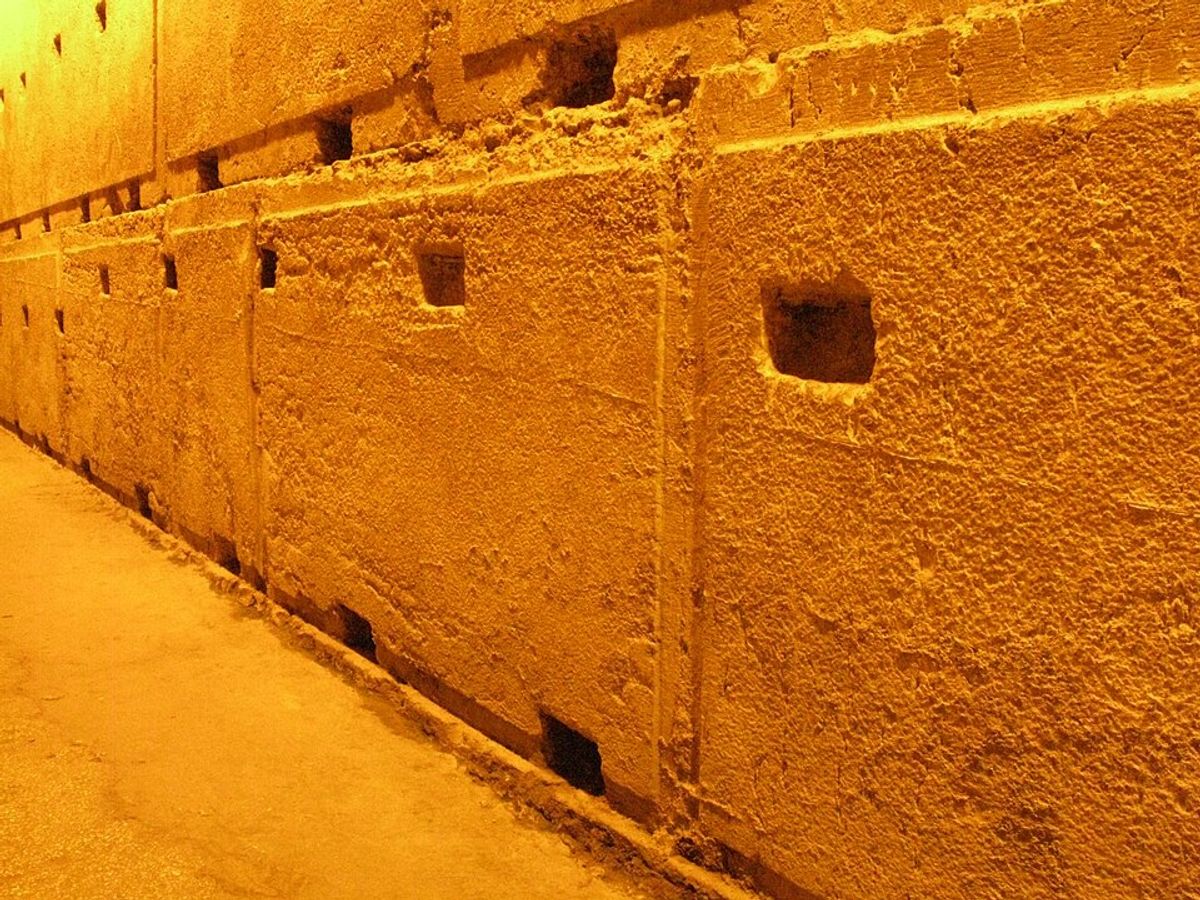
The Western Wall that visitors see in the plaza is only a small fraction of the full retaining wall. The visible section is about 57 meters long. The full western wall of the Temple Mount extends 488 meters, and most of it is buried underground, hidden behind centuries of construction. The Western Wall Tunnels Jerusalem take visitors along this hidden wall, through 2,000 years of excavated history, to places that most visitors never know exist. Two separate tour routes explore different sections of the underground complex, each revealing a different aspect of Herod’s engineering and the city that grew on top of it.
The Great Stone Tour Jerusalem
The Great Stone tour follows the base of the Western Wall northward from the plaza, passing the enormous Herodian stones that form the Temple Mount retaining wall. The masonry is visible throughout, and the scale is staggering. The Western Stone, the largest single building block at the Temple Mount, measures 13.6 meters long and 3.3 meters high. It was long estimated to weigh 570 tons, though a 2006 ground-penetrating radar study suggested the stone may be shallower than originally thought, putting the weight closer to 250 to 300 tonnes. Standing beside it underground, touching its surface, you are in physical contact with one of the most ambitious building projects of the ancient world.
The route passes Warren’s Gate, an ancient entrance to the Temple Mount that was sealed centuries ago. Named after Charles Warren, the British engineer who explored it in the 1860s, the gate once provided direct access from the street to the Temple compound. The massive stones of its frame are still visible, and the knowledge that pilgrims once walked through this gate to reach the Temple adds weight to every step.
The Closest Point and Rabbi Getz’s Secret Tunnel
The emotional peak of the tour is the Closest Point (HaMakom HaKarov), the section of the wall that stands directly opposite where the Holy of Holies once stood. A small underground synagogue marks this spot, and worshippers pray here facing the wall in near silence. This is as close as any Jew can get to the place where, according to Jewish tradition, the Divine Presence dwelled. Near this point stands the synagogue established by Rabbi Yehuda Meir Getz, the rabbi of the Western Wall from 1968 until his death in 1995. In 1981, Rabbi Getz secretly broke through Warren’s Gate in an attempt to reach the space beneath the Temple Mount, believing he might find the Ark of the Covenant. The discovery triggered a confrontation with the Waqf, and the opening was sealed with concrete. His synagogue remains a place of prayer and a memorial to a man who spent his life as close to the Temple as the modern world allows.
Along the way, the tour passes through Herodian-era streets, past ancient cisterns and water channels, and through spaces that served as markets, ritual baths, and storage rooms in different periods. The Hasmonean water channel, carved before Herod’s time, is one of the oldest structures visible in the tunnels and shows how earlier generations solved the challenge of bringing water into the city. The tour takes approximately 75 minutes, must be booked in advance, and passes the Struthion Pool, a large underground cistern from the Roman period whose vaulted ceiling and still water create one of the most atmospheric moments in the tunnels, and exits at the Via Dolorosa in the Muslim Quarter, which means visitors emerge from Herodian Jerusalem directly into the medieval streets of the Old City.
The Great Bridge Tour
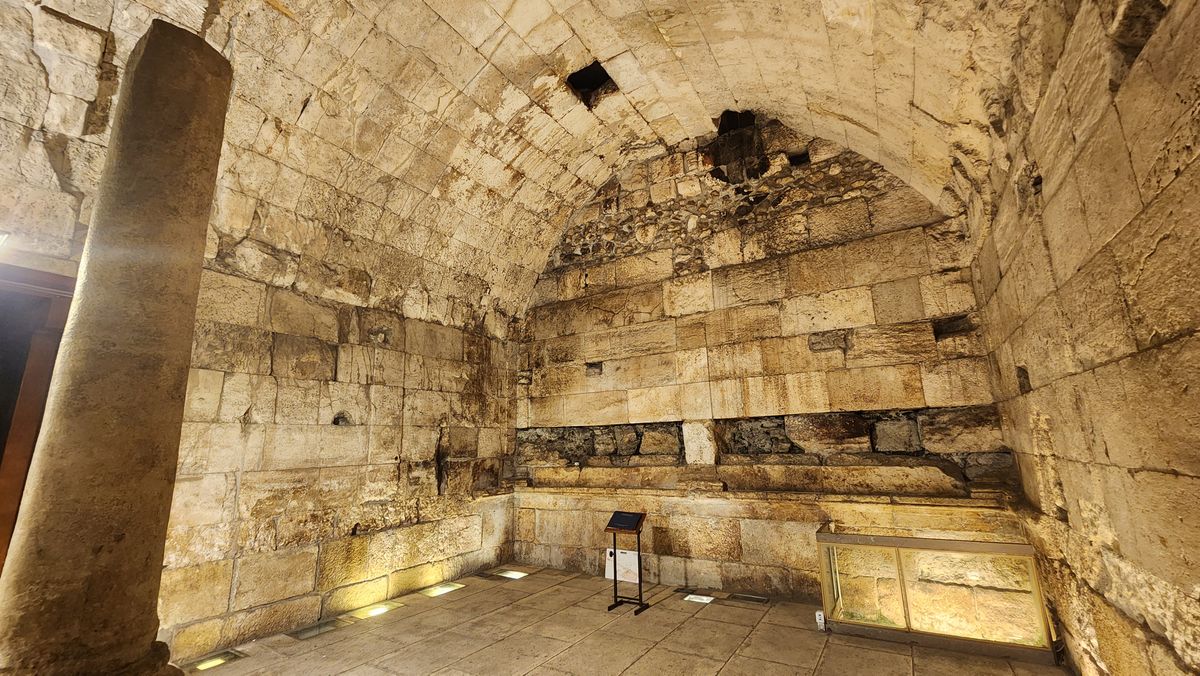
The second route follows the massive arched bridge known as Wilson’s Arch, which once connected the Temple Mount to the Upper City across the Tyropoeon Valley. The tour descends into vast underground halls and water channels that lie beneath the modern street level, passing through spaces that were buried for centuries. Visitors walk along Herodian-era waterways, stand inside enormous vaulted chambers that supported the ancient bridge, and see sections of the Western Wall that are even more impressive than those visible in the main tunnel. The chambers are huge, dark, and atmospheric, and the sound of dripping water echoes through spaces that have not seen daylight in two thousand years.
The Great Bridge tour offers a different perspective from the Great Stone route, focusing on the infrastructure that made Herod’s Temple Mount possible: the engineering of water supply, the construction of the bridge system, and the sheer scale of the underground spaces beneath the streets of the Old City. Some of the vaulted halls are large enough to hold hundreds of people, and the acoustics create an atmosphere that is part cathedral, part cave. The tour is less well known than the Great Stone route and draws fewer visitors, which adds to its sense of discovery.
Visitors descend through a Herodian-era street, passing sections of original paving stones still marked by ancient foot traffic. At the lowest point of the tour, the water channels are wide enough to walk through, and the marks of the quarrymen who carved them are still visible on the walls. The tour takes approximately 75 minutes and should also be booked in advance.
Visit with Hoshen Tours
The Western Wall Tunnels are one of the most popular attractions in Jerusalem, and advance booking is essential. Hoshen Tours arranges both the Great Stone and Great Bridge tours as part of Jerusalem itineraries, and a knowledgeable guide makes the difference between walking through dark corridors and understanding the 2,000-year story written in the stones around you. Without context, the tunnels are impressive but silent. With a guide who can explain what each stone, gate, and channel represents, they become one of the most moving experiences in Jerusalem. The tunnels combine naturally with the Western Wall plaza, the Jewish Quarter, and the Davidson Center for a complete picture of the Temple Mount from every angle.
Ready to experience Israel in true colors?
Plan Your TourPrivate tours designed around your interests, schedule, and pace.