



 Jerusalem” style=”float:right; margin:0 0 15px 20px; max-width:600px; width:55%; height:auto; border-radius:4px;” />
The Davidson Center sits at the southwestern corner of the Temple Mount, at the foot of the massive walls that Herod built to support the platform above. This is where the Pilgrimage Road ended, where pilgrims ascended the monumental staircase to enter the Temple compound, and where, in 70 CE, the Romans threw the Temple stones down from the walls above, shattering them on the street below. The archaeological park surrounding the Davidson Center is the single most important site for understanding what the Temple looked like and how it was destroyed.
Herodian Street and the Fallen Stones Jerusalem
The excavated street that runs along the base of the western and southern walls is the original Herodian commercial thoroughfare. The paving stones, laid in Herod’s time, bear the marks of two thousand years: the grooves of cart wheels, the wear of countless feet, and the impact craters of the stones thrown down by the Romans. A drainage channel runs beneath the street, and it was in this channel that residents hid during the Roman assault. A Roman sword, still in its scabbard, was found in the drain, dropped or hidden during the chaos of the destruction.
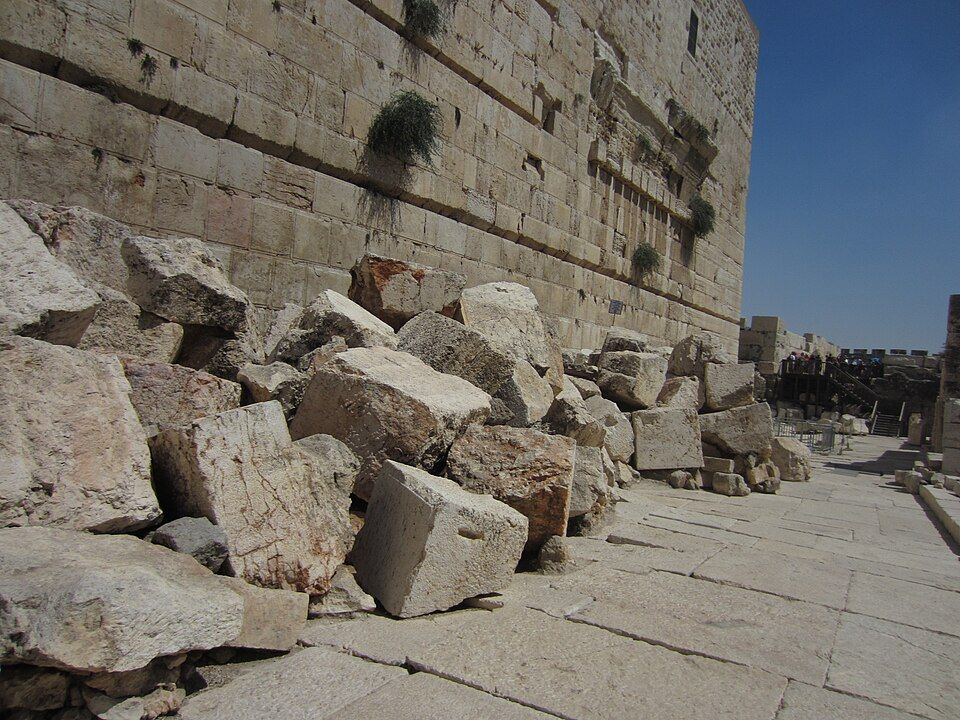
The most powerful sight in the park is the simplest: massive Herodian stones, some weighing over 50 tons, lying on the original street where they fell when the Romans toppled them from the walls in 70 CE. The stones lie in the exact positions they landed 2,000 years ago, crushing the paving beneath them. The sight of these enormous blocks, pushed from the height of the Temple Mount, is a physical testament to the violence of the destruction. The historian Josephus records that the Roman soldiers set fire to the Temple despite Titus’s orders to spare it, and the archaeology confirms the scale of the catastrophe.
Robinson’s Arch
The remains of Robinson’s Arch, a massive stone arch that once supported a monumental staircase leading from the street up to the Temple Mount, protrude from the western wall. The arch, discovered by the American explorer Edward Robinson in 1838, was part of the grand entrance system that Herod built for the Temple. The staircase rose from the street in a sweeping curve, and the shops that lined the street beneath it have been excavated, complete with stone counters, weights, and the remains of the goods they sold. Standing beneath the arch, you can see the scale of the original structure and imagine the crowds that climbed it.
Place of Trumpeting Stone
Among the fallen stones, one bears a Hebrew inscription that reads “Lebeit HaTekiah LeHa…” (To the Place of Trumpeting, to…). The full inscription was broken when the stone fell, but the meaning is clear: this stone marked the corner of the Temple Mount where a priest stood to blow the shofar (trumpet) to announce the beginning and end of Shabbat and festivals. The stone was found at the base of the southwestern corner, exactly where it would have fallen from the parapet above. It is one of the most vivid artifacts from the functioning Temple, a sign that once told a man where to stand and blow a horn that the entire city could hear.
Ritual Baths
At the base of the Southern Steps, dozens of mikvaot (ritual baths) have been excavated. Pilgrims were required to immerse in a mikveh before ascending to the Temple, and the concentration of baths at the foot of the steps confirms both the requirement and the volume of traffic. Some of the mikvaot are large enough for multiple people to immerse simultaneously, and the water channels that fed them are still visible.
Southern Steps and the Hulda Gates
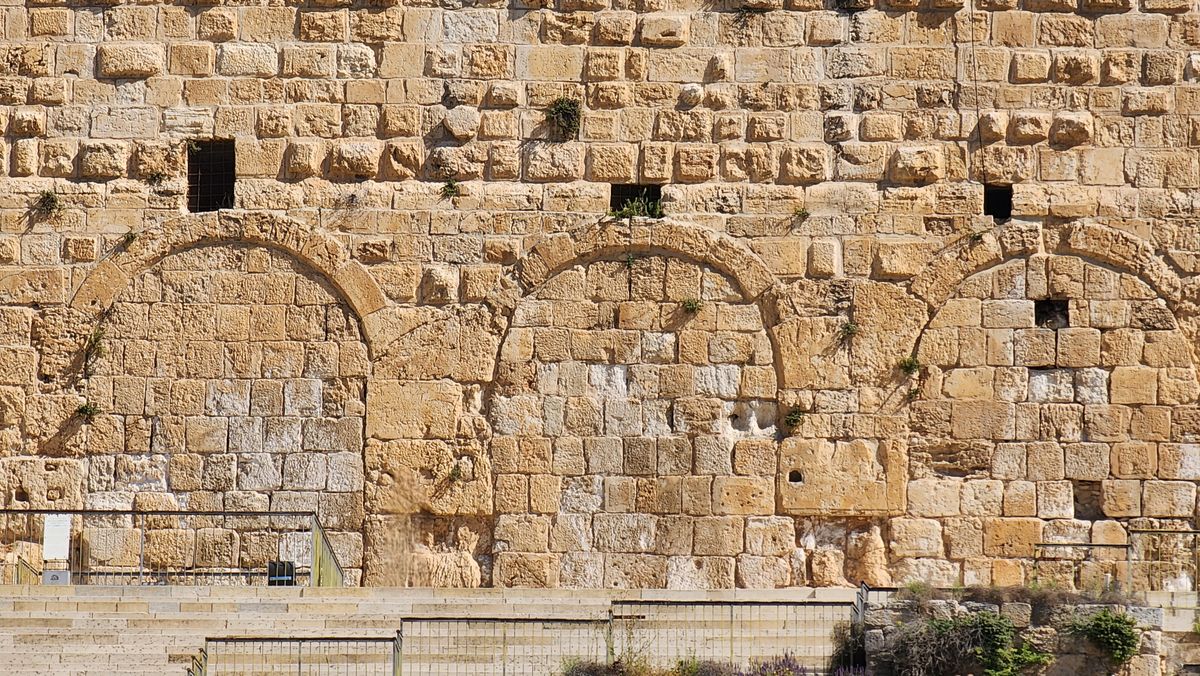
The Southern Steps were the main entrance for pilgrims ascending to the Temple. The broad staircase, with steps of alternating widths (narrow-wide-narrow-wide), was designed to slow the pace of those ascending. You cannot rush toward God. The steps lead up to the Hulda Gates, the main pilgrim entrances to the Temple Mount compound. There were two gates: the Double Gate (with two arches) served as the entrance, and the Triple Gate (with three arches) served as the exit. The gates gave access to tunnels that ascended through the massive platform to emerge on the Temple Mount surface above. The gates are now sealed, but their outlines are clearly visible in the southern wall, and the steps themselves are among the most authentic first-century remains in Jerusalem.
Jesus almost certainly climbed these steps. according to Acts, Peter preached here after Pentecost. And every Jewish pilgrim who came to the Temple during the festivals of Passover, Shavuot, and Sukkot would have ascended these stairs, purified and expectant, on their way to the house of God.
The Davidson Center Museum
The Davidson Center itself is an underground museum housed in the vaulted chambers of an Umayyad palace from the 8th century CE. The museum uses multimedia presentations, models, and artifacts to recreate the Temple Mount as it appeared in Herod’s time. A virtual reality experience allows visitors to “walk” through the Temple compound as it looked before the destruction, seeing the buildings, the courtyards, and the crowds that no longer exist. The combination of the physical remains outside and the virtual reconstruction inside creates an understanding of the Temple that neither could achieve alone.
Visit with Hoshen Tours
The Davidson Center brings the Temple period to life in a way that the Western Wall plaza alone cannot. Hoshen Tours includes it in every Jerusalem itinerary, connecting the Wall, the Temple Mount, and the City of David into a single narrative of construction, worship, and destruction.
Ready to experience Israel in true colors?
Plan Your TourPrivate tours designed around your interests, schedule, and pace.