



On the eastern wall of the Temple Mount, facing the Mount of Olives across the Kidron Valley, stands the most enigmatic gate in Jerusalem. The Golden Gate (Sha’ar HaRachamim in Hebrew, the Gate of Mercy; Bab al-Rahma in Arabic) has been sealed shut for centuries, its double archway blocked with stone. No other gate in any city in the world carries so much prophetic weight. Jews, Christians, and Muslims all believe that this gate is connected to the end of days, and its closure is itself part of the story.
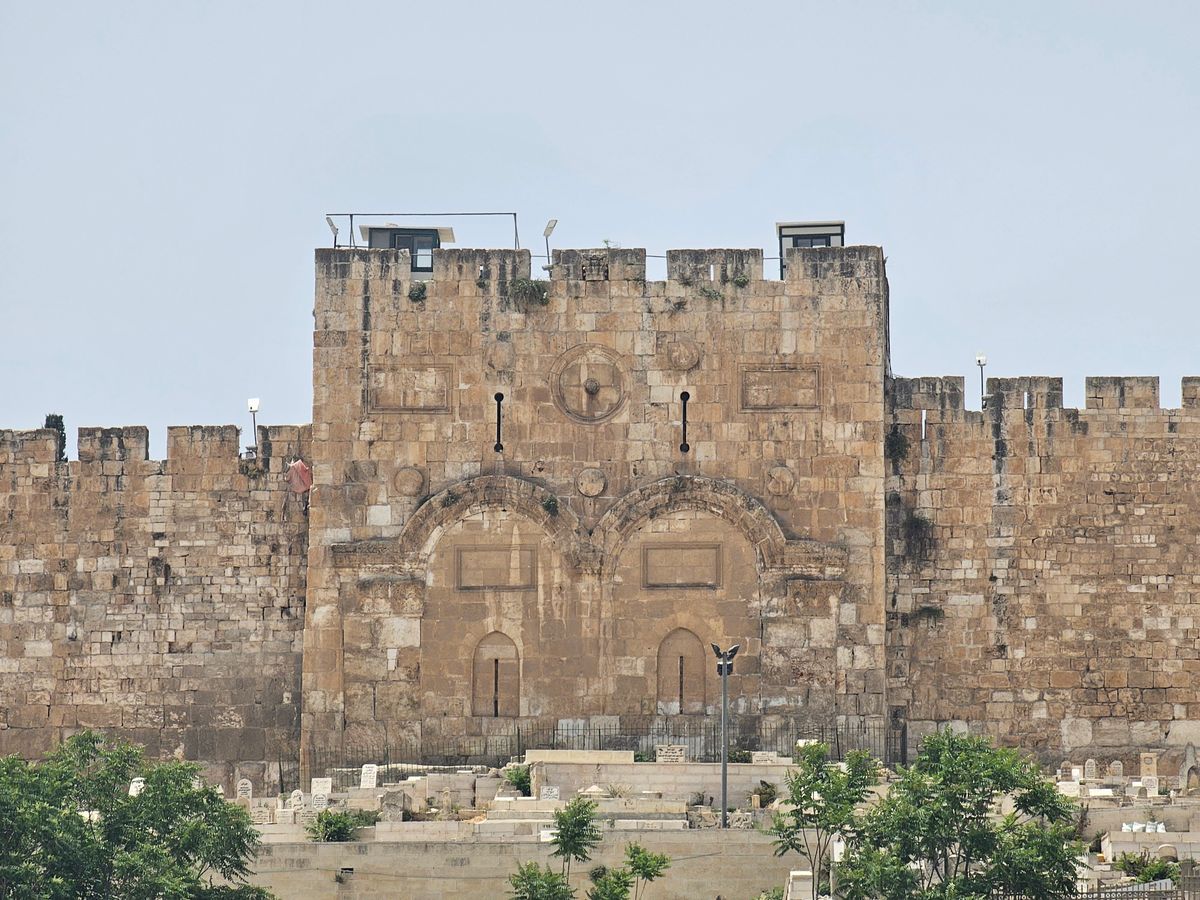
The Sealed Double Gate Jerusalem
The visible gate dates to the Byzantine or early Umayyad period (6th-7th century CE), though it almost certainly sits on the foundations of an earlier gate from the Second Temple period. The structure consists of two arched openings side by side: the southern arch is called the Gate of Mercy (Sha’ar HaRachamim) and the northern arch is called the Gate of Repentance (Sha’ar HaTeshuvah). The gate is built of massive stone blocks and is architecturally one of the finest structures in the eastern wall. Inside, a vaulted hall with columns and decorated capitals survives from the original construction.
Jewish Prophecy
In Jewish tradition, the Golden Gate is the gate through which the Messiah will enter Jerusalem. The prophet Ezekiel describes a vision of the eastern gate of the Temple: “Then the man brought me back to the outer gate of the sanctuary, the one facing east, and it was shut. The Lord said to me: This gate is to remain shut. It must not be opened; no one may enter through it. It is to remain shut because the Lord, the God of Israel, has entered through it” (Ezekiel 44:1-2). The gate is shut because God passed through it, and it will remain shut until the Messiah comes.
The Talmud and later rabbinic sources elaborate on this tradition. The Shechinah (Divine Presence) departed from the Temple through the eastern gate before the destruction, and it will return through the same gate at the time of redemption. The Messiah, a descendant of David, will enter Jerusalem through the Golden Gate, and the dead will be resurrected, beginning with those buried on the Mount of Olives, which faces the gate directly across the valley. This is one of the reasons why the Mount of Olives has been the most sought-after Jewish burial site for over 3,000 years: those buried there will be the first to greet the Messiah when he enters through the gate.
Christian Tradition
Christian tradition identifies the Golden Gate as the gate through which Jesus entered Jerusalem on Palm Sunday, riding on a donkey while crowds laid palm branches before him: “Blessed is the king who comes in the name of the Lord!” (Luke 19:38). The entry fulfilled the prophecy of Zechariah: “Rejoice greatly, Daughter Zion! See, your king comes to you, righteous and victorious, lowly and riding on a donkey” (Zechariah 9:9). Many Christians believe that Jesus will return through this same gate at the Second Coming, fulfilling the prophecy of Acts: “This same Jesus, who has been taken from you into heaven, will come back in the same way you have seen him go into heaven” (Acts 1:11), from the Mount of Olives, through the eastern gate, into the holy city.
The Byzantine empress Eudocia reportedly opened and restored the gate in the 5th century, and the annual Palm Sunday procession, which descends the Mount of Olives and approaches the Old City from the east, commemorates Jesus’ triumphal entry through this gate.
Muslim Tradition
In Islamic tradition, the gate is known as Bab al-Rahma (Gate of Mercy) and is associated with the Day of Judgment. Islamic eschatology holds that on the Last Day, the dead will be resurrected and must cross a bridge (al-Sirat) stretched across the Kidron Valley from the Mount of Olives to the Temple Mount. The righteous will cross safely; the wicked will fall. The gate’s location, facing the valley of judgment, connects it directly to this belief. A Muslim cemetery was established along the eastern wall, partly to honor the sanctity of the location and partly, according to some accounts, as a barrier against the entry of the Jewish Messiah, since a kohen (Jewish priest) cannot walk through a cemetery.
Why Was It Sealed?
The gate was sealed by the Ottoman Sultan Suleiman the Magnificent in 1541, when he rebuilt the walls of Jerusalem. The reasons for the sealing are debated and layered with legend. The most common explanation is that Suleiman sealed the gate to prevent the Jewish Messiah from entering the city through it, having heard the Jewish prophecy about the eastern gate. He also placed a cemetery in front of the gate, reasoning that a priestly Messiah would not be able to cross a graveyard. Whether Suleiman acted out of genuine theological concern, political calculation, or simple architectural logic (the gate was not needed as an entrance) is unclear. What is clear is that the sealed gate, with the Muslim cemetery at its foot and the Jewish cemetery on the mountain facing it, has become one of the most powerful visual symbols of messianic expectation in the world.
Some historians suggest the gate may have been sealed even earlier, possibly during the Crusader or Ayyubid period, and that Suleiman simply maintained the closure. Others note that the gate was briefly opened during certain periods and then resealed. Regardless of the exact timeline, the sealed gate has been a defining feature of Jerusalem’s eastern wall for nearly 500 years.
The View from the Mount of Olives
The Golden Gate is best viewed from the Mount of Olives, where its sealed double archway is clearly visible in the eastern wall of the Temple Mount, directly below the golden Dome of the Rock. The Muslim cemetery at the foot of the gate, the Jewish cemetery on the slope above, and the sealed gate between them create a landscape that is charged with eschatological meaning for three religions. No other view in Jerusalem compresses so much prophecy, hope, and tension into a single frame.
Visit with Hoshen Tours
While the Golden Gate itself is sealed, it remains one of the most meaningful sites to view from outside the walls. Your Hoshen Tours guide will explain the gate’s significance in Jewish, Christian, and Islamic tradition while showing you its best vantage points. A visit here pairs naturally with the Temple Mount compound above, the Western Wall plaza, and a walk past Lions’ Gate on the eastern wall. The Ramparts Walk also offers excellent views of the gate and the Kidron Valley below.
Explore Our Tour Collection
Ready to experience Israel in true colors?
Plan Your TourPrivate tours designed around your interests, schedule, and pace.