



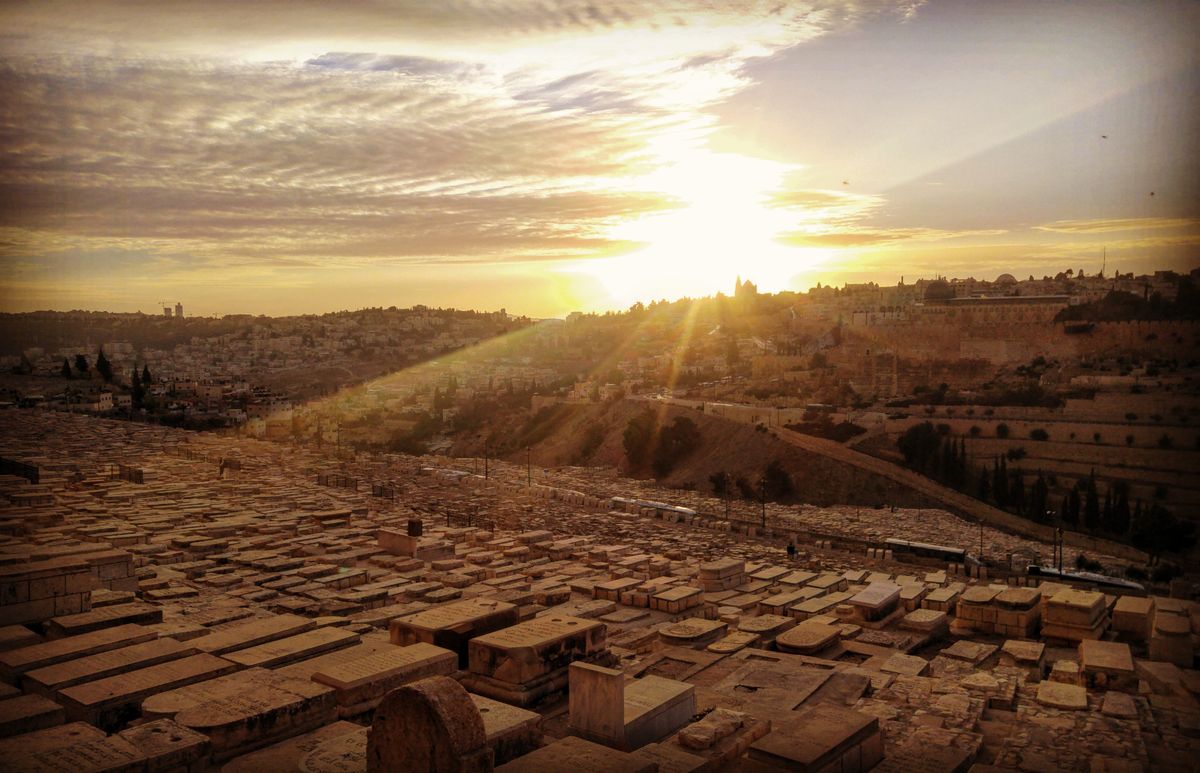
The Mount of Olives Cemetery in Jerusalem, Israel, is the oldest and most important Jewish cemetery in the world, with tombs dating back 3,000 years and an estimated 150,000 graves covering the western slope of the Mount of Olives. Jews have sought burial here for millennia because of the belief that the resurrection of the dead will begin on the Mount of Olives when the Messiah arrives through the Golden Gate across the valley.
Resurrection Will Begin Here
Jewish tradition, based on the prophecy of Zechariah, holds that the Messiah will stand on the Mount of Olives: “On that day his feet will stand on the Mount of Olives, east of Jerusalem, and the Mount of Olives will be split in two from east to west” (Zechariah 14:4). Those buried on the Mount of Olives will be the first to be resurrected, and they will be closest to the Messiah when he enters Jerusalem through the Golden Gate. This belief has made the Mount of Olives the most sought-after burial site in Judaism for three millennia. The Talmud teaches that the dead buried in the Land of Israel will be resurrected first, and among those, the dead of Jerusalem will rise before all others.
Those on the Mount of Olives, directly facing the Temple Mount across the Kidron Valley, will be the very first to stand. This is why, for thousands of years, Jews from across the diaspora have made provisions to be buried here, sometimes at enormous expense, and why the graves are packed so tightly on the slope that there is barely room to walk between them. The cemetery is not simply a burial ground; it is a statement of faith that history has a destination, and that destination begins here.
Notable Graves
The cemetery contains the graves of many of the most important figures in Jewish history: the prophets Haggai, Zechariah, and Malachi (according to tradition), Rabbi Obadiah of Bartenura (the great 15th-century commentator on the Mishnah), the Ohr HaChaim (Rabbi Chaim ben Attar), and many leading rabbis, scholars, and community leaders. Prime Minister Menachem Begin chose to be buried on the Mount of Olives rather than on Mount Herzl, reflecting his deep religious convictions. Other modern figures buried here include Henrietta Szold, the founder of Hadassah; Eliezer Ben-Yehuda, the man who revived the Hebrew language; and Rabbi Abraham Isaac Kook, the first Ashkenazi Chief Rabbi of British Mandatory Palestine. The ancient tombs at the base of the slope, in the Kidron Valley, include monumental rock-cut tombs from the Second Temple period traditionally associated with Absalom, Zechariah, and the priestly family of Hezir. The sheer density of burials across three thousand years, from biblical prophets to 21st-century rabbis, makes this slope the most concentrated Jewish burial ground on earth.
Jordanian Desecration
During the Jordanian occupation of the Old City (1948-1967), the Mount of Olives Cemetery was severely damaged. Tombstones were uprooted and used as building material, paving stones, and latrines in Jordanian military camps. A road was built through the cemetery, and the Intercontinental Hotel was constructed on part of the burial ground. After Israel recaptured the Old City in 1967, extensive restoration work began, but many graves were permanently damaged or destroyed.
The View of the Old City from the Graves
The cemetery offers one of the most iconic views of Jerusalem. Looking west from the graves, the entire Old City is spread out below: the Temple Mount with the golden Dome of the Rock, the walls, and the Golden Gate directly across the Kidron Valley. The view from the cemetery, with its ancient graves in the foreground and the holy city beyond, is one of the most photographed panoramas in the world.
Visit with Hoshen Tours
Walking through the Mount of Olives Cemetery with Hoshen Tours means reading the names that shaped Jewish history, from prophets to prime ministers. The visit often begins at the summit viewpoint on the Mount of Olives, then descends through the terraced graves toward the Kidron Valley and the monumental tombs of Absalom and Zechariah. Nearby, the Tomb of the Virgin Mary sits at the base of the slope, connecting Jewish and Christian layers of this ancient ridge.
Explore Our Tour Collection
Ready to experience Israel in true colors?
Plan Your TourPrivate tours designed around your interests, schedule, and pace.