



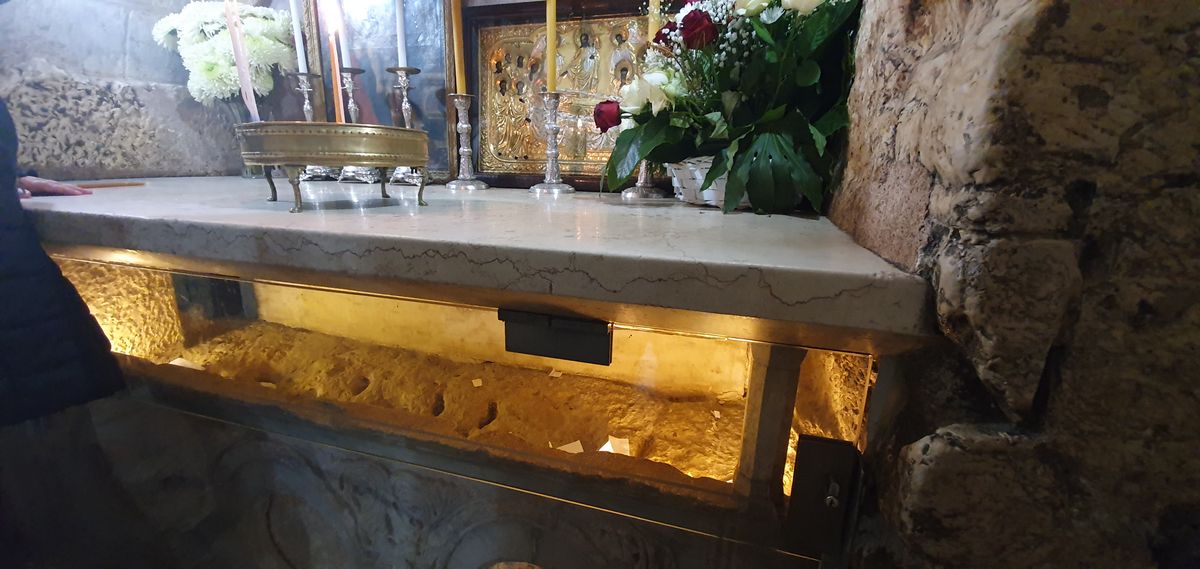
At the foot of the Mount of Olives where the Kidron Valley meets the approach to Gethsemane a grand staircase descends underground to the Tomb of the Virgin Mary Jerusalem Israel. The church, maintained by the Greek Orthodox and Armenian communities, is one of the most atmospheric underground spaces in Jerusalem, and the experience of descending into it feels like entering another world.
47 Steps Into the Earth
Forty-seven wide stone steps lead down from street level into a dimly lit, incense-filled crypt. The staircase, built by the Crusaders in the 12th century, is broad enough for processions and flanked by walls darkened by centuries of candle smoke. Oil lamps hang from the vaulted ceiling at every level, their light reflecting off the polished stone in a golden haze. The descent feels ceremonial, as if the architecture is preparing you for what waits at the bottom.
The church has ancient roots. A first shrine was built here in the Byzantine period, and the site was expanded significantly by the Crusaders in the 12th century, who constructed the monumental staircase and the underground basilica that survives today. When Saladin conquered Jerusalem in 1187, he did not destroy this church, out of respect for Mary’s place in Islam, he allowed it to remain in Christian hands, a rare act of preservation during the Crusader wars.
On the right side of the staircase, partway down, are the tombs of Queen Melisende of Jerusalem (died 1161) and her mother, Queen Morphia. Melisende was one of the most powerful rulers of the Crusader Kingdom, governing Jerusalem for over two decades. Her burial here, on the path to the Virgin’s tomb, was considered the highest honor a Crusader queen could receive.
The Rock-Cut Tomb of Mary
The tomb itself is a rock-cut chamber at the center of the underground church, venerated by Eastern Christians as the place where Mary was buried before her assumption into heaven. The tradition holds that the apostles buried Mary here three days after her death, and when they opened the tomb, they found it empty, her body having been taken up to heaven. Catholic tradition places the same event at the Dormition Abbey on Mount Zion but Eastern Orthodox, Armenian, and Coptic Christians hold firmly to this site.
The tomb chamber is small and enclosed, draped in fabrics and illuminated by dozens of oil lamps and candles. The walls are blackened by centuries of flame, and the atmosphere is dense with incense, devotion, and the accumulated prayers of countless pilgrims.
The underground church that surrounds the tomb is vast and surprisingly spacious. Massive stone columns support the ceiling, and the walls are hung with icons, oil lamps, and embroidered fabrics donated by pilgrims over the centuries. The different Christian communities that share the church, Greek Orthodox, Armenian, Coptic, and Syriac, each maintain their own altars and sections, creating a layered, multi-denominational space where overlapping traditions coexist in a single underground hall. On feast days, particularly the Feast of the Assumption on August 15, the church fills with processions, chanting, and the smoke of hundreds of candles, and the atmosphere becomes almost overwhelming in its intensity.
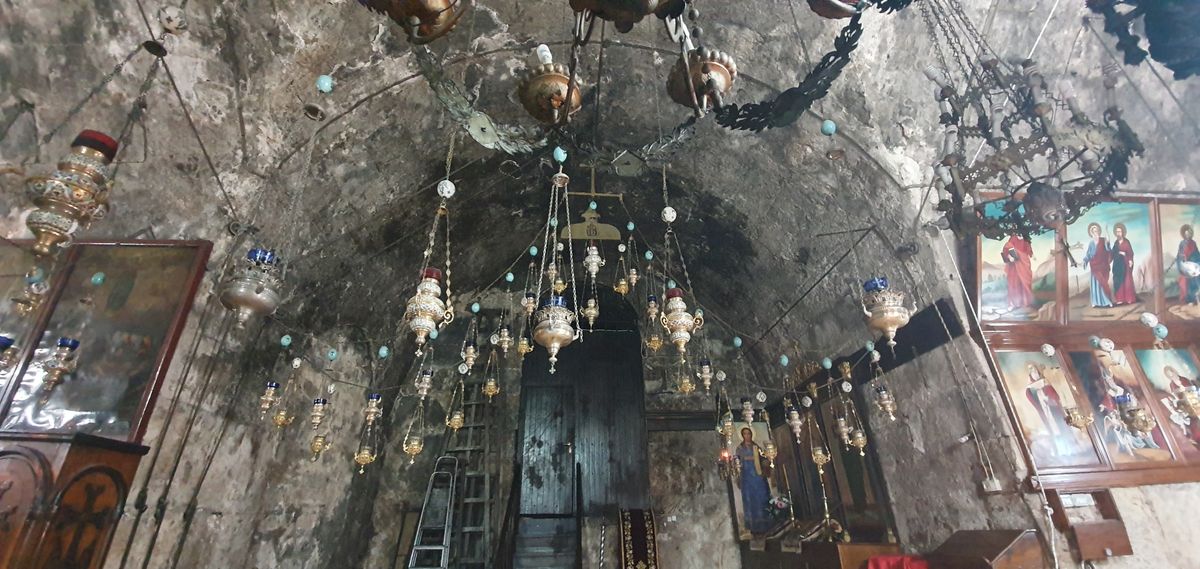
The church also contains the tombs traditionally attributed to Mary’s parents, Joachim and Anna, on alcoves along the descending staircase, and to her husband Joseph. These identifications are traditional rather than archaeological, but the devotion at each tomb is genuine and adds to the layered sacredness of the space.
A Muslim Prayer Niche in a Church
Uniquely, the underground church contains a mihrab (Islamic prayer niche) near the tomb. Muslims venerate Mary (Maryam) as one of the most righteous women in history, and she is mentioned more times in the Quran than in the New Testament. The presence of a mihrab in a Christian church reflects the shared reverence for Mary that crosses the boundary between the faiths.
Visit with Hoshen Tours
The Tomb of the Virgin Mary sits at the foot of the Mount of Olives, at the entrance to the Kidron Valley. Hoshen Tours visits this underground church as part of the descent from the summit, connecting it to the Church of the Ascension above and the Garden of Gethsemane just steps away. The Palm Sunday Road passes directly overhead, linking the site to the broader narrative of Jesus’s final week in Jerusalem.
Explore Our Tour Collection
Ready to experience Israel in true colors?
Plan Your TourPrivate tours designed around your interests, schedule, and pace.