



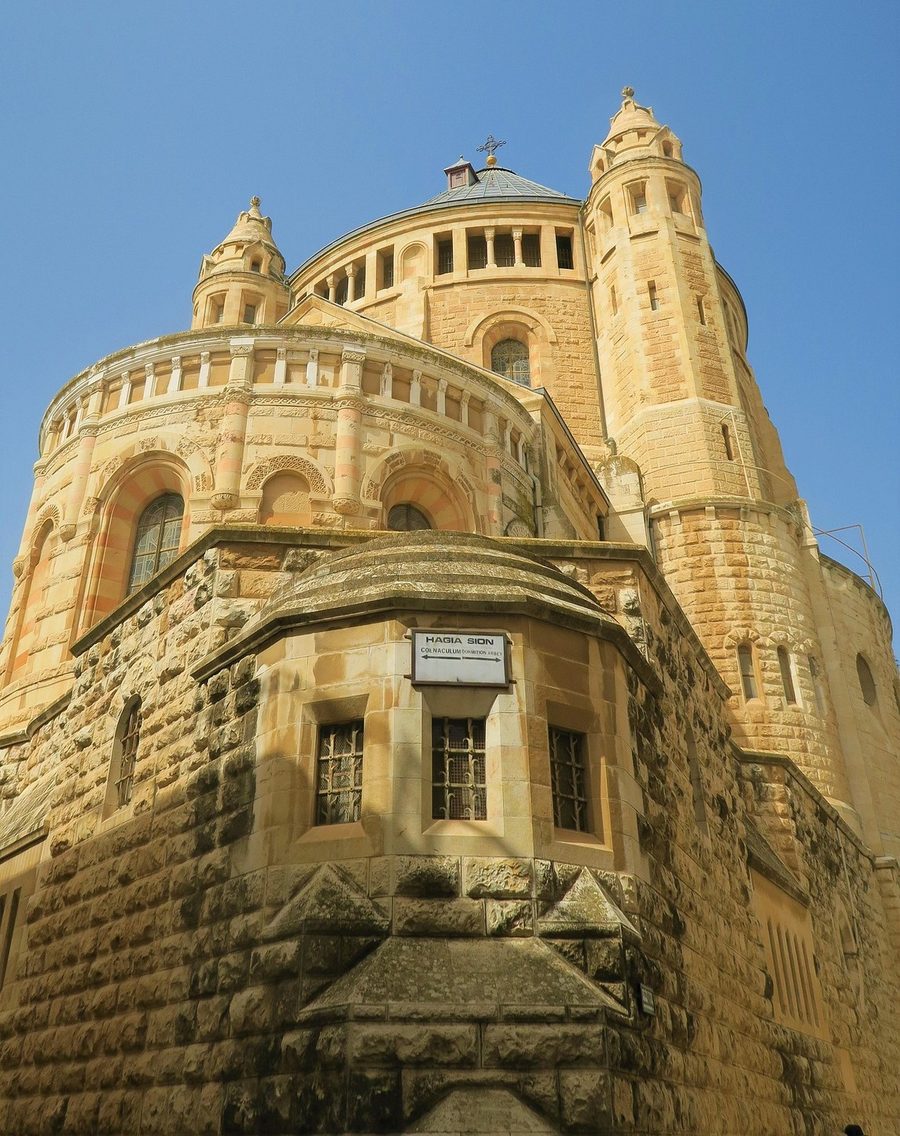
The Dormition Abbey Jerusalem (Hagia Maria Sion) crowns the summit of Mount Zion its distinctive cone-shaped tower and round apse forming one of the most recognizable landmarks on the Jerusalem skyline. The church marks the spot where, according to Catholic tradition, the Virgin Mary fell into eternal sleep (the Dormition) before her assumption into heaven. The building, completed in 1910 by German Benedictine monks, is one of the most beautiful churches in Jerusalem and one of the few places in the Holy Land where the architecture, the art, and the silence come together to create something genuinely transcendent.
Upper Church Jerusalem
The main floor of the church is a circular basilica inspired by the Carolingian churches of early medieval Germany. The floor is covered with an extraordinary mosaic depicting concentric circles: the zodiac signs, the names of the prophets, and the symbols of the twelve apostles radiating outward from a central medallion of the Holy Trinity. The apse above the altar features a golden mosaic of the Virgin Mary with the infant Jesus, flanked by the figures of prophets who foretold the birth of the Messiah, including Isaiah, Ezekiel, Daniel, and Micah.
Six side chapels ring the perimeter, each donated and decorated by a different Christian nation, Germany, the United States, Brazil, Hungary, Ivory Coast, and Austria among them. Each chapel reflects its national artistic tradition, so that walking around the church is a journey through different cultures united by a single faith. The acoustics of the circular space are remarkable; even a whisper carries across the basilica, and the monks’ chanting during services fills the dome with sound in a way that no recording can capture.
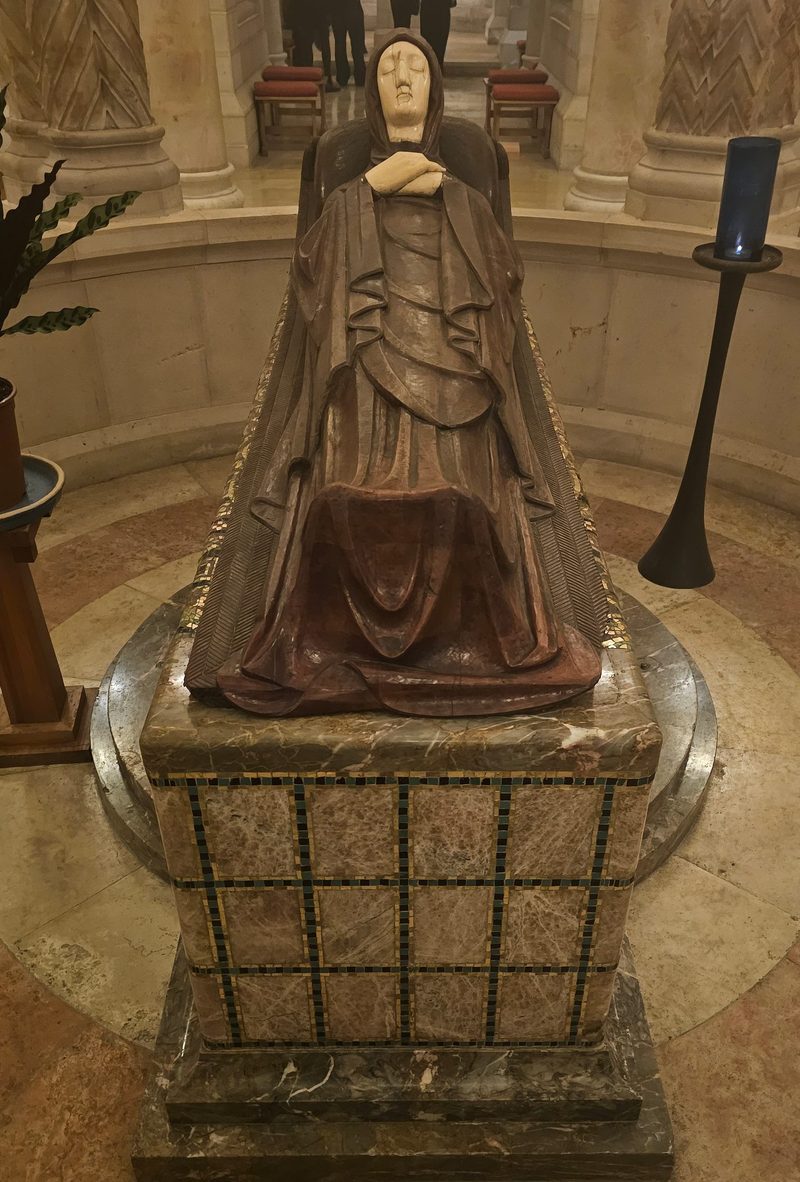
The Crypt of the Dormition of Mary
The crypt beneath the church is the emotional heart of the abbey. A narrow staircase descends into a dimly lit circular chamber, and in the center lies a life-size wooden effigy of the sleeping Mary, her eyes closed, her hands folded, her expression peaceful. The figure rests on a stone bier surrounded by columns of cherry wood and ivory, beneath a golden mosaic ceiling. According to Catholic tradition, Mary did not die in the ordinary sense but “fell asleep” (dormitio in Latin) and was assumed body and soul into heaven. The Orthodox tradition calls this the Koimesis (falling asleep), and it is one of the most important feasts in both traditions.
The walls of the crypt are lined with small altars and chapels donated by different countries, each reflecting its own artistic tradition, from delicate German woodwork to bold African iconography. The atmosphere is one of profound stillness, and the image of Mary in her final sleep, surrounded by candlelight and silence, is one of the most moving sights in Jerusalem.
Benedictine Monks on Mount Zion
The Dormition Abbey is home to a small community of German Benedictine monks who maintain the church and run a guesthouse for pilgrims. The monks follow the Rule of St. Benedict, with a daily rhythm of prayer, work, and study that has defined Benedictine life for 1,500 years. The abbey offers concerts and cultural events, and the monks’ liturgical singing during services adds an atmospheric dimension that recorded music cannot replicate.
Kaiser Wilhelm’s Gift
The present church was built on land purchased by Kaiser Wilhelm II of Germany during his visit to Jerusalem in 1898. The Kaiser’s visit, a grand affair that included a formal entry through a specially cut breach in the city wall near Jaffa Gate, was part of Germany’s effort to establish a presence in the Holy Land. The Benedictines designed the church to echo the Carolingian churches of Charlemagne’s era, creating a building that deliberately looks older than it is, as if it had always been there. During the 1948 and 1967 wars, the abbey suffered damage from its exposed position on the summit of Mount Zion, and bullet holes and shrapnel scars are still visible on the exterior walls.
Visit with Hoshen Tours
Dormition Abbey crowns the highest point of Mount Zion with its distinctive conical tower and lead dome. Hoshen Tours visits the abbey alongside the Cenacle just next door, exploring the mosaic floors and the crypt where tradition holds that Mary fell into eternal sleep. From here, the route often passes the Holocaust Chamber and enters the Old City through Zion Gate, with views down into the Valley of Hinnom.
Explore Our Tour Collection
Ready to experience Israel in true colors?
Plan Your TourPrivate tours designed around your interests, schedule, and pace.