



The Cenacle (from the Latin cena, supper) is the traditional site of the Last Supper, the final Passover meal that Jesus shared with his twelve disciples on the night before his arrest and crucifixion. The meal, described in all four Gospels and commemorated in the Christian Eucharist, is the moment when Jesus broke bread and said: “Take and eat; this is my body” (Matthew 26:26), and took the cup of wine and said: “Drink from it, all of you. This is my blood of the covenant, which is poured out for many for the forgiveness of sins” (Matthew 26:27-28). These words, spoken in this room, became the foundation of the central act of Christian worship.
A Passover Meal
The Last Supper was a Passover Seder, the ritual meal that Jews have celebrated every spring for over 3,000 years to commemorate the Exodus from Egypt. The meal follows a specific order (seder means “order” in Hebrew): four cups of wine, matzah (unleavened bread), bitter herbs, and the retelling of the story of slavery and liberation from the Book of Exodus. Jews around the world still celebrate Passover today with the same elements that were on the table at the Last Supper: the wine, the bread, the herbs, and the story of freedom.
It was during this Seder that Jesus gave the bread and wine a new meaning for his followers. He took the matzah, the bread of affliction that recalls the haste of the Exodus, and said: “Take and eat; this is my body” (Matthew 26:26). He took the cup of wine, one of the four cups of the Seder, and said: “Drink from it, all of you. This is my blood of the covenant, which is poured out for many for the forgiveness of sins” (Matthew 26:27-28). For Christians, these words transformed a Jewish Passover meal into the Eucharist, the central act of Christian worship. For understanding the Last Supper, knowing what a Passover Seder is, and that Jews still celebrate it today exactly as they did in that room, is essential.
The Prediction of Betrayal
During the meal, Jesus made two devastating predictions. First, he told his disciples that one of them would betray him. “Surely you don’t mean me, Rabbi?” asked Judas. Jesus answered: “You have said so” (Matthew 26:25). Then, as they left for the Mount of Olives, Peter declared that he would never abandon Jesus, even if all the others did. Jesus replied: “Truly I tell you, this very night, before the rooster crows, you will disown me three times” (Matthew 26:34). Peter protested: “Even if I have to die with you, I will never disown you.” Hours later, in the courtyard of the High Priest at Gallicantu, tradition holds that Peter denied knowing Jesus exactly three times, and the rooster crowed.
The Jerusalem Congregation
Before it became a Crusader hall or a Muslim shrine, this hilltop was the birthplace of the first community of believers in Jesus. According to the Book of Acts, after the Resurrection and the Ascension, the disciples returned to Jerusalem and gathered in an upper room (Acts 1:13). It was here, tradition holds, that the Holy Spirit descended upon them at Pentecost, filling the room with the sound of rushing wind and tongues of fire, and giving them the ability to speak in languages they had never learned (Acts 2:1-4). Peter stood and preached to the crowd that had gathered, and three thousand people were baptized that day (Acts 2:41). This was the birth of the Church.
The community that formed around this event, known as the Jerusalem Congregation, was led first by the apostles and then by James, the brother of Jesus, who served as its head until his execution in 62 CE. These earliest believers were Jews who continued to observe the Torah, worship at the Temple, and keep the Sabbath, while also gathering separately to break bread and pray in the name of Jesus. They lived communally, sharing property and meals (Acts 2:44-46). They were not yet called Christians, a term that would first be used in Antioch (Acts 11:26). They were simply the followers of the Way. The upper room on Mount Zion was their center, and tradition holds that the building that stands here preserves the memory of the place where it all began. Some archaeologists have proposed that the remains of a Jewish-Christian synagogue from as early as the 1st century lie beneath the current building, though this identification is debated.
The Gothic Hall
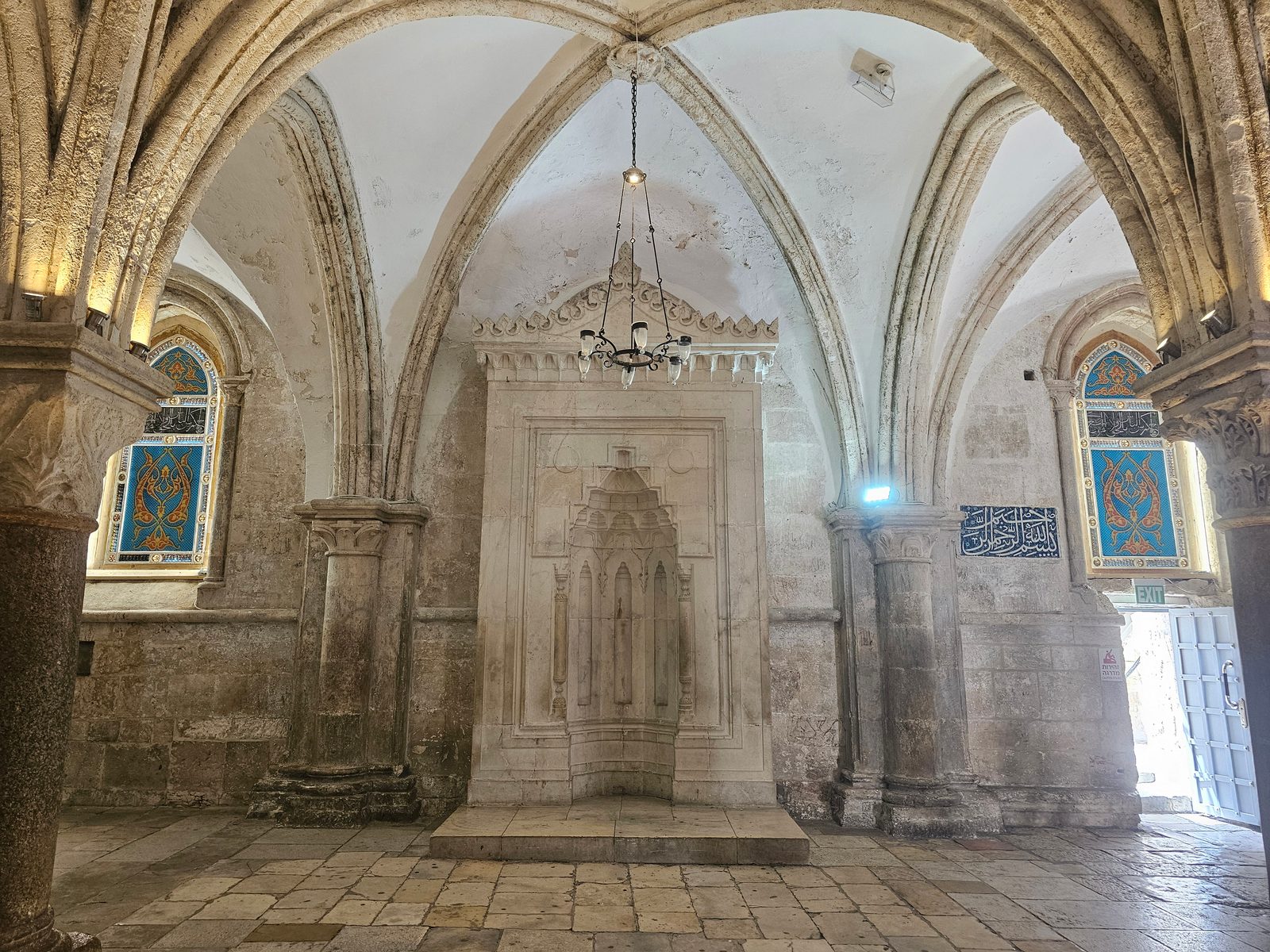
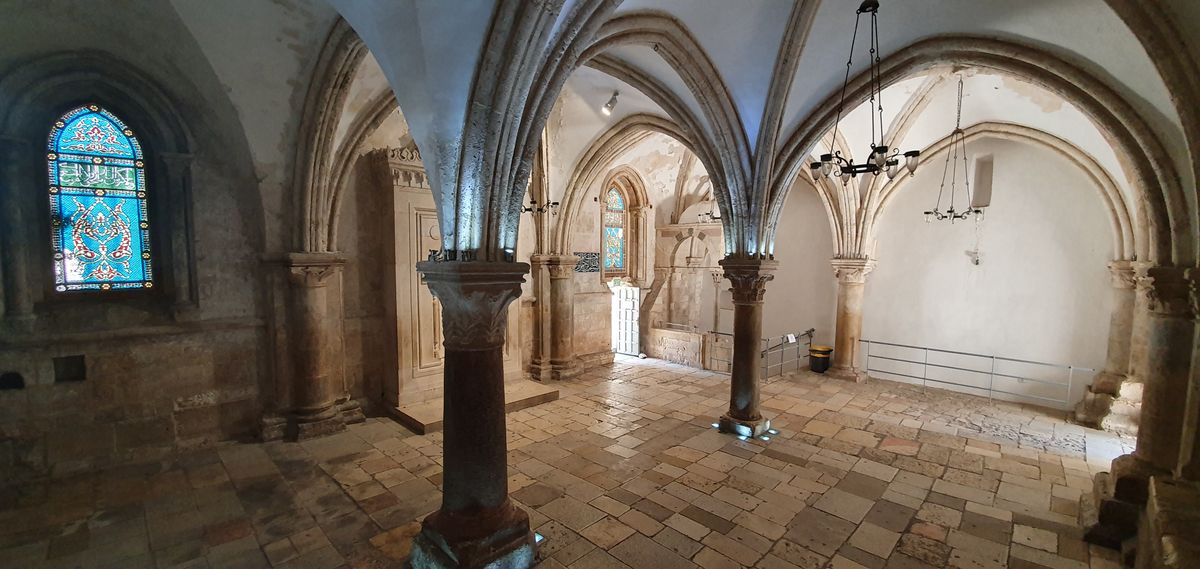
The current room is a Gothic hall on the second floor of a building on Mount Zion, dating to the 14th century over what they identified as the original site. The hall is austere and largely empty, with pointed arches, ribbed vaulting, and a small mihrab (Islamic prayer niche) added during the Ottoman period when the building was converted to a mosque. A capital carved with a pelican feeding its young with its own blood, a medieval symbol of Christ’s sacrifice, survives from the Crusader period.
The simplicity of the space is its power. There is no altar, no paintings, no elaborate decoration. Just stone walls, arched windows, and the weight of what happened here. The emptiness forces visitors to fill the room with their own imagination, and for many, the result is more powerful than any artwork could be.
Pentecost: The Holy Spirit Descends
The same room is also identified with the place where the Holy Spirit descended on the apostles at Pentecost, 50 days after the resurrection: “When the day of Pentecost came, they were all together in one place. Suddenly a sound like the blowing of a violent wind came from heaven and filled the whole house where they were sitting. They saw what seemed to be tongues of fire that separated and came to rest on each of them” (Acts 2:1-3). The apostles began speaking in other languages, and Peter preached to the crowd that gathered, converting 3,000 people in a single day (Acts 2:41). For Christians, the Cenacle is both the site of the last meal and the birthplace of the Church.
A Sacred Space, Three Claims
The Cenacle sits directly above the traditional Tomb of King David on the ground floor, which means the same building is sacred to both Christians and Jews. The competing claims have created tensions over the years, and access arrangements reflect the delicate balance between the communities. During the Ottoman period, the building was converted to a mosque, and Muslim claims added a third layer to the complexity. The building is one of the few places in Jerusalem where three religions share a single structure, and the arrangement, however imperfect, has held.
Visit with Hoshen Tours
The Cenacle, or Upper Room, stands at the heart of Mount Zion. With Hoshen Tours, visitors explore this layered building where Crusader arches meet Ottoman prayer niches, then step downstairs to Dormition Abbey and the traditional site of King David’s Tomb just below. The walk often continues to the Holocaust Chamber nearby and through Zion Gate into the Old City, with the Valley of Hinnom dropping away to the south.
Explore Our Tour Collection
Ready to experience Israel in true colors?
Plan Your TourPrivate tours designed around your interests, schedule, and pace.