



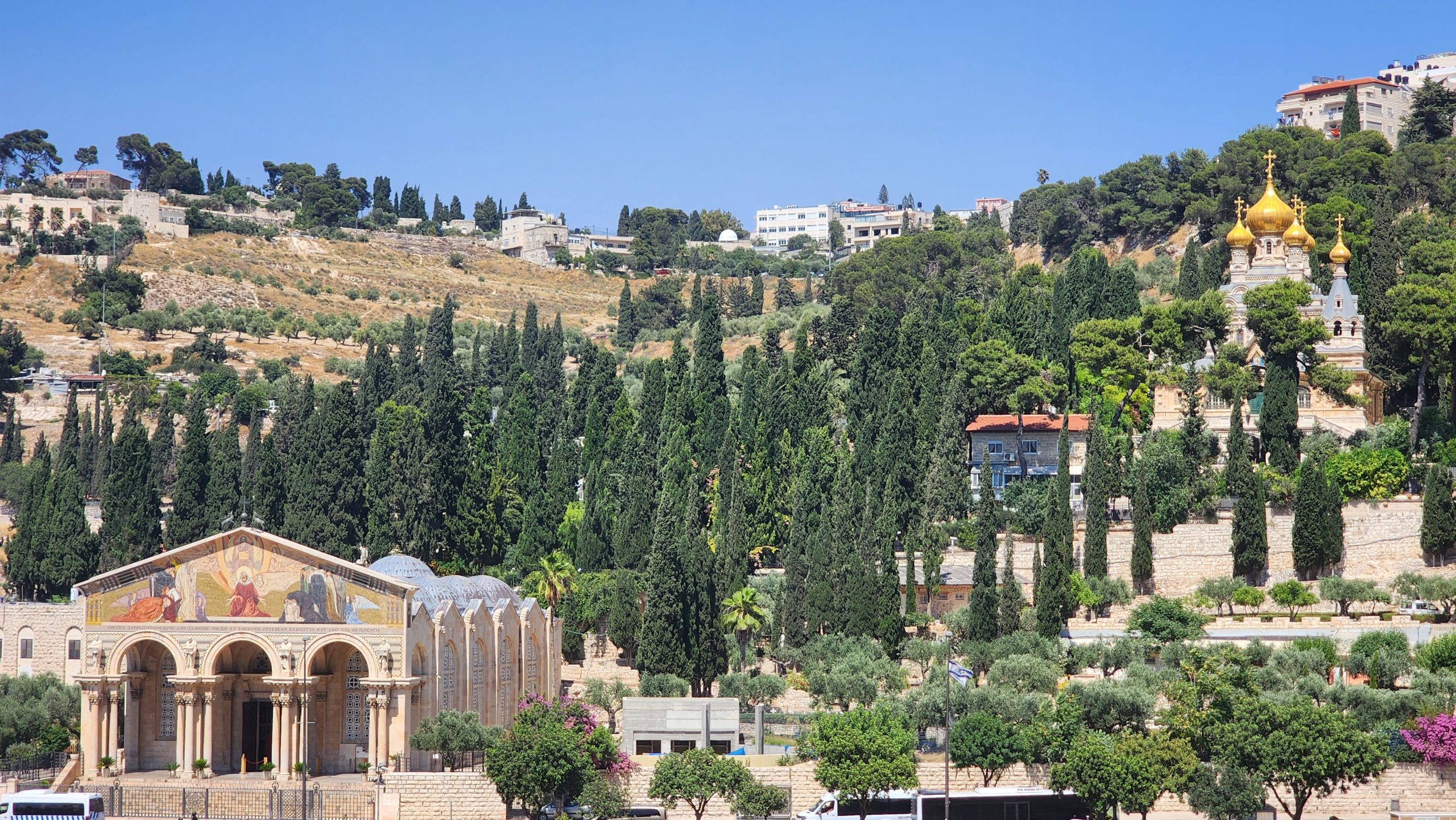
The Mount of Olives rises east of the Old City, across the Kidron Valley and its summit rises to approximately 818 meters above sea level, making it one of the highest points on the ridges surrounding Jerusalem (nearby Mount Scopus reaches 826 meters). This is the mountain where tradition holds David wept, where Ezekiel saw God depart, where tradition holds that Jesus taught and prayed and ascended to heaven, and where, in the faith of three religions, the final chapter of human history will unfold. No mountain on earth carries more weight per square meter than this one.
How the Mount of Olives Jerusalem Got Its Name
The mountain is named for the olive groves that covered its slopes in antiquity (2 Samuel 15:30 calls it ma’aleh hazeitim the ascent of the olive trees). The name Gethsemane, at the mountain’s foot, comes from Gat Shmanim oil press. The olives of this mountain provided oil for the Temple, for lamps, for food, and for anointing. Today, ancient olive trees still survive in the Garden of Gethsemane, their gnarled trunks dated to approximately 900 years, though the root systems may be older still.
David’s Flight
When Absalom seized the throne, David fled Jerusalem on foot. The account in 2 Samuel 15 is one of the most human passages in the Bible: the king crossed the Kidron Brook with his household, sent Zadok and the Levites back with the Ark of the Covenant (“If I find favor in the eyes of the LORD, He will bring me back”), and then “went up the ascent of the Mount of Olives, weeping as he went, with his head covered and walking barefoot” (15:30). All the people with him covered their heads and wept as they climbed. At the summit, David learned that his trusted counselor Ahithophel had joined the rebellion. Even in his grief, he organized a counter-intelligence operation, sending Hushai back to Jerusalem to undermine Ahithophel’s advice. The anointed king ascending the mountain barefoot and weeping, yet simultaneously running a spy network, piety and cunning in the same breath.
The Shekhinah Departs
The prophet Ezekiel, writing from exile in Babylon, described a vision in which the glory of God, the Shekhinah, left the Temple. The divine presence moved from the inner sanctuary to the threshold, from the threshold to the east gate, and from the east gate out of the city entirely: “The glory of the LORD went up from the midst of the city and stood on the mountain which is on the east side of the city” (Ezekiel 11:23). The mountain on the east side is the Mount of Olives. God’s presence paused there, as if looking back at the city one last time, before departing. Rabbinic tradition (Midrash Lamentations Rabbah) says the Shekhinah lingered on the Mount of Olives for three and a half years, calling Israel to repent, before finally leaving. The promise of return comes in Ezekiel 43: the glory of God returning from the east, entering the Temple through the same gate by which it left.
The Red Heifer
According to the Mishnah (Parah 3:6), the burning of the Red Heifer, the only means of ritual purification from contact with the dead (Numbers 19), was performed on the Mount of Olives, on a spot directly facing the entrance to the Temple. The priest had to be able to see the doorway of the sanctuary while sprinkling the blood. A special causeway was built from the Temple Mount across the Kidron Valley to the mount, constructed on arches upon arches to prevent contamination from graves in the ground below. The Mishnah records that from Moses to the destruction of the Second Temple, only nine Red Heifers were prepared, and that the tenth will be prepared by the Messiah.
The Mountain Splits
Zechariah placed the climax of history on this mountain: “On that day His feet shall stand on the Mount of Olives that lies before Jerusalem on the east, and the Mount of Olives shall be split in two from east to west by a very wide valley” (Zechariah 14:4). The splitting creates an escape route for Jerusalem’s inhabitants in the final battle. Living waters will flow from the city, half toward the Dead Sea, half toward the Mediterranean, and “the LORD shall be king over all the earth” (14:9). Geologists have noted that a fault line does in fact run through the Mount of Olives in an east-west direction.
The World’s Oldest Jewish Cemetery
The Jewish cemetery on the western slope is the oldest continuously used Jewish cemetery in the world, with burials spanning more than 2,000 years. An estimated approximately 150,000 graves cover the hillside, all facing the Temple Mount, all waiting. The desire to be buried here is rooted in the belief, drawn from Zechariah 14 and elaborated in rabbinic and kabbalistic tradition, that the resurrection of the dead will begin on this mountain when the Messiah comes. Those buried closest will rise first.
Traditional tombs on the mount include the burial site identified with the prophets Haggai, Zechariah, and Malachi, the last three voices of Hebrew prophecy. The modern sections include the graves of Menachem Begin and other Israeli leaders.
During the Jordanian occupation of East Jerusalem (1948–1967), the cemetery suffered systematic desecration. An estimated 38,000 to 50,000 tombstones were smashed, uprooted, or used as building material for roads, latrines, and military walls. A road was paved through the graves. The Intercontinental Hotel was built on the ridge above. After Israel recaptured the mount in the Six-Day War of June 1967, restoration efforts began, but many graves could never be fully restored. The cemetery is active today, with burials continuing, though vandalism remains a persistent concern.
Jesus on the Mount of Olives
The Mount of Olives is central to the final chapters of the Gospel narrative. Jesus descended from the mount on Palm Sunday, riding a donkey while crowds spread palm branches and cloaks before him, shouting “Hosanna to the Son of David!” (Matthew 21:1–11). As he approached and saw the city spread below, “he wept over it” and prophesied its destruction: “They will not leave one stone on another, because you did not recognize the time of God’s coming to you” (Luke 19:41–44). Sitting on the mount opposite the Temple, he delivered the Olivet Discourse, his longest teaching on the end of the age, the destruction of the Temple, and his return (Matthew 24–25).
On his last night, after the Passover meal, Jesus crossed the Kidron Valley to the Garden of Gethsemane at the foot of the mount, where he prayed in agony: “Father, if you are willing, take this cup from me; yet not my will, but yours be done” (Luke 22:42). It was there that Judas arrived with an armed crowd and betrayed him with a kiss. And after the resurrection, Jesus led his disciples to the mount, where “he was taken up before their very eyes, and a cloud hid him from their sight” (Acts 1:9). Two angels told them he would return “in the same way”, on this same mountain.
The Churches
The Mount of Olives is densely packed with churches marking these events. The Pater Noster church marks where tradition holds Jesus taught the Lord’s Prayer, its walls inscribed in over 140 languages. The Chapel of the Ascension now a mosque, contains a stone bearing what tradition calls Jesus’ last footprint on earth. Dominus Flevit Barluzzi’s tear-shaped church (1955), has a picture window behind the altar that frames the Dome of the Rock, the priest celebrating Mass looks out at the city tradition holds that Jesus wept for. The Church of All Nations at Gethsemane (1924) encloses the rock of agony in a deliberately darkened interior, surrounded by olive trees that may be 900 years old. The Church of Mary Magdalene with its seven golden onion domes, was built by Tsar Alexander III and houses the relics of Grand Duchess Elizabeth, murdered by the Bolsheviks. And the Tomb of the Virgin Mary reached by descending 47 steps into a subterranean crypt, marks where tradition holds Mary was buried before her assumption to heaven.
The Iconic View of Jerusalem
The panoramic view from the Mount of Olives observation point is widely considered the most iconic view of Jerusalem. Looking west, the entire Old City is spread out below: the golden Dome of the Rock dominates the Temple Mount platform, the silver dome of Al-Aqsa sits to its south, the Church of the Holy Sepulchre rises from the Christian Quarter, and the Tower of David marks the Jaffa Gate. The Kidron Valley drops steeply between the Mount of Olives and the Old City walls, its slopes covered with the ancient Jewish cemetery. Beyond the Old City, the modern city stretches across the Judean Hills. To the east, the view drops away into the Judean Desert, descending toward the Dead Sea and the mountains of Moab in Jordan. On a clear day, the contrast between the green western slopes and the barren eastern descent is one of the most striking visual transitions in the country.
The Descent
The walk down the Mount of Olives to the Old City follows a path that pilgrims and conquerors have used for millennia. The descent passes the Dominus Flevit chapel (where tradition holds that Jesus wept over Jerusalem), the Church of Mary Magdalene with its golden onion domes, the Garden of Gethsemane with its ancient olive trees, and the Church of All Nations at the base. The route takes about 30 minutes on foot and is one of the most concentrated stretches of sacred sites anywhere in the world. Every major event of Jesus’s final days in Jerusalem, the Triumphal Entry, the weeping over the city, the agony in the garden, the arrest, took place along this single slope.
Visit with Hoshen Tours
The Mount of Olives is where Jerusalem’s past, present, and prophesied future all converge on a single ridge of limestone. Hoshen Tours begins at the summit with the panoramic view, then descends through the ancient Jewish cemetery and the Palm Sunday Road, passing the Church of the Ascension and the Church of Pater Noster before reaching the Kidron Valley below. Every layer of the mountain tells a different chapter of Jerusalem’s story.
Explore Our Tour Collection
Ready to experience Israel in true colors?
Plan Your TourPrivate tours designed around your interests, schedule, and pace.