



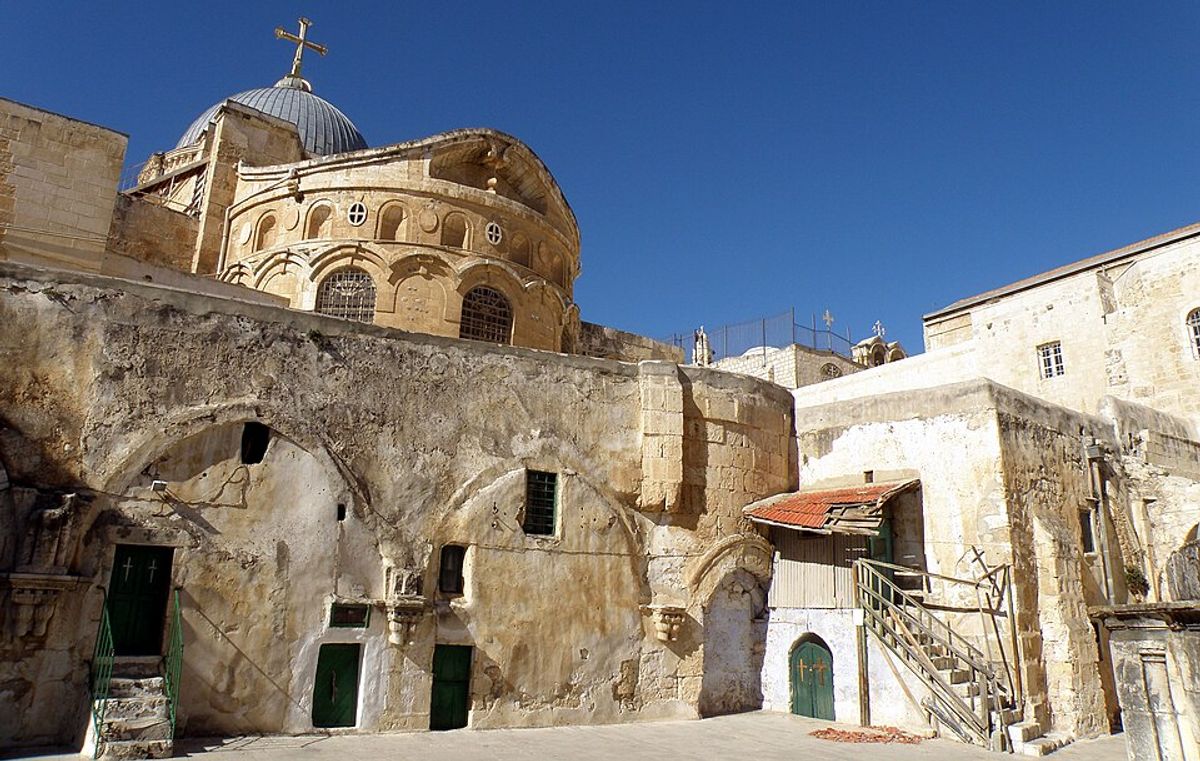
On the roof of the Church of the Holy Sepulchre, hidden from the bustling streets below, the small community of Deir es-Sultan, where Ethiopian Orthodox monks lives in a cluster of mud-colored huts surrounding a quiet courtyard. This is Deir es Israel-Sultan, one of the most atmospheric and least expected corners of Jerusalem’s Old City. Neither grand nor gilded, the monastery offers something rarer: stillness, antiquity, and a profound sense of faith that has endured for centuries at the very heart of Christendom. The monastery sits directly above the Chapel of St. Helena, embedded into the fabric of the holiest church in the Christian world.
For those who discover it, Deir es-Sultan is often the memory that lingers longest, a rooftop world apart, where incense drifts across worn stone, colorful icons glow in dim light, and monks go quietly about their devotions, indifferent to the crowds that fill the streets below. It is Jerusalem at its most layered and most human.
Ethiopia and the Holy Land
The connection between Ethiopia and the Holy Land is ancient and deeply rooted in scripture. Tradition holds that the Queen of Sheba, known in Ethiopian tradition as Makeda, traveled to Jerusalem to meet King Solomon, as recounted in 1 Kings 10. From that encounter, Ethiopian tradition traces the lineage of its royal dynasty and its people’s covenant with the faith of Israel. The bond between Ethiopia and Jerusalem, in this telling, stretches back nearly three thousand years.
The New Testament adds another thread. In Acts 8:26–39, an Ethiopian eunuch, a court official of Queen Candace, is baptized by the Apostle Philip while returning from Jerusalem, where he had come to worship. This account is understood by many scholars and by the Ethiopian Orthodox Church itself as evidence of Christianity reaching Ethiopia in the apostolic era. The Ethiopian Orthodox Tewahedo Church, formally established in the 4th century CE and among the oldest Christian churches in the world, has regarded Jerusalem as sacred ground ever since.
Ethiopian pilgrims and monks are believed to have maintained a presence in Jerusalem since at least the 4th century. Their community once held significant properties within and around the Church of the Holy Sepulchre. Over the centuries, that foothold shrank, but it never disappeared. Deir es-Sultan, perched above the Chapel of St. Helena, is what remains: modest in size, immeasurable in meaning.
The Ethiopian Monastery on the Roof
Deir es-Sultan, the name means “Monastery of the Sultan” in Arabic, a reference to an Ottoman-era connection, is unlike any other monastic space in Jerusalem. The visitor steps through a low doorway and emerges onto an open rooftop courtyard, where the noise of the Old City falls away and time seems to slow. Small, mud-plastered huts and iron-doored cells line the edges of the space, home to the monks who maintain the community year-round.
At the center of the courtyard, a modest dome rises from the roof, the upper surface of the dome of St. Helena’s Chapel below, now serving as the architectural anchor of the Ethiopian enclave above. In places, a circular opening in the rooftop floor offers a direct view down into the candlelit interior of that chapel, a striking reminder of how intimately the monastery is woven into the physical structure of the Church of the Holy Sepulchre itself.
A small chapel occupies one side of the courtyard. Inside, painted icons in the vivid, flat-perspective style characteristic of Ethiopian Orthodox art line the walls, saints with wide eyes and golden halos, rendered in deep reds and blues. The atmosphere is contemplative and genuinely welcoming. The monks here do not perform for visitors; they simply live their faith, and the courtyard absorbs that quality. For many travelers, the contrast with the crowded, incense-thick interior of the church below is startling, and revelatory.
The Status Quo
Understanding Deir es-Sultan requires a brief introduction to the Status Quo, the complex, centuries-old arrangement that governs rights, spaces, and practices within the Church of the Holy Sepulchre. The Status Quo was formalized in 1757 and confirmed by Ottoman firman in 1852. It assigns specific altars, chapels, corridors, and ritual rights to six Christian communities: Greek Orthodox, Roman Catholic (Franciscan), Armenian Apostolic, Coptic Orthodox, Syrian Orthodox, and Ethiopian Orthodox. Every lamp, every key, every step of a procession is governed by this arrangement, and it has remained largely unchanged for nearly two centuries.
The Ethiopian Orthodox community’s position on the rooftop reflects the precarious arc of their history at the site. As their community’s resources declined over the centuries relative to wealthier Christian denominations, their foothold within the church shrank. The rooftop became their domain, a space that was theirs, even if it placed them at the margins of the building that matters most to all of them. There is an ongoing dispute between the Ethiopian Orthodox and Coptic Orthodox communities regarding custodianship of the site; that dispute has its own long and complicated history, and it remains unresolved. What is not in dispute is the Ethiopian monks’ enduring, daily presence at Deir es-Sultan, which they have maintained with quiet tenacity.
For the visitor, the Status Quo is most visible not in legal documents but in the lived texture of the place: in the specific hours when certain doors are opened, in the sequence of liturgies that echo through the church at different times of day, and in the simple fact that a community of Ethiopian monks wakes each morning on a rooftop in Jerusalem and begins their prayers.
Visiting Deir es Israel-Sultan
Deir es-Sultan is free to enter and open to visitors throughout the day. The monastery can be reached by two routes: through a doorway near the 9th Station of the Cross on the Via Dolorosa, which leads up a staircase to the rooftop; or from the main courtyard of the Church of the Holy Sepulchre, via an exterior staircase on the right side of the church facade. Both entrances are easy to find with a little guidance, though first-time visitors often miss Deir es-Sultan entirely, which is part of what makes discovering it so rewarding.
The monks are generally welcoming to respectful visitors. Photography is typically permitted in the open courtyard, though it is always courteous to ask before photographing anyone at prayer or inside the chapel. Modest dress is appropriate, as it is throughout the Old City’s holy sites. A small donation left in the chapel is a thoughtful gesture of appreciation for the community’s hospitality. The best times to visit are in the morning or early afternoon, when the light is soft and the courtyard is at its most peaceful.
Plan to spend at least twenty to thirty minutes here, more if you arrive when the monks are conducting a service in the chapel. The sound of Ethiopian Orthodox chant in that small stone space is something that stays with visitors long after they have left Jerusalem.
Visit with Hoshen Tours
Deir es-Sultan is a rooftop monastery perched above the Church of the Holy Sepulchre, home to Ethiopian monks who have maintained a presence here for centuries. This hidden corner of the Christian Quarter is one of the Old City’s most atmospheric spots. Your Hoshen Tours guide can include it as part of a walk along the Via Dolorosa or a tour through the Muristan district, offering a perspective on Jerusalem’s Christian heritage that most visitors never discover. Hoshen Tours often combines this site with Sephardic Synagogues, Sisters of Zion, and Dung Gate for a memorable day exploring the region.
Explore Our Tour Collection
Ready to experience Israel in true colors?
Plan Your TourPrivate tours designed around your interests, schedule, and pace.